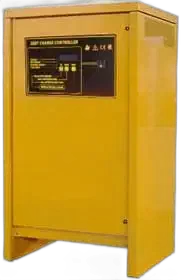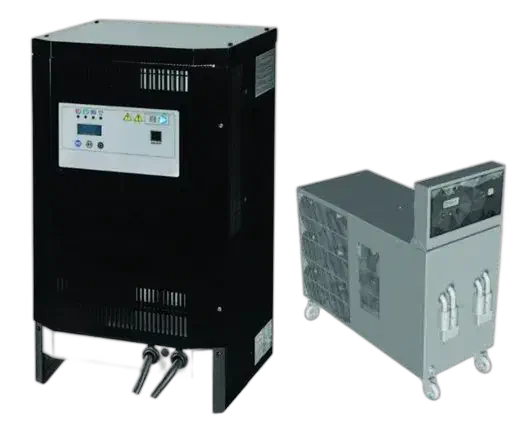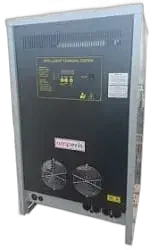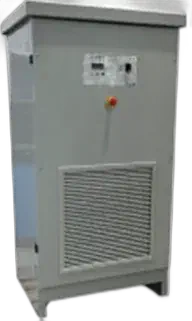
The HPS-HV family delivers DC fast charging from 10 to 60 kW per parallelable unit, with outputs up to 800 V DC, for lithium-ion and any other battery chemistry, indoors or outdoors.
Advantages
Fast charging without borders
Third-generation IGBT-Hybrid conversion supports batteries of any type, chemistry, voltage and size, with standard powers of 10-60 kW and outputs of 12-650 V DC (250-800 V DC in the H models).
Efficiency that pays for itself
Maximum efficiency exceeds 97 % with a power factor above 0.99, input current distortion below 15 % and output ripple under 8 % peak-to-peak; standby stays below 10 W.
A smart interface
The LCD interface manages charging priorities, timing, energy limiting and peak shaving, and a CANBUS link talks to the BMS with multiple protocols and data rates.
Multi-vehicle by design
Automatic battery/EV recognition and preprogrammed standard charging curves speed up set-up, while the integrated datalogger eases troubleshooting and optimisation.
Grows with the fleet
The parallelable design scales power as demand rises, with indoor and outdoor versions and supply voltages and certifications for markets worldwide.
Applications
- Fleets of industrial, commercial and passenger electric vehicles.
- Forklifts and airport ground support equipment (optional GSE version).
- Cold rooms and mining equipment (optional CME version).
- Fast and opportunity charging in 24/7 operations.
About the product
The HPS-HV combines third-generation IGBT-Hybrid power conversion with automatic DC cable voltage-drop compensation, and accepts options such as a status stacklight, an auto-watering system, an air pump for electrolyte recirculation, a charging stand with cable management and integration with wireless battery identification modules.
Technical specifications
| AC input voltage | 3×400/415/440 V AC (others on request) |
| Output voltage range (standard) | 12-650 V DC |
| Output voltage range (extended) | 250-800 V DC |
Standard models (12-650 V DC)
| Model | HPS.M12 | HPS.M20 | HPS.M24 | HPS.M30 | HPS.M36 | HPS.M50 | HPS.M60H |
|---|---|---|---|---|---|---|---|
| Output power | 12 kW | 20 kW | 24 kW | 30 kW | 36 kW | 50 kW | 60 kW |
| Max DC current | 150 A | 150 A | 150 A | 150 A | 150 A | 150 A | 150 A |
| AC input current @ 400 V AC | 20 A | 32 A | 40 A | 50 A | 60 A | 83 A | 100 A |
Extended-range models (250-800 V DC)
| Model | HPS.H50 | HPS.H60 |
|---|---|---|
| Output power | 50 kW | 60 kW |
| Max DC current | 100 A | 100 A |
| AC input current @ 400 V AC | 83 A | 100 A |
Dimensions — indoor (up to 36 kW)
| Width | 717 mm |
| Depth | 559 mm |
| Height | 1210 mm |
Dimensions — outdoor (up to 60 kW)
| Dimension | TM | TQ |
|---|---|---|
| Width | 887 mm | 870 mm |
| Depth | 716 mm | 689 mm |
| Height | 1318 mm | 1611 mm |
Frequently asked questions
Which batteries can it charge?
Any type, chemistry, voltage and size — the HPS-HV is optimised for lithium-ion but supports lead-acid and other chemistries across the full output range.
How much power does one unit provide?
Standard models range from 10 to 60 kW, and the parallelable design lets several units combine to feed larger fleets.
What output voltage is available?
12-650 V DC in the standard M models and 250-800 V DC in the extended H models.
Can it be installed outdoors?
Yes. There are indoor and outdoor versions, plus optional GSE execution for airport ground support and CME for cold rooms and mining.
How does it connect to the battery system?
Through a CANBUS interface to the BMS with multiple protocols and data rates, and integration with wireless battery identification modules.