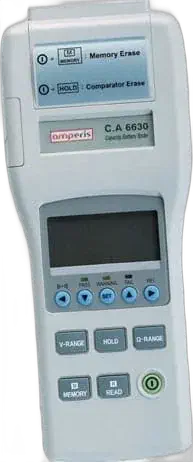
Battery Tester CA 6630
Internal resistance and open-circuit voltage in a single reading
The most effective way to find weak cells in a stationary battery bank without discharging it is to measure the internal resistance of each cell periodically by the 4-wire method, because its rise appears before the capacity falls noticeably. The CA 6630 measures internal resistance at 1 kHz in four ranges from 40 mΩ to 40 Ω, with resolution from 10 µΩ and an accuracy of ±(1 % m.v. + 8 digits), and at the same time the open-circuit voltage up to 40 V with ±(0.1 % m.v. + 6 digits); its comparator returns PASS, WARNING or FAIL, and it stores up to 999 readings to track the trend of each cell on a PC.
CA 6630 key data
- Internal resistance (4-wire): 40 mΩ, 400 mΩ, 4 Ω and 40 Ω ranges with 10 µΩ, 100 µΩ, 1 mΩ and 10 mΩ resolution; ±(1 % m.v. + 8 digits) accuracy on all four ranges and 1 kHz ± 10 % measurement frequency.
- Measurement current: 37.5 mA on the 40 mΩ range, 3.75 mA on 400 mΩ, 375 µA on 4 Ω and 37.5 µA on 40 Ω.
- Open-circuit voltage: 4 V (1 mV resolution) and 40 V (10 mV resolution) ranges with ±(0.1 % m.v. + 6 digits) accuracy, shown together with the resistance on the 2-display LCD screen.
- Batteries supported: nickel-cadmium, lithium-ion and nickel-metal hydride; the CA 6630 documentation does not describe a lead-acid battery mode.
- Comparator: compares each measurement with the theoretical results built into the instrument and shows PASS, WARNING or FAIL.
- Recording: 999 readings in manual memory or continuous recording in data logger mode with a 1 to 255 s sampling interval, downloaded to a PC with the supplied program.
- Temperature coefficient: ±(0.1 % m.v. + 0.5 digits)/°C for both the resistance and the voltage measurement.
- Portable: 6 × 1.5 V batteries with 7 h autonomy in continuous use, 1 VA maximum consumption and automatic standby after 30 min; 250 × 100 × 45 mm and 500 g with batteries.
Advantages
Precise 4-wire measurement
Internal resistance is measured with a 1.5 mVAC current at a frequency of 1 kHz ± 10 %, with an accuracy of ±(1 % m.v. + 8 digits) across the four available ranges, from 40 mΩ to 40 Ω.
Immediate assessment with the comparator
The comparator function compares the measurement with theoretical results built into the instrument and shows PASS, WARNING or FAIL directly, without having to interpret the resistance figure.
Manual memory and data logger mode
Up to 999 measurements can be stored manually, or recorded continuously in data logger mode, with a sampling interval adjustable from 1 to 255 s.
Treatment of the records on a PC
Dedicated software exports the stored data, plots the data-logger values graphically and stores all the results on the computer's hard drive.
Applications
- Preventive maintenance of stationary batteries in uninterruptible power supplies.
- Periodic checking of battery banks in telephone exchanges and security installations.
- Detection of weak cells before the battery's capacity falls noticeably.
- Tracking the trend of each cell between successive maintenance rounds.
About the product
The instrument runs on 6 × 1.5 V batteries, with an autonomy of 7 hours in continuous use and a maximum consumption of 1 VA; it goes into automatic standby after 30 minutes with no action on the keys and includes a zero-adjustment function to compensate the displayed voltage circuit. The LCD screen has 2 displays and numerous symbols. Its dimensions are 250 × 100 × 45 mm and it weighs 500 g including batteries.
It is supplied in a rigid carrying case with a set of two 1 m measurement leads ending in retractable test probe tips, the PC data-transfer program, the connection cable between the instrument and the PC, and the instruction manual in 5 languages.
Technical specifications
| Internal resistance (4-wire) | 40 mΩ...40 Ω, ±(1 % m.v. + 8 digits) |
| Open-circuit voltage | 4 V and 40 V, ±(0.1 % m.v. + 6 digits) |
| Batteries supported | Nickel-cadmium, lithium-ion and nickel-metal hydride |
| Memory | 999 manual measurements or data logger mode (1-255 s) |
| Power supply | 6 × 1.5 V batteries; 7 h autonomy; 1 VA max. consumption |
| Dimensions / weight | 250 × 100 × 45 mm / 500 g with batteries |
| Resolution / measurement current | 10 µΩ / 37.5 mA (40 mΩ); 100 µΩ / 3.75 mA (400 mΩ); 1 mΩ / 375 µA (4 Ω); 10 mΩ / 37.5 µA (40 Ω) |
| Measurement frequency | 1 kHz ± 10 % |
| Temperature coefficient | ±(0.1 % m.v. + 0.5 digits)/°C for resistance and voltage |
Frequently asked questions
Can the CA 6630 test lead-acid batteries?
The CA 6630 documentation only states nickel-cadmium, lithium-ion and nickel-metal hydride batteries and does not describe a lead-acid mode. For those three technologies it measures the 4-wire internal resistance and the open-circuit voltage in a single reading.
What resolution does it offer on cells with very low internal resistance?
On the 40 mΩ range the CA 6630 resolves 10 µΩ, with a 37.5 mA measurement current at 1 kHz and an accuracy of ±(1 % m.v. + 8 digits); on the 400 mΩ range it resolves 100 µΩ with 3.75 mA.
Which battery types can it test?
Nickel-cadmium, lithium-ion and nickel-metal hydride batteries.
How is the result interpreted?
With the comparator function, which shows PASS, WARNING or FAIL directly by comparing the measurement with built-in theoretical values.
How many measurements can it store?
Up to 999 manually, or continuously in data logger mode with an interval adjustable from 1 to 255 s.
How are the stored records treated?
They are downloaded to a PC with the supplied software, which exports them, plots them graphically and stores them on the computer's hard drive.