Protection relay test equipment
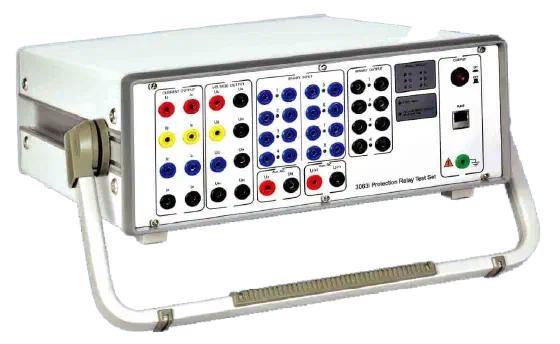
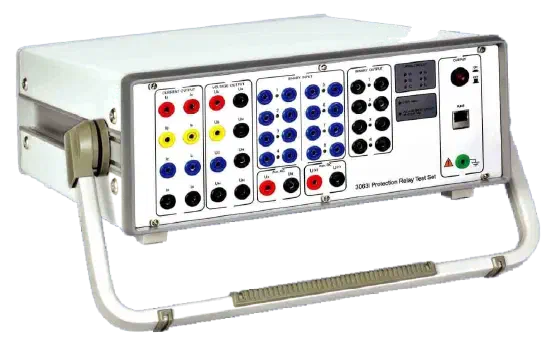
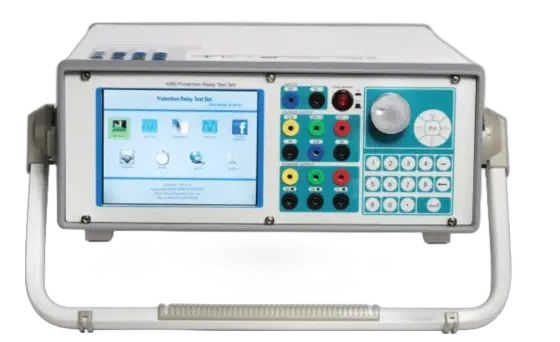
Relay test sets prove that protection relays — overcurrent, distance, differential or frequency elements — operate at the intended threshold and within the intended time. By injecting controlled currents and voltages and timing the relay response to the millisecond, they expose wrong settings, worn contacts and out-of-tolerance delays before they cause a nuisance trip or an uncleared fault.
What do they test and how?
A relay test set generates single- or three-phase test quantities and records pickup values, operating times against the characteristic curve, reset ratio and reclosing sequences. Three-phase units such as the AK-10 and AK-30 handle secondary injection on both numerical and electromechanical protection.
How to choose the right unit
- Channels: single-phase for simple elements; three-phase (AK-6, AK-10, AK-30) for distance and differential schemes.
- Injection range: cover 1 A and 5 A secondaries with enough headroom for inverse-time curves.
- Automation: test templates and automatic reporting cut commissioning hours in substations.
- Related tools: the AMCCB-500 tests LV circuit breakers and Traptor supports protection troubleshooting.
Not sure which model fits your scheme? Write to info@amperis.com.
Applications
- Commissioning and maintenance of protection schemes in transmission and distribution substations.
- Periodic relay verification in industrial plants, renewables and railway systems.
- Re-testing after protection coordination studies change relay settings.
Applicable standards
- IEC 60255 series: measuring relays and protection equipment.
- IEEE C37.90: general requirements for protective relays.
- ANSI/NETA ATS: field acceptance test tolerances.
Frequently asked questions
How often should protection relays be tested?
Common practice aligned with NETA MTS is every 2–3 years, and always after a settings change or a suspect operation. Operators of critical substations often test their main schemes yearly.
What is secondary injection testing?
Test signals are applied directly to the relay at instrument-transformer secondary levels, without energising the primary circuit. Faults are reproduced safely and repeatably, with precise control of magnitude, phase and duration.
Can one test set cover electromechanical and numerical relays?
Yes. The Amperis range tests legacy electromechanical units as well as modern numerical protection; for the latter it is good practice to also verify parameter files and binary inputs/outputs.
Resources and contact
Related categories: switch testing, insulation resistance meters and transformer testing. For quotations or technical advice: info@amperis.com · +34 982 20 99 20.