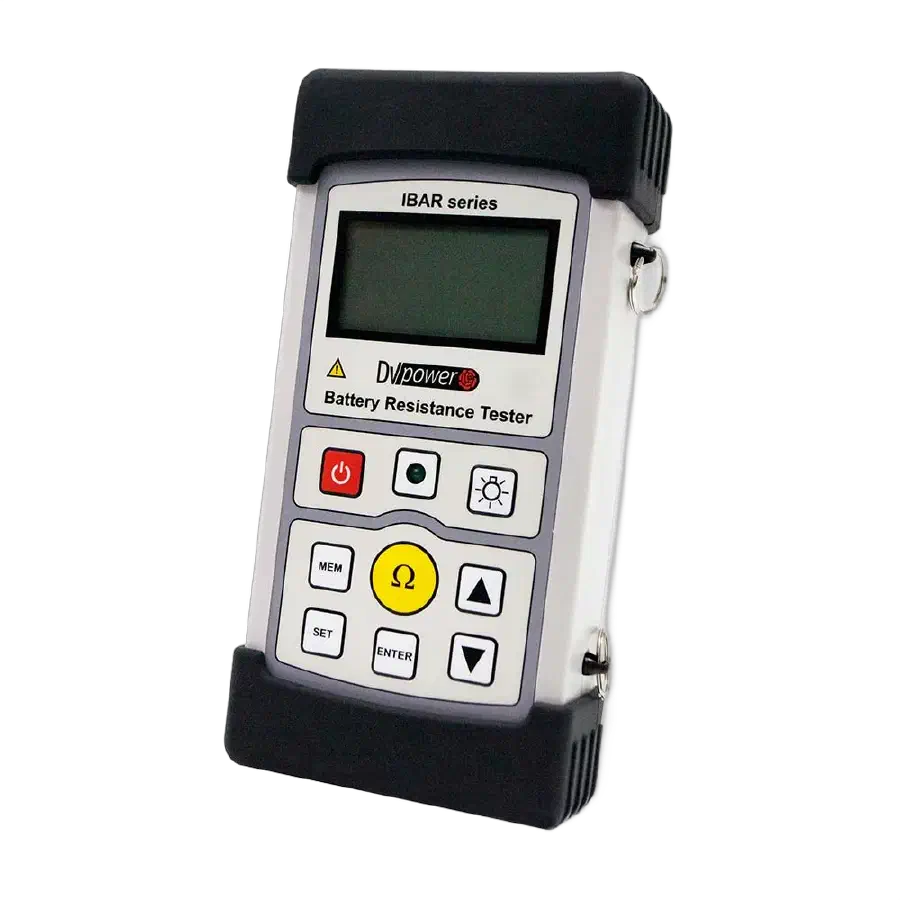
Measuring the internal resistance of stationary batteries and spotting ageing cells before they fail calls for a tester that also measures cell voltage and inter-cell connections and stores the readings to follow their trend. IBAR does it in about two seconds per cell with pin probes: resistance from 0 to 5 Ω in four scales, with resolution from 1 µΩ and ±(1.0 % of reading + 0.1 % of full scale) accuracy below 5 mΩ, voltage up to ±60 V with ±(0.1 % + 0.1 %) and a PASS, WARNING or FAIL verdict against defined thresholds, in a 0.5 kg instrument.
IBAR key data
- Internal resistance: 0 to 5 Ω in four scales with automatic detection: up to 5 mΩ (1 µΩ resolution, 150 mA) with ±(1.0 % rdg + 0.1 % FS); 5–50 mΩ (10 µΩ, 150 mA), 50–500 mΩ (100 µΩ, 15 mA) and 0.5–5 Ω (1 mΩ, 1.5 mA) with ±(0.8 % rdg + 0.1 % FS).
- Cell voltage: ±6 V (1 mV resolution) and ±60 V (10 mV) scales with ±(0.1 % of reading + 0.1 % of full scale) accuracy; the combined U+R mode measures voltage and resistance in a single pass.
- Inter-cell connections: measures their resistance to locate loose or corroded links on the same walk along the bank.
- Automatic verdict: with thresholds or tolerances defined in advance, each cell is flagged PASS, WARNING or FAIL during the test itself.
- Memory and trends: 64 Mbit memory with time and date for every reading, USB download and PC software for per-cell trends and reports in PDF, Word or RTF.
- Batteries: flooded lead-acid, VRLA, nickel-cadmium and lithium, tested offline, disconnected from the charger and the load, free of rectifier ripple.
- In the field: 0.5 kg and 236 × 125 × 50 mm, 7.4 V Li-Ion battery (2 × 2900 mAh) with 6-hour charge, 2.8-inch LCD and operation from −10 to +45 °C.
Advantages
Fast, repeatable readings
With the included pin probes each reading takes about two seconds and is free of rectifier ripple, because the battery is disconnected: values are comparable between inspections.
Automatic verdict
Thresholds or tolerance ranges are defined and the device flags each cell as PASS, WARNING or FAIL during the test itself, with automatic resistance range detection.
Genuinely light
It weighs 0.5 kg, runs on a rechargeable Li-Ion battery and is operated with one hand: made to walk complete battery rooms without fatigue.
A history that anticipates failures
Internal resistance grows with ageing before the voltage reveals the problem; its trend over time points out the cells to replace.
Applications
- Periodic inspections of stationary batteries in substations, UPS, telecom and data centres.
- Flooded lead-acid, VRLA, nickel-cadmium and lithium batteries.
- Detection of loose or corroded inter-cell connections.
- Acceptance tests and commissioning of new banks.
- Support during capacity tests by measuring each cell voltage.
About the product
The resistance range spans 0 to 5 Ω in four scales with resolution from 1 µΩ, and the voltage range reaches ±60 V. The combined U+R mode measures voltage and resistance in a single pass, and the internal memory keeps every reading with time and date. With the PC software, per-cell trends are built and reports generated in PDF, Word or RTF.
Accessories: straight or angled pin probe sets, zero calibration board, mains adapter, transport case and PC software included.
Technical specifications
| Resistance | 0 – 5 Ω in 4 scales; resolution from 1 µΩ |
| Voltage | ±6 V and ±60 V; accuracy ±0.1% rdg ±0.1% FS |
| Test current | 1.5 mA to 150 mA depending on scale |
| Internal battery | Li-Ion, 2 × 2900 mAh; 6-hour charge |
| Display and memory | 2.8-inch LCD; 64 Mbit memory |
| Communication | USB to PC |
| Operating temperature | -10 to +45 °C |
| Dimensions and weight | 236 × 125 × 50 mm; 0.5 kg |
| Resistance accuracy | ±(1.0% rdg + 0.1% FS) up to 5 mΩ; ±(0.8% rdg + 0.1% FS) from 5 mΩ to 5 Ω |
| Resistance scales | 5 mΩ (1 µΩ, 150 mA); 50 mΩ (10 µΩ, 150 mA); 500 mΩ (100 µΩ, 15 mA); 5 Ω (1 mΩ, 1.5 mA) |
Frequently asked questions
How is the internal resistance of a stationary battery measured?
With the battery offline, disconnected from the charger and the load, applying a test current to each cell through pin probes. IBAR injects 1.5 to 150 mA depending on the scale, measures 0 to 5 Ω with resolution from 1 µΩ and gives each reading in about two seconds, together with the cell voltage when the U+R mode is used.
Which tester suits cells with an internal resistance of only a few milliohms?
One with microohm resolution and enough test current on the lowest scale. IBAR measures up to 5 mΩ with 1 µΩ resolution, 150 mA test current and ±(1.0 % of reading + 0.1 % of full scale) accuracy; from 5 to 50 mΩ, with 10 µΩ resolution and ±(0.8 % + 0.1 %).
Why measure internal resistance and not just voltage?
Because a cell can show a normal voltage and still be degraded; internal resistance grows with ageing and anticipates the failure much earlier.
Does the battery have to be disconnected?
Yes. The device is designed for offline batteries, disconnected from the charger and the load, which removes interference and makes measurements repeatable.
How do I know a cell is bad?
By defining thresholds in advance: during the test each reading is automatically compared and flagged PASS, WARNING or FAIL.
Can I compare measurements from different campaigns?
Yes. All readings stay in memory with time and date, and the PC software builds per-cell trends to compare them between inspections.