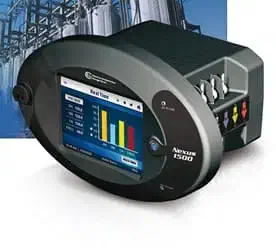
Metering billing energy at a substation and, with the same device, power quality with contractual validity calls for a certified class A analyser to IEC 61000-4-30 that also meets the 0.2S accuracy class of IEC 62053-22 and the 0.1 class of ANSI C12.20. The Nexus 1500+ measures energy to 0.06 % (0.02 % typical as shipped) and recalibrates itself every 10 seconds; it records waveforms at 1024 samples per cycle with 16 bits, transients at 50 MHz (over 800,000 samples per cycle) and harmonics to the 511th order, outputs synchrophasors to IEEE C37.118.1 and integrates through DNP3, Modbus and IEC 61850 with GOOSE over two independent Ethernet ports.
Nexus 1500+ key data
- Revenue accuracy: the Nexus 1500+ measures energy to 0.06 % and exceeds ANSI C12.20 class 0.1 and IEC 62053-22 class 0.2S, both third-party certified; typical shipping accuracy of 0.02 % and internal recalibration every 10 s.
- Power quality: certified IEC 61000-4-30 class A edition 3 and PQI-A classification to IEC 62586-2; harmonics and interharmonics to IEC 61000-4-7 class A up to the 511th order (real-time magnitude and angle to the 127th), flicker to IEC 61000-4-15 class A and customisable EN 50160 reports.
- Waveforms and transients: up to 1024 samples per cycle with 16-bit conversion, fault capture up to eight times full scale and a 50 MHz transient recorder on versions V3 and V6; export in COMTRADE and PQDIF.
- Phasor measurement unit: synchrophasors to IEEE C37.118.1-2011/.1a-2014, P and M classes, at 10 to 60 frames per second on 60 Hz systems and 10 to 50 on 50 Hz systems, IRIG-B or IEEE 1588 PTPv2 time sync and up to two simultaneous clients (versions V4 to V6).
- Measuring inputs: 5–347 V AC line to neutral and 10–600 V AC line to line, isolated to 2500 V AC; 1 A (class 2) or 5 A (class 20) current transformers, with fault recording up to ±80 A peak; frequency from 42.5 to 69.9 Hz, with one-cycle readings at a resolution better than 10 mHz.
- Communications: six simultaneous ports (USB, ANSI optical, two Ethernet ports with their own MAC and IP addresses, the second in RJ45 or fibre, and two optional RS-485 ports); Modbus RTU/ASCII/TCP with up to 32 sockets per Ethernet port, DNP3 level 2 plus, IEC 61850 edition 2 with GOOSE and up to six MMS clients, SNMP and SNTP.
- Inputs, outputs and memory: eight high-speed status inputs up to 150 V DC, time-stamped to 100 µs, an auxiliary voltage input, up to 32 additional internal I/O points and 512 MB, 1 GB or 4 GB of memory depending on the version.
- Clock and environment: 3.5 ppm clock (less than 10 s drift per month), operation from -20 to +70 °C, IP30 and a 90–264 V AC / 100–240 V DC or 18–60 V DC supply.
Advantages
Constant calibration
A separate calibration circuit measures the incoming signal every ten seconds, which keeps the metrology stable over time and temperature. Readings exceed the ANSI C12.20 0.1 class and IEC 62053-22 0.2S standards, with an energy class accuracy of 0.06 % and typical shipping accuracy of 0.02 %.
Advanced revenue metering
- Full four-quadrant metering with virtually unlimited historical trending.
- Transformer and line loss compensation for iron, copper and total substation losses, plus CT/PT compensation.
- Load aggregation through pulse inputs, including gas and water commodities.
- Perpetual time-of-use calendar and test mode that does not disturb load profiling or demand recording.
50 MHz transient recorder
Waveforms are captured at up to 1024 samples per cycle at 16-bit resolution, on voltage and current, and a transient recorder adds capture at over 800,000 samples per cycle, that is, 50 MHz sampling speed. Records are exported in COMTRADE and PQDIF formats for third-party analysis.
Applications
- Substation automation, grid monitoring and distribution reliability measurement.
- Co-generation plants and independent power producers.
- Critical loads where a small error turns into a large cost.
- Synchrophasors for wide-area situational awareness and islanding detection.
- Setpoint control: capacitor banks, load shedding, automatic transfer schemes and transformer control.
About the product
Harmonics, flicker, unbalance, transients, frequency changes, sags, swells and outages are measured to the class A specification, with harmonic and interharmonic analysis to the 511th order and a flicker meter to IEC 61000-4-15 class A. EN 50160 reports are generated automatically and can be customised to meet local requirements, backed by an independent ITIC/CBEMA log and SEMI F47 graphing for voltage events.
The phasor measurement unit outputs synchrophasors to IEEE C37.118.1-2011 and .1a-2014, supporting P and M classes, with time synchronisation by IRIG-B or IEEE 1588 PTPv2 and data frame rates of up to 60 per second. The meter carries six simultaneous communication ports, dual Ethernet with separate addresses, DNP3 level 2 plus, IEC 61850 with GOOSE messaging and a colour touchscreen with pre-configured screens for readings, alarms and power quality.
Technical specifications
| Energy accuracy | 0.06 %; recalibrated every 10 s; typical shipping accuracy 0.02 % |
| Power quality measurement | IEC 61000-4-30 class A edition 3; PQI-A device (IEC 62586-2) |
| Harmonics and flicker | IEC 61000-4-7 and IEC 61000-4-15, to the 511th order |
| Transient recording | Up to 50 MHz (over 800,000 samples/cycle) |
| Waveform recording | Up to 1024 samples/cycle, 16-bit conversion |
| Phasor measurement unit | IEEE C37.118.1-2011 and .1a-2014, P and M classes |
| Communications | 6 ports: dual Ethernet, RS-485, ANSI optical, USB |
| Time synchronisation | IRIG-B, IEEE 1588 PTPv2 |
| Accuracy class | Exceeds ANSI C12.20 class 0.1 and IEC 62053-22 class 0.2S |
| Measuring inputs | 5–347 V AC L-N, 10–600 V AC L-L; 1 A or 5 A CTs; 42.5–69.9 Hz |
| Protocols | Modbus RTU/ASCII/TCP, DNP3 level 2 plus, IEC 61850 Ed. 2 with GOOSE, SNMP |
Frequently asked questions
Which Nexus 1500+ version includes the 50 MHz transient recorder and the phasor measurement unit?
The 50 MHz transient recorder and 4 GB of memory come with versions V3 and V6; the phasor measurement unit and enhanced cyber security with V4, V5 and V6; the IEC 61850 server with GOOSE with V2, V3, V5 and V6. All versions measure to class A per IEC 61000-4-30 and can be upgraded in the field with a virtual key, without removing the meter.
Which voltages and currents does the Nexus 1500+ accept without additional transformers?
It measures directly from 5 to 347 V AC line to neutral and from 10 to 600 V AC line to line; above that it connects through voltage transformers. The current inputs work with 1 A (class 2, twice overrange) or 5 A (class 20, four times overrange) current transformers and withstand 100 A for 10 s, 300 A for 3 s and 500 A for 1 s.
What billing accuracy does it offer?
0.06 % energy accuracy, with automatic recalibration every ten seconds and a typical shipping accuracy of 0.02 %.
Can it record fast transients?
Yes, it includes a transient recorder of up to 50 MHz, equivalent to over 800,000 samples per cycle, in addition to waveform recording at 1024 samples per cycle.
What is the phasor measurement unit for?
A module that outputs synchrophasors to IEEE C37.118, with time synchronisation by IRIG-B or IEEE 1588 PTPv2, useful for wide-area monitoring and islanding detection.
Which protocols integrate it into a SCADA system?
DNP3 level 2 plus, Modbus TCP/IP, IEC 61850 with GOOSE messaging, SNMP and SNTP or IEEE 1588 PTPv2 time synchronisation.
Which power quality standards does it meet?
IEC 61000-4-30 class A edition 3, with PQI-A classification under IEC 62586-2, and harmonic analysis to IEC 61000-4-7.