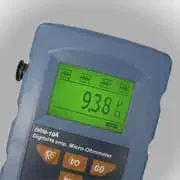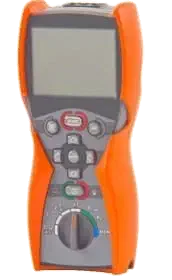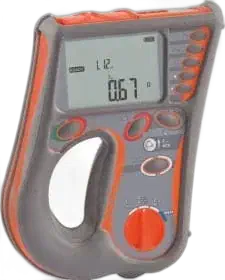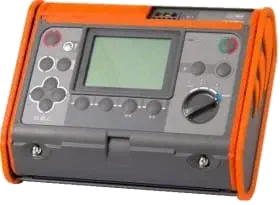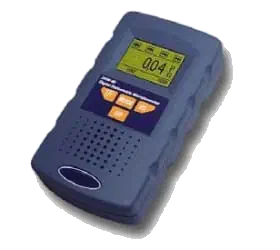
Inspecting earth connections, busbars, welded joints and circuit-breaker and fuse contacts in the field calls for a lightweight four-point micro-ohmmeter with micro-ohm resolution and a mode that compares each point against a reference. The PDRM-1A measures from 1 µΩ to 200 Ω with 1 µΩ resolution over 4¾ digits and an accuracy of 0.1% of reading ±2 counts, adjusts the 1 A, 100 mA or 5 mA DC test current to the range by itself and, in differential mode, shows the deviation of each reading from a stored reference measurement; it weighs 0.86 kg and performs over 4000 measurements at 1 A on six AA NiMH batteries.
PDRM-1A key data
- Range and resolution: 1 µΩ to 200 Ω with automatic range selection; 1 µΩ resolution over 4¾ digits.
- Accuracy: the PDRM-1A measures with 0.1% of reading ±2 counts.
- Test currents: 1 A, 100 mA and 5 mA DC, automatically adjusted; the low current protects applications with small measuring contacts.
- Measurement method: four-point Kelvin; the microprocessor cancels offset and parasitic voltages, and the filtered inputs keep the reading stable in strong magnetic fields.
- Differential mode: the PDRM-1A stores the reading from a reference connection and shows the deviation of every new reading, to decide quickly whether each point of an earthing grid is acceptable.
- Autonomy: six rechargeable AA NiMH batteries, with over 4000 measurements at 1 A and over 10,000 at the other currents; automatic shutdown after 2 minutes and backlight off after 30 seconds.
- In the field: sealed, shock-resistant 203 × 114 × 51 mm enclosure weighing 0.86 kg; operation from -20 to +50°C, storage from -40 to +50°C and 0 to 95% humidity, non-condensing; 128 × 64 pixel LCD with two-level backlight.
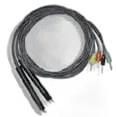
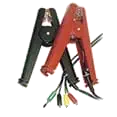
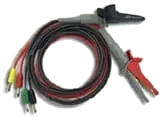
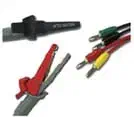
- Accessories: dual hand probes with spring-loaded tips (122 cm; heavy-duty version up to 3 m), 35 mm and 19 mm Kelvin clamps, exothermic weld probe, cable-elbow accessory and 9.5 µΩ reference resistance.
Advantages
Category-leading accuracy
The instrument resolves 1 µΩ over 4¾ digits with an accuracy of 0.1% of reading ± 2 counts, using three test currents — 1 A, 100 mA and 5 mA — that adjust automatically to the range.
Four points, no contact resistance
Two leads inject the current at the ends of the joint while another two read the voltage drop directly across the section under test, so contact resistance stays out of the measurement; the microprocessor also cancels offset and parasitic voltages.
Stable readings near live busbars
Heavily filtered inputs keep the reading accurate even in the presence of strong magnetic fields, a condition frequently found in substations and switchgear rooms.
Built for field and bench work
At 0.86 kg and 203 × 114 × 51 mm, the sealed, shock-resistant enclosure operates from -20°C to +50°C, and the backlit LCD display can be read in dark locations.
Rechargeable autonomy
Six rechargeable NiMH AA batteries deliver over 4000 measurements at 1 A and more than 10,000 at the lower currents, with automatic shutdown after 2 minutes of inactivity.
Applications
- Checking earth connections and power busbars using the relative measurement mode against a stored reference.
- Verification of welded joints made with high current and of mechanical connections.
- Testing circuit-breaker contacts and power fuses.
- Quality control of castings and electrodes, and non-destructive verification of exothermic welds.
About the product
The differential mode stores the reading from a reference connection — for example, an earth connection known to be in good condition — and compares every new measurement against it, displaying the deviation; this speeds up inspection campaigns across large earthing grids. Low current injection protects applications with small measuring contacts, and the display backlight switches off after 30 seconds to save battery power.
The kit includes the micro-ohmmeter, the Kelvin clamps, the batteries, the manual and the calibration certificate. Available accessories: dual hand probes with replaceable spring-loaded tips, 35 mm and 19 mm Kelvin clamps, a dedicated probe for exothermic welds, a cable-elbow accessory, a 9.5 µΩ reference resistance, and a nylon pouch or rigid transport case.
Technical specifications
| Measurement range | 1 µΩ to 200 Ω, automatic range selection |
| Test currents | 1 A, 100 mA and 5 mA DC, automatically adjusted |
| Resolution | 1 µΩ; 4¾ digits |
| Accuracy | 0.1% of reading ± 2 counts |
| Measurement method | Four-point Kelvin |
| Operating modes | Standard and differential |
| Power supply | Six rechargeable NiMH AA batteries |
| Dimensions and weight | 203 × 114 × 51 mm; 0.86 kg |
| Display | 128 × 64 pixel LCD, 60 × 41 mm; two-level backlight (100% and 50%) |
| Autonomy | Over 4000 measurements at 1 A; over 10,000 at the other currents |
| Environmental conditions | Operation from -20 to +50°C; storage from -40 to +50°C; 0 to 95% humidity, non-condensing |
Frequently asked questions
When is the PDRM-1A enough, and when is the PDRM-10A the better choice?
It depends on the resolution and current the measurement needs. The PDRM-1A resolves 1 µΩ with up to 1 A DC and an accuracy of 0.1% of reading ±2 counts; if readings below 1 µΩ or more current are needed, the PDRM-10A resolves 0.01 µΩ and injects up to 10 A DC, in the same size and the same 0.86 kg.
What does the PDRM-1A kit include, and which accessories are worth adding?
The kit includes the micro-ohmmeter, the Kelvin clamps, the AA batteries, the manual and the calibration certificate. Dual hand probes with spring-loaded tips speed up measurement on any surface, and the 9.5 µΩ reference resistance lets you validate the instrument before starting a job.
Why does the instrument measure at four points?
Because the current and the voltage use separate pairs of leads, so the resistance of the leads and the contacts stays outside the reading circuit and does not distort the result.
Can it be used near energised equipment?
Yes. The filtered inputs keep the reading stable even with strong magnetic fields present, which makes the instrument usable in live substations.
What is the differential mode used for?
It stores a reference measurement and compares every new reading against it, showing the deviation; this is the recommended method for inspecting a series of earth connections.
How much autonomy do the batteries provide?
The six rechargeable NiMH AA batteries exceed 4000 measurements at 1 A and 10,000 measurements at the 100 mA and 5 mA currents.
Is it suitable for exothermic welds?
Yes. With the optional dedicated probe, the instrument verifies exothermic connections non-destructively, a common requirement in substation earthing grids.