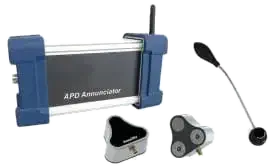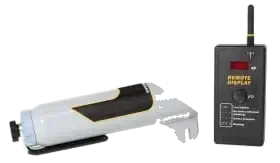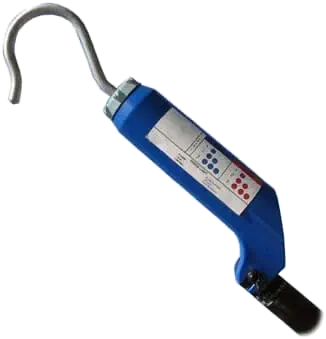
Locating the defective metal-oxide arrester that causes radio or TV interference requires checking each arrester by contact, with the line energised, using a partial discharge detector, because directional radio-frequency locators cannot single out the specific arrester. The PADD carries out that check on overhead lines up to 69 kV (45 kV phase-to-neutral): its hook electrode rests on the bare conductor next to the arrester, detects the discharge by ultra-wide-band radio frequency and indicates it on 6 levels arranged in 2 colour zones, with an audible alert at the highest levels.
PADD key data
- Application: metal-oxide arresters, dry-type transformers, bushings and insulators on medium-voltage networks, on energised overhead lines up to 69 kV (45 kV phase-to-neutral).
- Detection principle: direct-contact method with ultra-wide-band radio-frequency detection; the electrode is applied to the bare conductor as close as possible to the arrester being checked.
- Indication: 6 levels in 2 colour zones, 3 low in blue and 3 high in red, with an audible signal at the highest levels; the red zone indicates partial discharge or sparking inside or on the surface of the arrester.
- Location: by checking each arrester individually in a three-phase overhead installation, it identifies the one causing the interference and avoids replacing arresters that are not defective.
- Verification: Auto-Test function before each use, independent battery-status indicator and a power light that changes from slow blinking to steady when the line voltage is detected.
- Equipment: very lightweight handheld unit for a single operator, with a built-in universal adapter for an insulated handling bar, a 60mm hook electrode as standard (Y-type as an alternative), 1 9V alkaline battery and carrying case.
Advantages
Accurate location of the defective arrester
Unlike directional radio-frequency detection equipment, the PADD makes it possible to identify exactly which arrester is causing radio or TV interference, so only the defective part needs to be replaced instead of the whole group of nearby accessories.
Two-zone, six-level indication
The PADD's light indicators are arranged in two colour zones: the blue zone shows three low levels of partial discharge and the red zone three high levels, with an additional audible signal when the detected activity is very high.
Prior verification with the Auto-Test function
The unit includes a self-test (Auto-Test) function that confirms the detector is working correctly before each inspection, together with its own battery-status indicator.
Lightweight design ready for an insulated hotstick
The PADD is a very lightweight unit, adapted for use under voltage and compatible with an adapter for an insulated handling bar, and is carried in an included case together with its contact electrodes.
Applications
- Partial discharge detection on metal-oxide arresters installed on overhead lines up to 69 kV.
- Inspection of in-service dry-type transformers, bushings and insulators on medium-voltage networks.
- Locating the specific arrester causing radio or TV interference in the area.
- Preventive arrester maintenance programmes on overhead distribution networks.
About the product
The unit consists of a handheld device with a hook-shaped contact electrode, applied to the bare live conductor as close as possible to the arrester being checked. A panel of light indicators, arranged in two colour zones, shows the detected partial discharge level, and an audible signal activates when the recorded activity is very high.
The unit includes a built-in universal adapter for attaching an insulated handling bar, allowing the check to be carried out without direct contact between the operator and the energised part, together with an Auto-Test function that verifies the unit is working correctly before each use. The unit is powered by a 9V alkaline battery and is carried in an included case together with its contact electrodes.
Available accessories: 60mm hook-type contact electrode, Y-type contact electrode, adapter for insulated handling bar and carrying case.
Technical specifications
| Maximum line voltage | Up to 69 kV (45 kV phase-to-neutral) |
| Indication levels | 6 levels in 2 colour zones: 3 low (blue) and 3 high (red) |
| Indication type | Visual and audible |
| Self-test | Built-in Auto-Test function |
| Hotstick adapter | Built-in universal adapter for insulated handling bar |
| Power supply | 1 9V alkaline battery, included |
| Battery indicator | Battery-status indicator |
| Weight and case | Very lightweight unit; carrying case included |
| Detection technology | Direct contact with ultra-wide-band radio-frequency detection, for energised lines |
| Contact electrode | 60mm hook as standard; Y-type electrode as an alternative |
| Operation | By a single person |
Frequently asked questions
How do I know the PADD is resting on an energised line?
When the PADD is switched on, the power light blinks slowly; when the hook electrode touches the conductor and the unit detects the line voltage, the light becomes steady. Before each inspection, the Auto-Test function confirms that the detector is working correctly.
Why does the PADD locate the defective arrester better than a radio-frequency interference locator?
A directional radio-frequency locator only points to the pole the interference comes from, not to the specific arrester. The PADD is applied by contact next to each arrester of the three-phase installation, so it identifies the defective one and only that arrester needs replacing.
Is contact with the conductor needed to measure?
Yes. The PADD works by direct contact: the hook electrode is applied to the bare live conductor, as close as possible to the arrester being checked.
How many indication levels does it have?
Six, arranged in two colour zones: the blue zone indicates three low levels of partial discharge and the red zone three high levels.
Can it be used with the line energised?
Yes, the unit is designed for use on energised medium-voltage overhead lines, up to 69 kV, with an adapter for an insulated handling bar.
What accessories does it include or accept?
The 60mm hook-type contact electrode, the Y-type electrode as an alternative, the hotstick adapter and the carrying case.