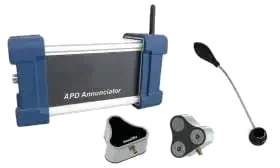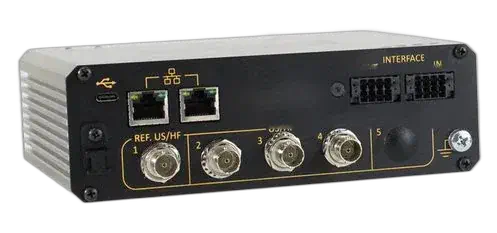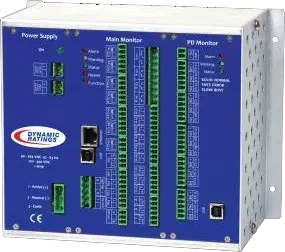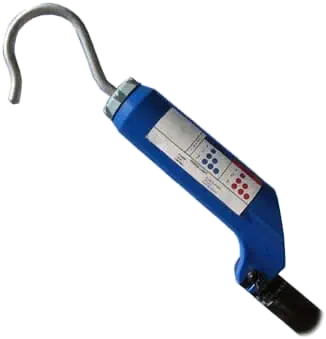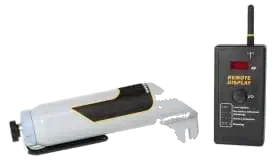
To check whether an overhead-line arrestor, cable head or insulator has partial discharges without interrupting service or touching the conductor, you use a meter with a capacitive sensor mounted on an insulated hotstick that sends the reading wirelessly to a display held by the operator. That is how the APD-LT works: its measurement module picks up the signal in the 30 to 47 MHz band with a 60 dB dynamic range and ± 2 dB accuracy, and transmits it over Bluetooth Low Energy, with a typical range of 30 m, to a touchscreen remote display, giving 10 hours of continuous use per 9V battery.
APD-LT key data
- Measurement: 60 dB dynamic range and ± 2 dB accuracy in the 30 to 47 MHz band (direct contact injection), with an absolute maximum input signal of 16 dBm, 3 dBV (1.4 VAC) and an analogue front-end self-test at start-up.
- Sensor and mounting: capacitive sensor adjustable in any orientation, with no contact with the conductor, and a universal end fitting for any standard insulated hotstick; use outdoors, indoors, on underground networks and in substations.
- Wireless link: Bluetooth Low Energy 4.1 between the measurement module and the display, with a typical range of 30 m.
- Remote display: 5.5" sunlight-readable colour touchscreen, 720 × 1440 px, that works with gloves; IP68 (1.2 m for 30 min), vibration, drop and shock resistance to MIL-STD-810G and 196 g.
- Inspection records: observation and comparison modes, measurements saved with picture, video, audio, text, tags and GPS coordinates, and export by e-mail to a spreadsheet over Wi-Fi or a hotspot.
- Autonomy: the measurement module runs 10 h continuously on 1 9V alkaline battery and switches off after 15 min of inactivity (configurable); the display has a 4200 mAh lithium battery.
- Ruggedness: IP66 measurement module, -20 °C to +55 °C at 0 to 95 % RH non-condensing, 0.43 kg and 192.5 × 120.7 × 47.4 mm; CE marked.
Advantages
Contactless measurement without interrupting service
The APD-LT's capacitive sensor is applied to the line accessory with no need for direct contact with the conductor or for disconnecting the installation, allowing energised equipment to be inspected with maximum safety for the operator.
Compact, lightweight and hotstick-ready
The measurement module attaches to any standard insulated hotstick through a universal end fitting, and its reduced weight makes it easy to handle during extended overhead-line inspections.
Wireless reading at a distance
The reading is transmitted by radio frequency to an independent remote display, so the operator can move away from the measuring point and check the discharge level without approaching the energised accessory.
Long autonomy and immediate start-up
The measurement module runs on a standard 9V alkaline battery, offers up to ten hours of continuous use, and switches off automatically after a period of inactivity to extend battery life.
Applications
- Partial discharge detection in cable heads.
- Partial discharge detection in line arrestors.
- Partial discharge detection in insulators.
- Partial discharge detection in bushings.
About the product
The unit consists of a measurement module with a highly sensitive capacitive sensor, adjustable to match the geometry of the accessory being inspected, and an independent remote display that receives the reading by radio frequency. The display indicates the discharge level in decibels and separately shows the battery status and signal-overload detection.
The measurement module includes a universal end fitting compatible with the insulated hotsticks commonly used in the industry, allowing the check to be carried out from the ground or from an aerial bucket without climbing the structure. The complete set is carried in a semi-rigid case that protects both units and their accessories while moving between sites.
Available accessories: wireless remote display, universal hotstick end fitting, adjustable capacitive sensor and semi-rigid carrying case.
Technical specifications
| Dynamic range | 60 dB |
| Accuracy | ± 2 dB (direct contact injection) |
| Bandwidth | 30 MHz to 47 MHz |
| Wireless communication | Bluetooth Low Energy (BLE), up to 30 m typical range |
| Measurement module power supply | 1 9V alkaline battery; up to 10 hours of continuous use |
| Protection rating | IP66 (measurement module) / IP68 (remote display) |
| Measurement module weight and dimensions | 0.43 kg; 192.5 x 120.7 x 47.4 mm |
| Approval | CE directive |
| Absolute maximum input signal | 16 dBm, 3 dBV (1.4 VAC) |
| Measurement module temperature | Operating -20 °C to +55 °C (0 to 95 % RH non-condensing); storage -40 °C to +55 °C |
| Remote display | 5.5" colour touchscreen, 720 × 1440 px, sunlight readable; 4200 mAh lithium battery; 196 g; MIL-STD-810G (vibration, drop and shock) |
Frequently asked questions
How far from the APD-LT measurement module can the operator stand?
The APD-LT measurement module sends the reading to the remote display over Bluetooth Low Energy 4.1, with a typical range of 30 m. The display is rated IP68 (1.2 m for 30 min) and resists vibration, drops and shocks to MIL-STD-810G.
Can the APD-LT document each measurement for the inspection report?
Yes. The APD-LT saves each measurement with picture, video, audio, text, tags and GPS coordinates, and exports it by e-mail to a spreadsheet over a Wi-Fi connection or a hotspot, with no additional PC software.
Is contact with the conductor needed to measure?
No. The measurement module's capacitive sensor is applied to the accessory's surface with no direct contact with the conductor, from the ground or with an insulated hotstick.
How is the reading received?
Wirelessly, on an independent remote display that shows the discharge level in decibels together with battery status and overload detection.
What autonomy does the unit offer?
The measurement module runs on a 9V alkaline battery and offers up to ten hours of continuous use, with a configurable automatic shut-off after a period of inactivity.
Is it compatible with any hotstick?
Yes, the measurement module includes a universal end fitting compatible with the standard insulated hotsticks used in the industry.
Which accessories can it be used on?
Cable heads, line arrestors, insulators and bushings, in both outdoor and indoor installations.