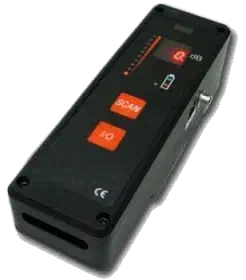
Portable ultrasonic inspection system for corona effect, arcing and gas leaks, with built-in, parabolic or contact sensor
Finding corona and arcing on insulators, arresters, cable terminations and switchgear before they cause a failure calls for a narrow-band ultrasonic detector that turns the signal into audible sound and reaches overhead assets from the ground. The PULD-40 works from 38 to 48 kHz centred on 40 kHz, with 96 dB of dynamic range, shows the level in dB and on an LED bar graph and plays the signal converted to 2.4 kHz through its speaker or headphones; with the laser-sighted parabolic sensor it aims at 15 m, and the unit weighs 528 g and runs for 4 h per charge.
PULD-40 key data
- Detection band: 40 kHz centre frequency and 38 to 48 kHz bandwidth; the 40 kHz signal is converted into a 2.4 kHz audible tone, with 120 kHz sampling.
- Dynamic range and reading: the PULD-40 offers 96 dB of dynamic range, with a numeric dB reading and an LED bar graph.
- Sensitivity: with the built-in cone sensor it detects a 0.125 mm diameter leak at 0.35 bar at 3 m, the distance it is optimised for.
- Parabolic sensor: optimised for 15 m, with sight and laser pointer for overhead insulators, arresters, cable terminations, bushings and switches.
- Contact sensor: with magnetic holders, for metal-clad cabinets (switchgear, RMU, cable boxes), resin dry-type transformers and cable splices.
- Audio: built-in speaker and 3.5 mm jack headphone output, 32 Ω and 1 V peak-to-peak; optional audio cable for recording on an external device.
- Battery: 3.6 V lithium-ion; 4 h of autonomy and 2.5 h charging; operation from -20°C to 60°C.
- Format: the PULD-40 weighs 528 g and measures 57 × 52 × 185 mm, in an impact-resistant Delrin case; it comes in a hard-shell case and can be checked with the ultrasonic noise generator.
Advantages
Corona, arcing and leak detection in a single unit
It locates corona effect, electric arcing and pressure or vacuum leaks with a high-sensitivity built-in cone-shaped sensor for close range, showing the reading on a digital display and an LED bar graph.
Reliable even in noisy environments
It works in a narrow band centred on 40 kHz and plays back the ultrasonic signal converted to audible sound through its built-in speaker or a headset, making it easier to tell the real signal apart from background noise in industrial plants.
Precise long-range parabolic sensor
The external parabolic sensor, optimised for 15 m, includes a sight and a laser pointer for precise aiming at insulators, arresters, cable terminations and other hard-to-reach overhead assets.
Lightweight design, ready in seconds
Weighing 528 g and built with an impact-resistant housing, the unit is ready to measure as soon as its switch is pressed, with 4 hours of autonomy per battery charge.
Applications
- Electrical inspection: locating corona effect and electric arcing on conductors and high-voltage installations.
- General mechanical inspection of motors, compressors, gears and pumps, as well as pressure or vacuum leaks.
- Checking the airtightness of aircraft doors and windows and other aviation-sector applications.
- Predictive maintenance in the chemical, petrochemical, manufacturing and textile industries, even in noisy environments.
About the product
Corona discharge is caused by the ionisation of the air around an electrically charged conductor, when the electric field is strong enough to form a conductive region without causing a full electrical breakdown. Besides representing an economic loss of energy for utilities, it generates corrosive gases that degrade and embrittle nearby materials.
The PULD-40 detects these ultrasonic emissions with a built-in cone-shaped sensor or an external parabolic sensor, showing the detected activity level in dB on its digital display and LED bar graph. The operator can also listen to the resulting audible signal to discriminate the real source from ambient noise.
Accessories available: external parabolic sensor with sight and laser pointer, ultrasonic noise generator for periodic verification of the unit, direct-contact sensor with magnetic holders for metal-clad cabinets and dry-type transformers, noise-isolating headphones and a hard-shell transportation case.
Technical specifications
| Dynamic range | 96 dB |
| Sensitivity (built-in sensor) | 0.125 mm diameter leak at 0.35 bar, at 3 m |
| Centre frequency and bandwidth | 40 kHz; 38 to 48 kHz |
| Operating distance | Optimised for 3 m (built-in sensor) or 15 m (parabolic sensor) |
| Battery | Lithium-ion; 4-hour autonomy; 2.5-hour charging |
| Operating conditions | -20°C to 60°C; storage -30°C to 85°C |
| Weight and dimensions | 528 g; 57 × 52 × 185 mm |
| Audible output | 2.4 kHz for 40 kHz; 32 Ω, 1 V peak-to-peak; 3.5 mm jack |
| Sensors | Built-in cone (3 m), external parabolic with sight and laser (15 m) and magnetic contact sensor |
| Sampling frequency | 120 kHz |
Frequently asked questions
Which ultrasonic detector is best for finding corona and arcing in substations and on overhead lines?
One with a narrow band around 40 kHz that converts ultrasound into audible sound and has a parabolic sensor for overhead assets. The PULD-40 works from 38 to 48 kHz with 96 dB of dynamic range, plays the signal at 2.4 kHz and, with the laser-sighted parabolic sensor, aims at insulators and arresters at 15 m.
Can the PULD-40 be used on switchgear and dry-type transformers?
Yes, with the optional contact sensor. It attaches magnetically to metal-clad cabinets such as switchgear, RMUs or cable boxes, and can also be used on resin dry-type transformers and cable splices, so several cabinets can be scanned in a row.
What phenomena does the PULD-40 detect?
Corona effect, electric arcing and gas, pressure or vacuum leaks, converting the detected ultrasound into an audible signal and a numeric dB reading.
Can it be used in noisy environments?
Yes. Its detection is centred on a narrow band around 40 kHz, making it easier to tell the real signal apart from the ambient noise of an industrial plant.
What range does the external parabolic sensor offer?
It is optimised for 15 m and includes a sight and a laser pointer for precise aiming at hard-to-reach overhead assets.
Can the unit be checked before an inspection?
Yes, using the ultrasonic noise generator, which allows periodic verification of the system's operation.