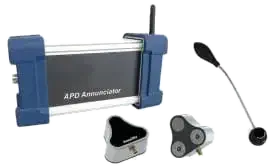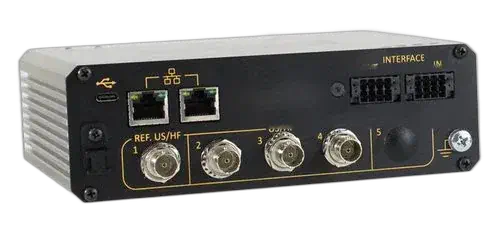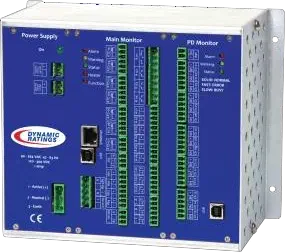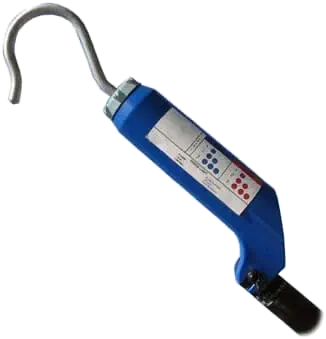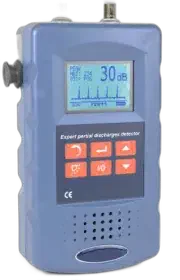
Locating partial discharges with the installation in service takes a portable detector that accepts several sensor types (TEV, acoustic, HFCT and capacitive) and synchronises the measurement with the network phase to obtain the PRPD pattern. The PXDP-II does both: it measures with 5 pC sensitivity (depending on the capacitance of the device under test), a 60 dB dynamic range and ± 1 dB accuracy across the 300 kHz to 70 MHz band, in relative dB and pC values, and with a pico-coulomb calibrator and a high-voltage source of up to 50 or 100 kV it also becomes an offline test system.
PXDP-II key data
- Measurement: 60 dB dynamic range, 5 pC sensitivity depending on the capacitance of the device under test, ± 1 dB accuracy and 1 dB resolution, in relative dB values and in picocoulombs (pC).
- Bandwidth: 300 kHz to 70 MHz, with a 30 MHz sampling frequency.
- Online sensors: TEV and contact acoustic sensors for metal-clad cabinets, 20 and 60 mm HFCT clamps for grounding conductors, a capacitive spatula sensor for cable splices and elbows, a bi-phase coupler for switchgear with voltage indicators (VIS) and a parabolic acoustic sensor with sight and laser pointer, optimised for 15 m, for corona effect.
- Phase synchronisation: wireless synchronizer module to record the PRPD pattern, with a network phase signal of 50 to 700 mVrms (50-60 Hz).
- Offline testing: pC measurements with a pico-coulomb calibrator and a suitable high-voltage source of up to 50 or 100 kV, not included.
- Recording: over 380 measurements with waveform, date and time, a real-time internal clock and automatic shutdown after 30 min of inactivity; data are transferred to a PC for classification.
- In the field: rechargeable NiMH batteries with 7.5 h of autonomy and 3 h charging, operation from -20 °C to +50 °C at 0 to 95 % non-condensing humidity, splash-proof protection, 203 × 114 × 51 mm and 860 g.
Advantages
Online and offline measurement
It records partial discharge activity in service, in relative dB and pC values, and also allows offline testing at voltages of up to 50 or 100 kV using a pico-coulomb calibrator.
Wide range of sensors
It includes a high-frequency current sensor for grounding conductors, a capacitive spatula sensor for cable splices and terminations, a TEV sensor and a contact acoustic sensor for metal-clad cabinets, a bi-phase coupler for switchgear, and a parabolic acoustic sensor with a laser pointer for corona effect.
Noise rejection and phase synchronisation
A wireless phase synchronizer module enables PRPD (phase-resolved partial discharge) analysis and reduces random noise, with a built-in speaker that helps distinguish real discharge activity from ambient noise.
Simple operation and analysis software
Press the power button, connect the sensor and select the operating mode; recordings stored in the internal memory are then transferred to a PC and classified with the PXDP-SOFT software.
Applications
- Quality control of medium- and high-voltage equipment: transformers, switchgear, arresters, insulators and couplers.
- Insulation control during installation or repair of underground networks: cable splices and elbows.
- Monitoring insulation degradation in critical components and safety checks before live-line work.
- TEV testing on switchgear cabinets and detection of corona effect and arcing on overhead devices with the acoustic sensor.
About the product
The PXDP-II is a battery-powered portable unit: simply switch it on, connect the appropriate sensor and select the operating mode to start measuring. Partial discharge activity is shown on screen with synchronised patterns, and a speaker plays an audible version of the signal to help distinguish real discharge activity from ambient noise.
Besides online measurement, the unit can become an offline test system at voltages of up to 50 or 100 kV, using the appropriate pico-coulomb calibrator and high-voltage source. Recordings are stored in an internal memory with capacity for over 380 measurements.
Accessories available: high-frequency current sensor, capacitive spatula sensor, TEV sensor and contact acoustic sensor, bi-phase coupler for switchgear, parabolic acoustic sensor with laser pointer, wireless phase synchronizer module and PXDP-SOFT analysis software.
Technical specifications
| Dynamic range | 60 dB |
| Sensitivity | 5 pC (depending on the capacitance of the device under test) |
| Accuracy and resolution | ± 1 dB; 1 dB resolution |
| Bandwidth | 300 kHz to 70 MHz |
| Memory | Over 380 recordings |
| Display and protection | High-contrast backlit LCD; splash-proof protection |
| Power and autonomy | Rechargeable NiMH batteries; 7.5-hour autonomy; 3-hour charging |
| Weight and dimensions | 203 × 114 × 51 mm; 860 g |
| Network phase signal | 50 to 700 mVrms (50-60 Hz) |
| Environmental conditions | Operating -20 °C to +50 °C; charging 0 °C to +50 °C; humidity 0 to 95 % non-condensing |
| Clock and auto shutdown | Real-time internal clock; shuts down after 30 min of inactivity |
Frequently asked questions
What sensitivity does the PXDP-II have and which frequency band does it cover?
The PXDP-II has a sensitivity of 5 pC, which depends on the capacitance of the device under test, with a 60 dB dynamic range, ± 1 dB accuracy and 1 dB resolution. Its bandwidth runs from 300 kHz to 70 MHz.
Can the PXDP-II detect corona effect on overhead equipment?
Yes. With the parabolic acoustic sensor, which includes a sight and laser pointer and is optimised to work at 15 m, the PXDP-II detects and locates corona effect and arcing on overhead devices without approaching the energised parts.
What is the difference between online and offline measurement?
Online measurement is taken with the installation in service using sensors such as the TEV or acoustic sensor; offline measurement uses a pico-coulomb calibrator and a high-voltage source of up to 50 or 100 kV.
In what units are the results shown?
In relative dB values and in picocoulombs (pC), with patterns synchronised to the network phase (PRPD).
Does it include analysis software?
Yes, the PXDP-SOFT software classifies, visualises and analyses on a PC the recordings downloaded from the unit.
What battery life does it offer?
Its rechargeable NiMH batteries provide 7.5 hours of autonomy, with a full charge in 3 hours.