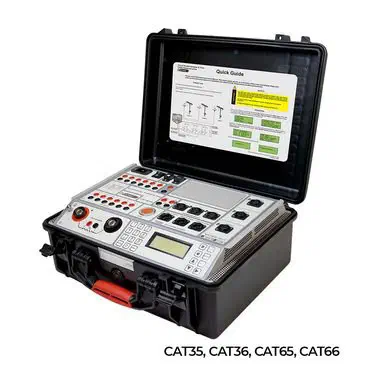
Up to 12 contacts, six coils and a 500 A micro-ohmmeter in one instrument
Where the basic range falls short, the advanced series of the CAT family begins: eight circuit breaker analyzers conceived for comprehensive diagnosis in high-voltage substations. Simultaneous timing of up to 12 main contacts (4 breaks per phase) and 6 auxiliaries, six coil current channels, six analog voltage channels, three transducer channels and, depending on the model, an internal 200 or 500 A micro-ohmmeter for static and dynamic resistance measurement.
Advantages
Static and dynamic resistance (DRM)
The built-in micro-ohmmeter generates pure DC with a regulated ramp and measures by Kelvin's method; during the operation, the resistance-versus-travel curve exposes arcing contact wear without opening the chamber.
Eight models to choose wisely
Three acquisition sizes (3, 6 or 12 main contacts) combined with a 200 A or 500 A micro-ohmmeter, or none (CAT64A and CAT124A); the internal high-precision module is optional on the micro-ohmmeter models.
First trip and anti-pumping
The first trip test captures the first opening after months at rest with the installation in service, and the anti-pumping relay test verifies the interlock without dismantling anything.
High-resolution sampling
Up to 40 kHz sampling with 0.025 ms resolution and an accuracy of ±0.01% of reading ±0.1 ms, with six analog inputs offering four ranges between ±1 and ±300 V AC/DC.
Applications
- Complete diagnosis of HV and MV circuit breakers in substations.
- Static and dynamic contact resistance with both sides grounded (BSG, optional).
- Travel, over-travel, rebound and velocity curves with three simultaneous transducers.
- Resistance of three coils at once during the open or close sequence.
- Minimum operating voltage test and motor current with the associated coil power source.
About the product
All eight models share a 480 × 197 × 395 mm metal housing weighing 10.7 to 13.2 kg, with a consumption from 100 VA up to 3900 VA with the 500 A micro-ohmmeter working. The transducers can be analog or digital, and the included control software assesses each operation against the test plans in its database. Accessories: cables with SCT clamps, linear and rotary transducers, online first trip kits and current clamps.
Technical specifications
| Models | CAT35, CAT36, CAT65, CAT66, CAT125, CAT126, CAT64A and CAT124A |
| Main contacts | 3, 6 or 12 inputs (up to 4 breaks per phase) |
| Auxiliary contacts | 6, dry or wet |
| Coil channels | 6, ±35 A AC/DC; 25 mA resolution |
| Analog channels | 6, ranges ±1 / ±5 / ±60 / ±300 V AC/DC |
| Internal micro-ohmmeter | 200 or 500 A by model (not on CAT64A/CAT124A) |
| Time resolution | 0.025 ms (40 kHz); accuracy ±0.01% ±0.1 ms |
| Dimensions and weight | 480 × 197 × 395 mm; 10.7 – 13.2 kg |
Frequently asked questions
What does dynamic resistance measurement bring?
It records resistance while the breaker operates: the curve as a function of travel reveals the arcing contact's condition, which neither static measurement nor timing can show.
Which models carry the micro-ohmmeter?
All but the CAT64A and CAT124A: the CAT35, CAT65 and CAT125 provide 200 A while the CAT36, CAT66 and CAT126 reach 500 A, the current recommended for reliable defect detection.
How does it differ from the standard series?
In scale: it triples the coil and analog channels, reaches 4 breaks per phase with 3 simultaneous transducers, samples at 40 kHz and adds the micro-ohmmeter, DRM, first trip and anti-pumping tests.
Can it measure with both sides grounded?
Yes, as an option (BSG): timing and resistance measurements are made without removing either of the breaker's two ground connections, with the safety that entails.

