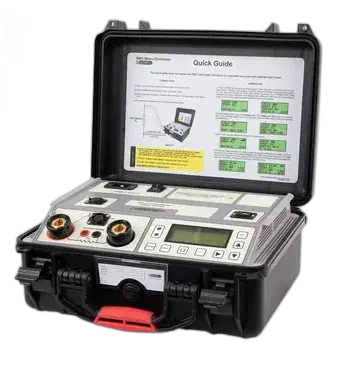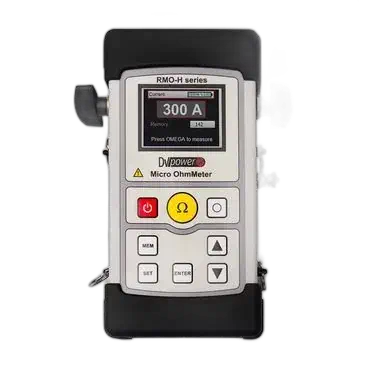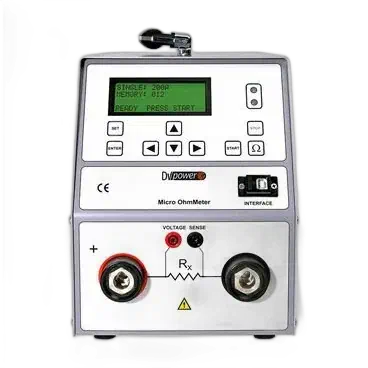
Up to 600 A of true ripple-free DC current in a 7-8 kg device
Measuring the contact resistance of a medium- or high-voltage circuit breaker takes a four-wire (Kelvin) micro-ohmmeter with a high DC current, as IEEE C37.09 and IEC 62271-100 call for, kept stable and resolved to tenths of a micro-ohm. RMO-A does it with six models from 100 to 600 A DC and ripple below 1 %: the current rises and falls in automatically regulated ramps that remove magnetic transients, and the measurement has 0.1 µΩ resolution and ±(0.1 % of reading + 0.1 % of full scale) typical accuracy, in a 7 to 8 kg instrument.
RMO-A key data
- Models and current: RMO100A to RMO600A, 100 to 600 A DC with ripple below 1 %; continuous operation at 100 A and 20 to 150 s at maximum current depending on the model.
- Range and resolution: 0.1 µΩ to 999.9 mΩ, expandable to 6 Ω; 0.1 µΩ resolution and, with the optional high-precision module, 0.01 µΩ between 1 and 30 µΩ.
- Accuracy: ±(0.1 % rdg + 0.1 % FS) typical and ±(0.2 % rdg + 0.2 % FS) guaranteed, with filtering that cancels interference from high-voltage electric fields.
- Test modes: SINGLE (spot measurement), CONTIN (sustained current for longer tests) and DTRtest (saturates the current transformers of dead-tank breakers before measuring); pass/fail assessment with an Rmax limit.
- Long or thin cables: the high output voltage allows testing at 100 A with 20 m of cable of only 16 mm².
- In the field: 198 × 255 × 380 mm, 7 to 8 kg, −20 to +55 °C and IP50; memory for 500 time- and date-stamped measurements, USB (RS232 and Bluetooth optional) and optional thermal printer.
Advantages
Laboratory accuracy in the field
Typical accuracy of ±(0.1% of reading + 0.1% of full scale) and 0.1 µΩ resolution, with filtering that cancels the interference of high-voltage electric fields.
Three modes for every situation
SINGLE mode solves the spot measurement, CONTIN generates sustained current for longer tests and DTRtest saturates the current transformers of dead-tank breakers before measuring.
Power that gives margin
The high output voltage widens the measuring range at high currents and accepts long or thin cables: 20 m of only 16 mm² to test at 100 A.
Results in order
The internal memory stores 500 time- and date-stamped measurements, and an optional thermal printer prints the result right at the breaker.
Applications
- Contact resistance of medium- and high-voltage breakers, live tank and dead tank.
- Disconnectors, busbars and high-current joints.
- Cable splices, welded joints and fuses.
- Switchgear manufacturing, commissioning and maintenance.
- Pass/fail verification with Rmax limit.
About the product
The measuring range spans 0.1 µΩ to 999.9 mΩ, expandable to 6 Ω, and an optional high-precision module resolves 1 to 30 µΩ with 0.01 µΩ. The PC software controls the test from the PC over USB or RS232, records at configurable intervals and generates reports with export to Excel.
Accessories: current cables of several cross-sections and lengths, sense cables with clamps, verification shunt, transport bag, optional thermal printer and Bluetooth.
Technical specifications
| Models | RMO100A to RMO600A (100 – 600 A DC) |
| Measuring range | 0.1 µΩ – 999.9 mΩ; expandable to 6 Ω |
| Typical accuracy | ±(0.1% rdg + 0.1% FS) |
| Current ripple | Below 1% |
| Memory | 500 time- and date-stamped measurements |
| Communication | USB; optional RS232 and Bluetooth |
| Operating temperature | -20 to +55 °C; IP50 |
| Dimensions and weight | 198 × 255 × 380 mm; 7 to 8 kg |
| Guaranteed accuracy | ±(0.2 % rdg + 0.2 % FS) |
Frequently asked questions
Which micro-ohmmeter do I need to measure the contact resistance of a high-voltage circuit breaker?
A four-wire instrument with a high DC current, because IEEE C37.09 and IEC 62271-100 call for high currents on breaker contacts. RMO-A offers 100 to 600 A DC depending on the model (RMO100A to RMO600A), 0.1 µΩ resolution and ±(0.1 % of reading + 0.1 % of full scale) typical accuracy, with a DTRtest mode for dead-tank breakers.
How accurate is the RMO-A when measuring micro-ohms?
Typical accuracy is ±(0.1 % of reading + 0.1 % of full scale) and guaranteed accuracy ±(0.2 % of reading + 0.2 % of full scale), with 0.1 µΩ resolution over the 0.1 µΩ to 999.9 mΩ range. For very low resistances, the optional high-precision module resolves 1 to 30 µΩ with 0.01 µΩ.
Which model do I need?
It depends on the required test current: IEEE C37.09 and IEC 62271-100 call for high currents on breaker contacts, and the series goes from 100 to 600 A.
Why does the current ramp up?
Because abrupt current changes induce magnetic transients in the test object; the automatic ramp removes them and stabilises the reading.
Can it measure dead-tank breakers?
Yes. The DTRtest mode first saturates the breaker's current transformers and then measures, avoiding the magnetisation error.
How long can it hold the current?
At 100 A, continuously; at maximum current, 20 to 150 seconds depending on the model, with duty cycles that prevent overheating.