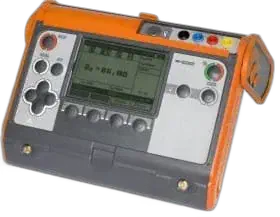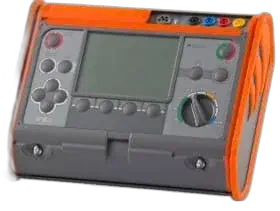
Measuring an earthing grid with many electrodes, such as a substation grid, and later knowing which point each reading belongs to, calls for an earth tester that stores the satellite position together with the result. The AMRU-200 GPS records the coordinates of every measurement with 3 m (50 % CEP) accuracy plus the real-time clock time, and measures earth resistance by the 3- and 4-pole method from 0.10 Ω to 19.99 kΩ per IEC 61557-5 with ±(2 % m.v. + 4 digits) up to 3.999 Ω, by the pulse method with 4/10, 8/20 and 10/350 μs slopes, and with a double clamp with no auxiliary electrodes.
AMRU-200 GPS key data
- Positioning: built-in GPS receiver with 3 m (50 % CEP) accuracy in good weather with satellites in view; coordinates and time stored with each of the 990 measurements (10 banks of 99 cells) and transferred to the PC over USB.
- 3- and 4-pole earth: 0.10 Ω to 19.99 kΩ per IEC 61557-5; 0.001 Ω resolution up to 3.999 Ω; ±(2 % m.v. + 4 digits) up to 3.999 Ω, ±(2 % m.v. + 2 digits) up to 3999 Ω and ±(5 % m.v. + 2 digits) up to 19.99 kΩ; over 200 mA at 25 or 50 V.
- Pulse method: 4-pole earth impedance from 0.0 to 200 Ω with ±(2.5 % m.v. + 3 digits), 4/10, 8/20 and 10/350 μs slopes, pulse current of approx. 1 A and peak voltage of approx. 1500 V.
- Multiple earths: 3-pole plus clamp from 0.12 to 1999 Ω per IEC 61557-5 with ±(8 % m.v. + 4 digits) up to 3.999 Ω; double clamp from 0.00 to 149.9 Ω with ±(10 % m.v. + 3 digits) up to 19.99 Ω.
- Interference: measurement with disturbance voltage at 16 2/3, 50, 60 or 400 Hz and automatic or manual selection; disturbance voltage up to 100 V with ±(2 % m.v. + 3 digits) and frequency from 15 to 450 Hz with ±(1 % m.v. + 2 digits).
- Continuity and current: compensating and protective connections from 0.045 Ω to 19.99 kΩ per IEC 61557-4 at 200 mA or more; AC current with clamps from 0.1 mA to 300 A with ±(8 % m.v. + 5 digits) up to 99.9 mA.
- Instrument: 4.8 V 4.2 Ah Ni-MH battery, IP54, operation from -10 to +50 °C, 288 × 223 × 75 mm and about 2 kg; Wenner resistivity from 0.0 Ωm to 999 kΩm with spacing in metres or feet.
Advantages
Every method in a single meter
Earth resistance by the 2, 3 or 4-pole method, pulse method, double clamp and soil resistivity, without swapping instruments at each point.
Multiple earths without disconnecting the installation
With auxiliary electrodes and clamps, or with a double clamp when electrodes cannot be placed, it measures each electrode of an earthing network without disconnecting it from the rest.
Satellite positioning and real-time clock
The built-in GPS receiver stores the coordinates of each measurement together with the time stamp from the real-time clock (RTC), making it easier to identify each electrode and carry that data over into inspection reports without writing it down by hand.
Measurement in the presence of disturbance voltage
It measures with disturbance voltage present on the network at 16 2/3 Hz, 50 Hz, 60 Hz or 400 Hz, with automatic or manual frequency selection.
Memory and transfer to a PC
990 measurements in 10 banks of 99 cells, transferred to the computer over a USB cable; an optional program builds documentation from that data.
Applications
- Checking earth electrodes and earthing networks in substations and industrial installations.
- Soil resistivity studies for earthing system design.
- Measuring multiple earths without disconnecting the installation, with clamps or a double clamp.
- Continuity of compensating and protective connections with a self-neutralising function.
About the product
The meter also measures the resistance of the RH and RS auxiliary electrodes, read independently on the right-hand side of the display, and current with clamps -including leakage current-. The distance between electrodes for resistivity is entered in metres or feet, and the clamps used are calibrated from the meter itself. It runs on a Ni-MH 4.8 V 4.2 Ah battery set, good for more than 300 measurements per charge, and meets CAT III 600 V measurement category and IP54 protection.
Technical specifications
| Measurement methods | 2, 3 and 4-pole; pulse; double clamp; resistivity (Wenner) |
| Earth resistance (3/4-pole) | 0.00 Ω to 19.9 kΩ, according to IEC 61557-5 |
| Soil resistivity | 0.1 Ω·m to 999 kΩ·m |
| Continuity | 0.045 Ω to 19.99 kΩ, according to IEC 61557-4, current >200 mA |
| Alternating current (with clamps) | 0.1 mA to 300 A |
| Memory | 990 measurements (10 banks of 99 cells) |
| Positioning and clock | Built-in GPS and real-time clock (RTC) |
| Power supply | Ni-MH 4.8 V 4.2 Ah battery; more than 300 measurements |
| Safety | CAT III 600 V; IP54 |
| Environmental conditions | -10…+50 °C operating; -20…+70 °C storage |
| GPS position accuracy | 3 m (50 % CEP), with good satellite visibility |
| Accuracy (3/4-pole) | ±(2 % m.v. + 4 digits) up to 3.999 Ω; ±(2 % m.v. + 2 digits) up to 3999 Ω; ±(5 % m.v. + 2 digits) up to 19.99 kΩ |
| Pulse method | 0.0...200 Ω, ±(2.5 % m.v. + 3 digits); 4/10, 8/20 and 10/350 μs |
Frequently asked questions
How accurate is the GPS of the AMRU-200 GPS?
3 m (50 % CEP) in good weather with satellites in view. Each measurement is stored with its coordinates and the real-time clock time in one of the 990 memory cells and downloaded to the PC over a USB cable.
Which earth tester can measure a substation earthing grid point by point?
One that measures each electrode without disconnecting it and identifies where each reading was taken. The AMRU-200 GPS measures with 3 poles plus clamp from 0.12 to 1999 Ω per IEC 61557-5, with ±(8 % m.v. + 4 digits) up to 3.999 Ω, or with a double clamp up to 149.9 Ω, and links each result to its GPS position with 3 m accuracy.
Which earth-resistance methods does it support?
The 2, 3 or 4-pole technical method, the pulse method with three pulse slopes and the double-clamp method, plus soil resistivity by Wenner's method.
What are the GPS coordinates for?
Every measurement is stored with its position and the time from the real-time clock, which makes it easier to identify each electrode on installations with many earthing points and complete inspection reports without writing the data down by hand. The GPS gives the position as latitude and longitude (WGS84). If the site drawings use UTM, ETRS89 or the older ED50, the coordinate converter translates it from one system to the other right in the browser.
Can it measure multiple earths without disconnecting them?
Yes, with auxiliary electrodes and clamps, or with a double clamp when auxiliary electrodes cannot be placed.
How many measurements does the memory hold?
990, held in 10 banks of 99 cells, transferable to a computer over USB.