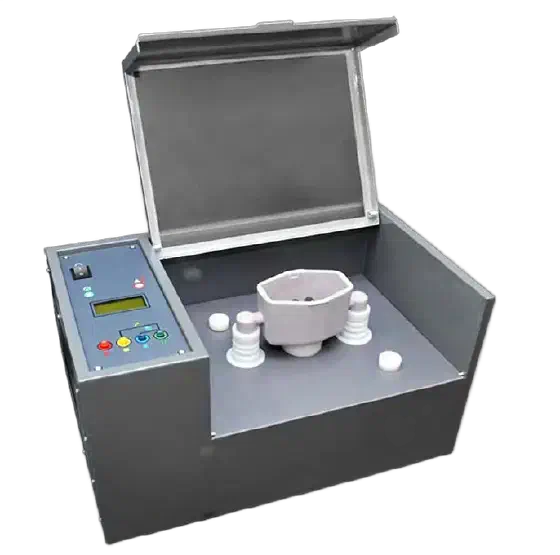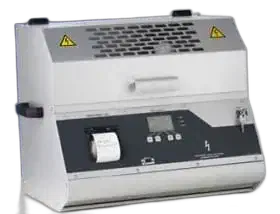
Measuring the dielectric strength (breakdown voltage) of transformer oil takes an instrument that raises the voltage between two electrodes immersed in the sample at the rate set by the standard, detects the breakdown and switches off instantly, repeating the sequence to calculate the average. The Dielectrotest does it on its own: in 60, 80 and 100 kV RMS versions, it raises the voltage at 0.1 to 10 kV/s, measures it as true RMS with ±1 kV accuracy, disconnects in less than 1 ms after breakdown and runs pre-programmed sequences of IEC 60156, ASTM D877, ASTM D1816 and other national standards.
Dielectrotest key data
- Test voltage: the Dielectrotest comes in the 60A-2, 80A-2 and 100A-2 versions, of 60, 80 and 100 kV RMS, with true RMS measurement, 0.1 kV resolution and ±1 kV accuracy.
- Test sequence: voltage rise programmable from 0.1 to 10 kV/s, with rise, voltage hold and time in 5 steps; in automatic mode it is set by the selected standard.
- Pre-programmed standards: IEC 156 (IEC 60156), VDE 370, BS 5874, UTE C 27-221, UNE 21309, NEN 10156, SEV 3141, CEI 10-1, ASTM D1816, ASTM D877 and JIS 2101, plus up to 10 user-defined sequences.
- Switch-off at breakdown: in less than 1 ms, with a trip current programmable from 1 to 5 mA, to avoid carbonisation of the sample.
- Results: individual breakdown values, average value and standard deviation on a backlit graphic display, report on a built-in 24-character-per-line thermal printer and memory of the last 20 tests, downloadable to a PC via RS-232 or Bluetooth in spreadsheet format.
- Vessel and electrodes: 400 ml glass vessel with lid and magnetic stirrer with PTFE bar, mushroom, sphere or disc electrodes and adjustable spacing with 2 and 2.5 mm gauges.
- Safety: interlock that cuts the high voltage when the lid opens and electromagnetically shielded test chamber in an aluminium housing.
- Physical data: 503 (+70 handles) × 450 × 390 mm; 35 kg for the 60 kV version and 39 kg for the 80 and 100 kV versions; 110, 230 or 240 V, 50/60 Hz supply with 900 VA maximum consumption; operation from 0 to +50 °C.
Advantages
The standardised test, with a couple of keys
The sequences of the most common national and international standards come pre-programmed, and the user can freely define and store up to 10 sequences of his own.
Switch-off in less than 1 millisecond
The high voltage is disconnected in less than 1 ms after breakdown, which avoids carbonisation of the sample and allows reliable consecutive measurements.
Statistics computed on the spot
The set displays the individual breakdown values, the average value and the standard deviation, the figures with which the standards characterise the sample.
Printed report and PC archive
The built-in thermal printer issues the report with date, time, temperature and sample number; the last 20 tests remain in memory and are downloaded to the computer via Bluetooth or RS-232.
Designed for safe operation
An interlock cuts the high voltage if the lid is opened during the test, and the test chamber is electromagnetically shielded within a rugged housing.
Applications
- Periodic control of the oil of power and distribution transformers.
- Commissioning and field maintenance of oil-insulated switchgear.
- Laboratories analysing mineral oils and insulating liquids.
- Verification of the oil after filtering, drying or regeneration processes.
About the product
The sample is tested in a 400 ml glass vessel with lid and magnetic stirrer, using mushroom, sphere or disc electrodes with adjustable spacing checked with the 2 and 2.5 mm gap gauges. Before starting, the set displays the electrode type and spacing required by the selected standard, and accepts the sample temperature and number for the report.
The backlit graphic display and the four keys F1 to F4 guide the operation in several languages. Available accessories: pairs of mushroom, sphere or disc electrodes to ASTM D877, thermal paper and PC software for storing and printing the results.
Technical specifications
| Test voltage | Up to 100 kV |
| Switch-off at breakdown | Less than 1 ms |
| Standards | Pre-programmed IEC and ASTM sequences (IEC 60156, ASTM D877) |
| User sequences | Up to 10, configurable |
| Results | Individual values, average and standard deviation |
| Recording | Built-in printer; 20-test memory; PC via Bluetooth or RS-232 |
| Test vessel | Glass, 400 ml, with lid and magnetic stirrer |
| Electrodes | Mushroom, sphere or disc; adjustable spacing (2 and 2.5 mm gauges) |
| Voltage measurement | True RMS; resolution 0.1 kV; accuracy ±1 kV |
| Rate of rise and trip | 0.1-10 kV/s programmable; programmable trip current 1-5 mA |
| Power supply and environment | 110, 230 or 240 V, 50/60 Hz, max. 900 VA; operation from 0 to +50 °C |
Frequently asked questions
How accurately does the Dielectrotest measure the breakdown voltage?
The Dielectrotest measures the voltage as true RMS with 0.1 kV resolution and ±1 kV accuracy. The voltage rises at a programmable rate of 0.1 to 10 kV/s and is disconnected in less than 1 ms when breakdown occurs, with an adjustable trip current of 1 to 5 mA.
Which Dielectrotest versions are available?
Three: the 60A-2, of 60 kV RMS and 35 kg, and the 80A-2 and 100A-2, of 80 and 100 kV RMS and 39 kg. All measure 503 (+70 handles) × 450 × 390 mm and run on 110, 230 or 240 V, 50/60 Hz.
Why is the oil breakdown voltage tested?
Because moisture and particles reduce the dielectric strength; measuring it at regular intervals detects the degradation of the liquid insulation in time.
Which standards can it apply?
The most common sequences of the international standards, such as IEC 60156, come pre-programmed, with mushroom, sphere or disc electrodes to ASTM D877.
How are the results documented?
The thermal printer issues the full report at the end; the last 20 tests are stored in memory and can be reprinted or downloaded to a PC.
Is it safe for the operator?
Yes. The lid interlock disconnects the high voltage when opened, and the test chamber is shielded inside a rugged housing.
Is it suitable for field work?
Yes. It is a portable set conceived for commissioning and maintenance on site, as well as for the laboratory.