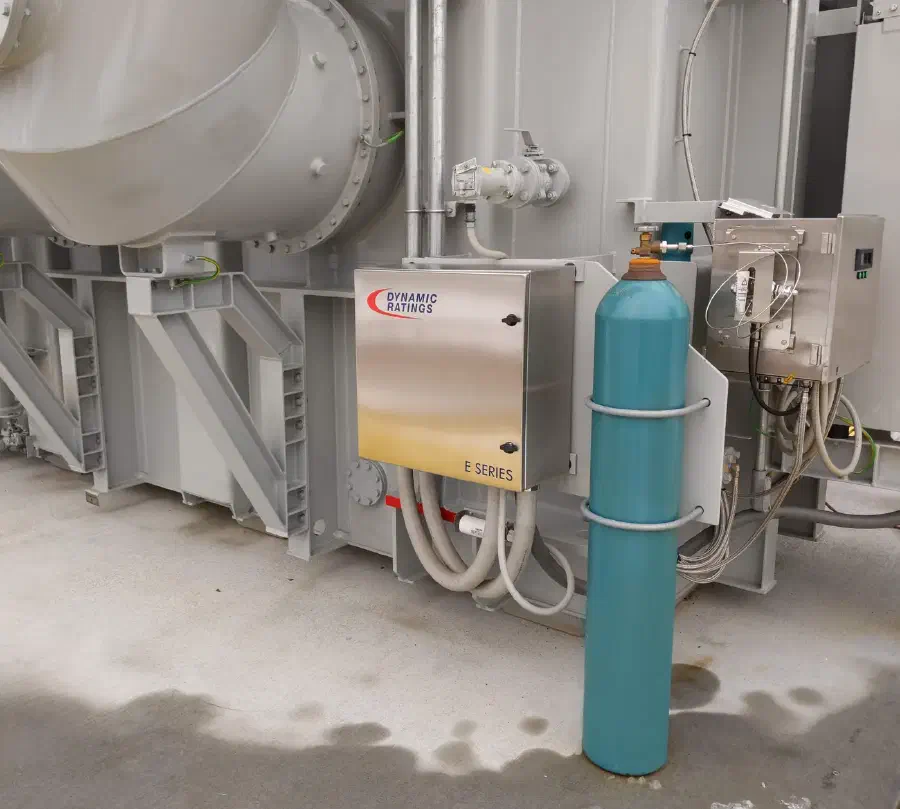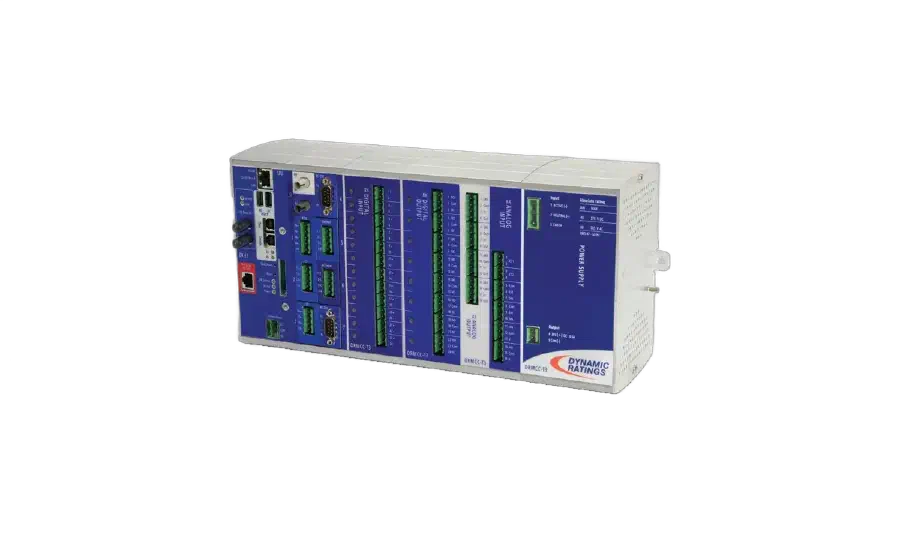
Monitoring a whole power transformer in one system — bushings, windings, on-load tap changer, cooling, oil and insulation — and knowing what load it can safely carry at any moment calls for a modular monitor with a thermal model and dynamic rating. The E3 combines the CPU and power supply with up to twelve input, output and communications modules on DIN rail, calculates the hot spot to IEC 60076-7 / IEEE C57 and, from it, the time remaining and the maximum safe load, controls cooling and voltage, and consolidates third-party DGAs and other IEDs into a single SCADA link over IEC 61850, DNP 3.0 or Modbus. It operates from -40°C to 80°C.
E3 key data
- Architecture: mandatory CPU and universal power supply plus up to 12 modules in any combination — 12 digital inputs, 8 form C outputs, 6 analogue inputs, analogue I/O, fibre optic and an eight-port multiport — on 35 mm DIN rail.
- Bushings and partial discharge: up to 12 test-tap sensors measure the capacitance and power factor of each bushing, with self-learning; the E3 partial discharge monitor acquires 15 simultaneous channels, with two alarm levels in mV or pC and up to 2 years of history.
- Winding temperature: 4 fibre optic probes per module and up to 3 modules (12 probes), from -30 to +200°C with an accuracy of ±2°C or 1% of full scale.
- Thermal model and loading: hot spot to IEC 60076-7 / IEEE C57 with losses per tap and cooling system health; dynamic rating with time remaining and maximum safe load, and "what if" load-for-time and time-for-load calculations.
- Cooling: predictive SMART cooling and control of more than 4 discrete stages, dual-speed fans, parallel pumps with equal-wear duty cycling and direct VSD drive.
- OLTC and voltage control: motor current and voltage, per-tap counter, contact wear, Delta T and hunting detection; primary or backup regulator with line drop compensation and paralleling by circulating current, master-follower, VAR sharing or reverse reactance.
- Faults and GIC: harmonics and fault counter card with total fault count, maximum and accumulated fault current, THD and the even/odd harmonic ratio; GIC sensors are installed without de-energising the transformer.
- Logging and communications: 1 GB flash card, by default one year at 1-minute intervals with up to 200 data points per minute (up to 5 years) and CSV export; IEC 61850, DNP 3.0, Modbus and TCP/IP over RS-232, RS-485, copper or fibre Ethernet and serial fibre.
Full service solution
- Monitors all key transformer components.
- Consolidates data and manages communication to third party IEDs and DGAs on the transformer.
- Provides a single point of communication for alarms.
- LIFESTREAM® support services verify that units are implemented properly and provide training and support throughout the life cycle of the asset management programme.
Monitoring capabilities
| Thermal | Top oil temperature, winding temperature, fibre optic, insulation ageing |
| Bushings | Change in power factor, change in capacitance, partial discharge |
| Power system | Harmonics, load profile, load power factor, voltage level |
| Transformer faults | Fault detection, fault counting, fault magnitude accumulation |
| Core, coil and DETC | DGA (key gas and multigas), moisture, partial discharge |
| OLTC | Time since last thru neutral, tap counter, contact wear, excessive tap operations, motor failure, contact overheating, slow tap change, breather |
| GIC | DC currents in the neutral and harmonics |
| Cooling system | Fan and pump current, loss of cooling power, contactor fail, breaker trip, cooler efficiency, run hours |
| Oil and preservation | Oil level with alarm, oil leak, conservator bladder rupture, breather, nitrogen pressure |
| Control system | Panel heater, loss of auxiliary power, circuit breaker trip, cabinet door left open, not in auto |
Improved reliability
With online condition-based data, users receive alarms when problems first arise, allowing action before they escalate. 50 % of bushing failures can end in a fire; offline testing is typically conducted every few years, whereas online monitoring is continuous and performed at normal operating temperature at the network voltage.
The on-load tap changer has the highest failure rate of all devices on the transformer. The E3 gives early indication of OLTC drive or motor problems by monitoring motor current and voltage and alarming on any unexpected deviation. An individual counter is maintained for each tap position, providing a summary of historic operation.
Reduced maintenance costs
Advanced analytics filter through the condition data to automatically identify issues requiring maintenance attention, letting operations and maintenance crews resolve problems rather than manually collect data. Alarms are routed to the right stakeholders through multiple SCADA connections and email notifications, and can be grouped into common, major and minor alarm groups.
E3 analytics include active moisture modelling, advanced thermal modelling — precise winding temperatures, insulation ageing, dynamic rating, "what if" rating calculations, predictive oil temperature model, cooling efficiency and cooling system health — and insulation health with fault counting.
Maximised life and loading
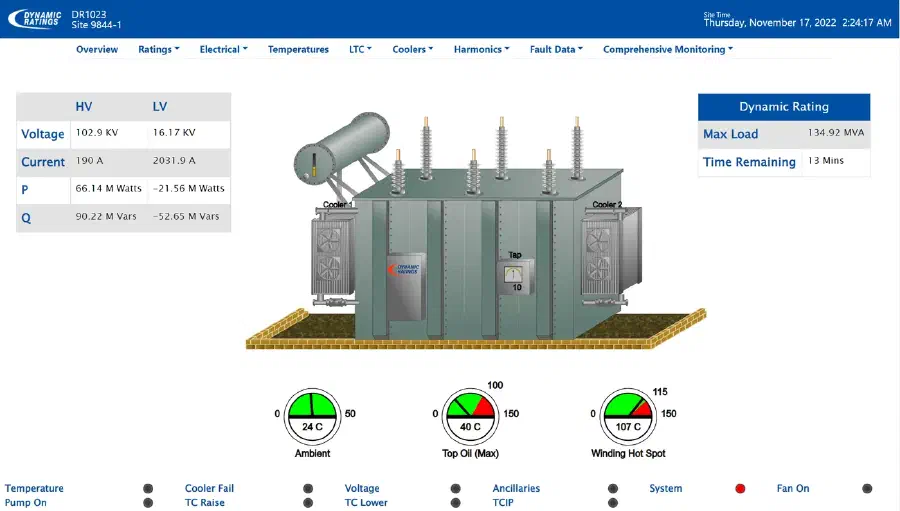
The dynamic rating provides the time remaining at the current state and the maximum safe load the transformer can carry given the present health of the cooling system and the environmental and operating conditions, without exceeding the thermal limit. Built on the predictive oil temperature model, the "what if" function answers two questions: how long the transformer can run at an assumed load before exceeding a limit, and what maximum load it can sustain over a given time.
Predictive SMART cooling turns the cooling system on earlier to reduce insulation loss of life and reserve overload capacity for later in the day. Cooling control supports discrete control of more than four stages, dual speed fans, parallel pumps with automatic duty cycling for equal wear, and direct drive of variable speed drive systems.
Safety
- Online monitoring through SCADA connectivity, increasing situational awareness for crews entering substations.
- Advanced analytics that ensure crews bring the right equipment and replacement parts: fewer trips to site means less exposure to hazards.
- User interfaces providing key safety warnings, diagnostic interpretations and trouble shooting tips.
Modules and architecture
In addition to the CPU and power supply, both mandatory in any configuration, the E3 supports up to twelve modules. The multiport module counts as one of the twelve regardless of how many cards are installed on it.
| CPU and power supply | Connection via USB, copper ethernet or fibre ethernet. Operation from 48 to 275 V DC and 60 to 275 VAC at 50 or 60 Hz |
| Digital input | 12 per module, isolated to 2.5 kV AC for 60 s and 5 kV impulse, with status LEDs |
| Digital output | 8 form C outputs per module, NO and NC, rated 6 A @ 250 VAC / 6 A @ 30 VDC |
| Analog input | 6 per module: 2 AC current, 2 PT100 RTD (3-wire) and 2 DC inputs configurable for 0-1 mA, 4-20 mA or 0-10 VDC |
| Analog input/output | The above plus 8 outputs of 4-20 mA, accuracy ±0.2 % of range |
| Fibre optic | Temperature probes for direct winding hot spot measurement |
| Multiport | OLTC motor current, dual CT+, dual PT100 RTD, AC+ input, RS-232, RS-485, serial fibre optic and DC analog |
Product specifications
| Mounting | 35 mm (1.37 in.) DIN rail |
| Connection type | Numbered terminal blocks (removable) |
| Operating temperature | -40 °C to 80 °C (-40 °F to 176 °F) |
| Humidity | Up to 95 % non-condensing |
| Power supply | DC input 48 to 275 V DC; AC input 60 to 265 V RMS, 47-63 Hz; 50 W |
| DC output | 24 VDC nominal unregulated (18-32 V DC), 0.5 A |
| Power input | 275 VDC / 265 VAC rms maximum, IEC 60664 over-voltage category II |
| Digital inputs | 125 VDC / 125 VAC rms maximum, IEC 60664 category I |
| Digital outputs | 125 VDC / 250 VAC rms maximum, IEC 60664 category I |
| Motor energy input | 300 VAC rms maximum, 47-63 Hz |
| VT inputs | 150 VAC rms maximum, 47-63 Hz |
| Module dimensions | 166.87 mm high; 50.80 mm (2") or 76.20 mm (3") wide; 105.66 mm deep |
| Digital output contacts | 6 A @ 250 VAC / 6 A @ 30 VDC; 0.4 A resistive / 0.15 A inductive @ 125 VDC |
| Fibre optic probes | 4 per module, up to 3 modules (12 probes); -30 to +200°C; ±2°C or 1% of full scale |
| Data logging | 1 GB flash; default 1 year at 1-minute intervals with up to 200 points (up to 5 years); CSV |
Frequently asked questions
How much load can the transformer carry, and for how long?
The E3 dynamic rating gives the time remaining at the current state before the thermal limit is exceeded and the maximum safe load for the present cooling system health and environmental and operating conditions. Using the predictive oil temperature model, the "what if" calculations show how long a given load can be carried and the maximum load the transformer can sustain for a given time.
How much data does the E3 store?
A 1 GB industrial flash card stores data at user-defined intervals: by default one year at 1-minute intervals with up to 200 data points per minute, and up to five years, in CSV format, together with a time-stamped alarm history. The clock is synchronised by NTP, DNP or Modbus.
Which transformer components does the E3 monitor?
Bushings, windings, on-load tap changer, cooling system, oil and preservation system, core and coil, control system, through faults and geomagnetic induced currents.
Does it integrate with third party equipment?
Yes. Its open architecture allows integration with a wide array of third party multigas DGAs and moisture monitors over a serial link, which preserves measurement precision and gives access to additional diagnostic information.
Can it replace the existing voltage regulator?
The E3 provides voltage control for the transformer and can be configured as primary control or as backup for an existing system, reducing the number of devices and potential failure points.
How is the data accessed?
Every unit includes a software system with its own web pages: dynamic rating, transformer overview, harmonics, total harmonic distortion, voltage control and temperatures, available remotely at any time.
What does DynamicMetrix® add?
It aggregates data from multiple monitors into a single web-based visualisation solution, designed to prioritise decisions across a large fleet of transformers from each asset's current and historical status.
The Dynamic Ratings E3 is manufactured by Dynamic Ratings and distributed by Amperis.