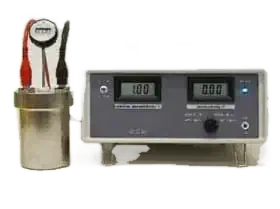
Assessing the quality of an insulating oil by its conductivity and dissipation factor (tanδ), even at room temperature, takes an IEC 61620 meter applying a low-amplitude, low-frequency alternating square wave, a method far more sensitive than the bridge method. The TAND220A excites the 210 ml sample with ±30 V at 0.5 Hz without DC component and measures conductivity from 0.01 to 20,000 pS/m with ±1 digit ±1 % of reading, relative permittivity up to 5.00 with ±1 digit ±0.2 % and tanδ values down to 10−6 (at 50 Hz), with a test voltage and current that pose no danger to the operator.
TAND220A Dielectric Oil Delta Tangent Meter
The measuring instrument type TAND220A complies with the international standard IEC 61620.
The instrument is based on the so-called "low-amplitude, low-frequency alternating current square wave method" and allows accurate measurements of conductivity and relative permittivity. Conductivity measurement in the range of 0.01 pS/m to 20,000 pS/m allows the use of this instrument for quality control of high resistivity liquids even at room temperature.
The TAND220A works with a low test voltage and also with a low test current so that it does not represent a danger for the operators.
Measurement method
The liquid in the test vessel is excited with a low amplitude (30 V), low frequency (0.5 Hz) and square alternating wave without a continuous component (see figure 1).
By measuring the current flowing through the liquid, the capacity C and conductance G can be determined and the values of relative permittivity εr and conductivity σ are provided according to the following equations
εr = C/Co
σ = εo.G/Co
The dissipation factor derived tanδ for a given frequency f can be determined by the following equation:
tanδ = G/C-2
For the determination of conductivity or tanδ, the alternating square wave method is far more sensitive than the bridge method. It allows the determination of conductivity down to values as low as 0.01 pS/m and values from tanδ as low as 10-6 (at 50 Hz). This high sensitivity allows conductivity and tanδ measurements at low temperatures and therefore the characterization of liquids at room temperature can be performed safely.
Test vessel
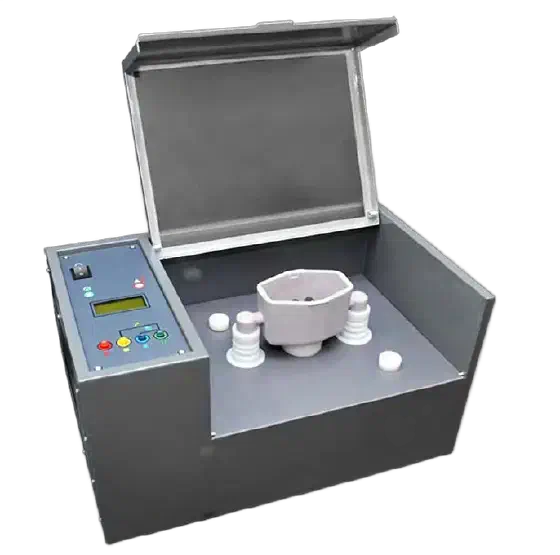
The application of the square-shaped excitation voltage with a low amplitude of only ±30 V allows the development of a test vessel with a simple, easy to use and clean design. The test vessel of the TAND220A consists of only two parts, a container and an active part. Two coaxial electrodes (stainless steel) are installed in one vessel (also stainless steel). This beaker also holds two BNC connectors attached to the two electrodes. The electrodes have a clean and polished surface. The vessel and the active part can be cleaned according to procedures described in appendix A. It is not possible or necessary to disassemble the active part for cleaning.
The required amount of liquid for the test is 210 ml. To reach this amount fill up to 23 mm from the end of the vessel with liquid.
The temperature of the liquid can be determined by inserting an electronic thermometer into the vessel through the hole in the lid.
Application
A typical application of TAND220A is the quality control of mineral oil used as a dielectric fluid in high-voltage switchgear such as power or measurement transformers, capacitors, terminals, etc.
Several studies have shown that the conductivity of the oil is influenced by impurities and ionic components, which were introduced into the oil or were produced in the oil. Therefore the conductivity of the oil characterizes well the quality of the oil. On the other hand it has been proven that moisture dissolved in oil does not significantly influence the conductivity. The following conductivity values at room temperature are typical depending on use:
- New oil (laboratory quality) ≤ 0.05 pS/m
- New oil (industrial quality) 0.05...0.1 pS/m
- Oil with little use in good condition 0.1...1.0 pS/m
- Oil with average use in acceptable condition 1.0...5.0 pS/m
- Heavily used oil in bad conditions > 5.0 pS/m
Specifications
Conductivity measurement range | 10-14 ... 2'10-8 S/m in four ranges |
Uncertainty of conductivity measurements | ±1 digit ±1% of reading |
Measurement range of relative permittivity | up to 5.00 |
Resolution of the permittivity measure | 0.001 for relative permittivity up to 1.999 |
Uncertainty of permittivity measures | ±1 digit ±0.2% of reading |
Frequency of voltage measurements | 0.5 Hz |
Voltage measurement range | ±30 V square wave without continuous component |
Analog outputs | 2 V from 0 to 100%. |
Weight | 2.6 kg |
Size(width ' depth ' height in mm) | 260 ´ 283 ´ 115 |
Food in the field | four AA batteries |
Food in the laboratory | 100 ... 240 Vac 50/60 Hz |
Operating temperature | 0¼35°C |
Vessel | |
Amount of liquid required | 210 ml |
No load capacity | ≈ 60 pF |
Derives from capacity with temperature | < 50 ppm/°C |
Distance between electrodes | 1.5 mm |
Temperature measurement | electronic thermometer |
Weight | 1.2 Kg |
Size (height ' diameter in mm) | 125 ´ 82 |
Table 1: Electronic measuring instrument | |
Optional equipment
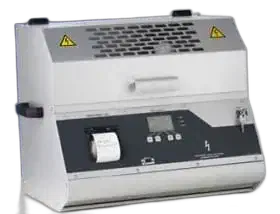
Z1 Vessel heater The instrument heats and maintains the temperature of the samples at a temperature of 90ºC ± 0.1°C to perform the measurement in accordance with the IEC standard. | Z2 Vessel for continuous measurement The vessel for continuous measurement from tanδ in an oil circuit like that of an oil treatment plant. The probe for continuous measurement will be installed at the outlet of an oil circuit after the pump. A certain amount of oil will pass through the continuous measurement probe of tanδ. |
TAND220A key data
- Measuring method: the TAND220A complies with IEC 61620 and excites the liquid with an alternating square wave of ±30 V and 0.5 Hz without DC component; from the current it obtains capacitance and conductance, and from these the relative permittivity, conductivity and tanδ.
- Conductivity: from 0.01 to 20,000 pS/m (10−14 to 2 × 10⁻⁸ S/m) in four ranges, with an uncertainty of ±1 digit ±1 % of reading.
- tanδ and permittivity: tanδ down to 10−6 (at 50 Hz); relative permittivity up to 5.00, with 0.001 resolution up to 1.999 and an uncertainty of ±1 digit ±0.2 % of reading.
- Oil diagnosis: typical conductivities at room temperature of ≤ 0.05 pS/m for new laboratory-grade oil, 0.05-0.1 pS/m for new industrial-grade oil, 0.1-1.0 pS/m with little use, 1.0-5.0 pS/m with average use and over 5.0 pS/m for heavily used oil; dissolved moisture has no significant influence.
- Test vessel: 210 ml of sample, two coaxial polished stainless-steel electrodes with a 1.5 mm gap, empty capacitance ≈ 60 pF, temperature drift below 50 ppm/°C and BNC connectors; 1.2 kg and 125 × 82 mm (height × diameter), with an electronic thermometer through the hole in the lid.
- Options: Z1, a heater that holds the sample at 90 °C ± 0.1 °C for measurement to the IEC standard, and Z2, a vessel for continuous tanδ measurement in an oil circuit, installed at the pump outlet, for example in a treatment plant.
- Instrument: 2.6 kg and 260 × 283 × 115 mm, powered by four AA batteries in the field or 100-240 V AC, 50/60 Hz, in the laboratory, 2 V analogue output for 0-100 % and operation from 0 to 35 °C.
Frequently asked questions
What conductivity shows that transformer oil is degraded?
As a reference at room temperature, new laboratory-grade oil stays at ≤ 0.05 pS/m, new industrial-grade oil at 0.05-0.1 pS/m, lightly used oil at 0.1-1.0 pS/m, oil with average use at 1.0-5.0 pS/m and heavily used oil in poor condition exceeds 5.0 pS/m. The TAND220A measures from 0.01 to 20,000 pS/m, so it covers the whole span with ±1 digit ±1 % of reading.
Can the TAND220A be used in the field or for continuous measurement?
Yes. The TAND220A weighs 2.6 kg and runs on four AA batteries in the field or on 100-240 V AC in the laboratory. With option Z2, a vessel installed at the pump outlet of an oil circuit such as a treatment plant, it measures tanδ continuously.