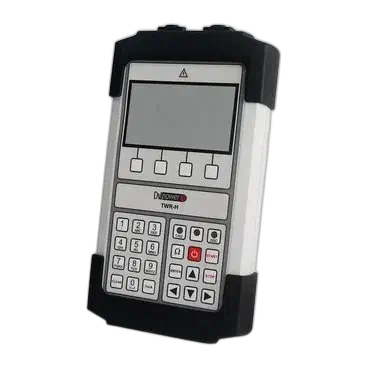
Testing distribution and instrument transformers in the field only needs a handheld tester that combines turns ratio, winding resistance and demagnetization, with enough accuracy against the ±0.5% tolerance of IEC 60076-1. TWR-H does it in 1.4 kg on battery power: turns ratio from 0.8 to 20 000 with ±0.1% typical accuracy at 40 V AC, excitation current and phase shift, winding resistance from 1 µΩ to 3 kΩ with two DC current sources (up to 2 A on the HV side and 10 A on the LV side) and automatic core demagnetization, all with the same cable set.
TWR-H key data
- Turns ratio: 0.8–20 000 range (at 40 and 10 V AC), 5-digit resolution; test voltages of 40, 10 and 1 V AC. Accuracy for ratios 0.8 to 999: ±0.1% typical and ±0.25% guaranteed at 40 V; ±0.2% typical and ±0.5% guaranteed at 10 and 1 V. From 1000 to 3999: ±0.15% typical at 40 V.
- Three-phase transformers: the ratio is measured phase by phase, sequentially; the deviation from the nameplate is calculated automatically.
- Excitation current and phase shift: excitation current up to 500 mA with ±(1% of reading + 0.5 mA) typical and ±(1% + 1 mA) guaranteed accuracy; phase shift with 0.01° resolution and ±0.06° typical, ±0.12° guaranteed accuracy.
- Winding resistance: 1 µΩ to 3 kΩ with one source of up to 2 A DC for the HV side and another of up to 10 A DC for the LV side; in the high range (1–3 kΩ), ±(0.5% of reading + 0.5% FS) typical and ±(1% + 1% FS) guaranteed.
- Demagnetization: automatic after the resistance test, on transformers, motors and generators.
- Current transformers: at 1 V AC it verifies ratio and polarity without saturating the core.
- Autonomy and protection: user-replaceable 14.8 V Li-Ion battery, up to 100 tests per charge, and mains operation as well; IP40, IP67 in the closed case; 170 × 310 × 58 mm and 1.4 kg.
- Data: 100 transformer records with up to 30 results each, transferred over Bluetooth to the PC software to create reports.
Advantages
Two DC current sources
One source of up to 2 A tests the high-voltage winding and another of up to 10 A the low-voltage one: each winding of a distribution transformer is measured with the right current, even simultaneously.
Ratio up to 20 000
The test voltage is chosen among 40, 10 and 1 V AC; at 1 V the ratio of current transformers is verified without saturating them, and the deviation from the nameplate is calculated automatically.
Automatic demagnetization
After the resistance test the device demagnetizes the core automatically and safely, leaving the transformer ready for service or for further diagnostic tests.
A full day on one charge
The user-replaceable Li-Ion battery lasts a complete day of testing, and the device also runs connected to the mains.
Applications
- Turns ratio of single-phase and three-phase distribution transformers.
- Ratio and polarity verification of instrument transformers.
- Winding resistance of transformers, motors and generators.
- Excitation current and phase angle.
- Demagnetization of transformers, motors and generators.
About the product
Winding resistance is measured from 1 µΩ to 3 kΩ with an accuracy of ±(0.5% of reading + 0.5% FS), and the ratio with accuracy from ±0.1%. The memory organizes 100 transformer records with up to 30 results each, and the PC software receives the results over Bluetooth to analyse them and create customized reports.
Accessories: H- and X-side cables with clamps, jumper cable, mains adapter, verification shunt and a transport case with IP67 protection.
Technical specifications
| Tests | Ratio, winding resistance and demagnetization |
| Turns ratio | 0.8 – 20 000 (at 40/10 V AC); accuracy from ±0.1% |
| DC sources | Up to 2 A (HV side) and up to 10 A (LV side) |
| Winding resistance | 1 µΩ – 3 kΩ; ±(0.5% rdg + 0.5% FS) |
| Battery | 14.8 V Li-Ion, replaceable; up to 100 tests |
| Memory and communication | 100 records; Bluetooth to PC |
| Protection | IP40; IP67 in the closed case |
| Dimensions and weight | 170 × 310 × 58 mm; 1.4 kg |
| Turns ratio accuracy | ±0.1% typical, ±0.25% guaranteed (40 V, ratio 0.8 - 999); ±0.2% typical, ±0.5% guaranteed (10 and 1 V) |
| Excitation and phase shift | Up to 500 mA, ±(1% rdg + 0.5 mA) typical; phase shift ±0.06° typical, ±0.12° guaranteed (0.01° resolution) |
| Resistance accuracy (1 - 3 kΩ) | ±(0.5% rdg + 0.5% FS) typical; ±(1% + 1% FS) guaranteed |
Frequently asked questions
Which portable instrument measures turns ratio and winding resistance on a distribution transformer?
A combined handheld tester such as TWR-H: at 1.4 kg and battery-powered, it measures turns ratio from 0.8 to 20 000 (±0.1% typical at 40 V AC), winding resistance from 1 µΩ to 3 kΩ with 2 A and 10 A DC sources for the HV and LV sides, and demagnetizes the core at the end, with the same cable set and up to 100 tests per charge.
Is the TWR-H turns ratio accuracy enough for IEC 60076-1?
Yes, when testing at 40 V AC. IEC 60076-1 allows a ±0.5% deviation from the nameplate, and TWR-H guarantees ±0.25% (±0.1% typical) at 40 V for ratios 0.8 to 999, twice as accurate as that tolerance. At 10 and 1 V the guaranteed accuracy is ±0.5%, so 40 V is the voltage to use when checking that tolerance; 1 V is intended for current transformers.
Why two current sources?
Distribution transformers have a high turns ratio and very different resistances on the HV and LV sides; with one source per side, both windings are tested with the correct current.
Does it work on current transformers?
Yes. The 1 V AC test voltage verifies the ratio and polarity of most current transformers without saturating the core.
When does the core need demagnetizing?
After any DC test, such as winding resistance: remanent magnetism distorts other tests and causes high inrush currents.
How are the results transferred to the computer?
Over Bluetooth, with the included PC software: stored records are analysed at the office and turned into customized reports.