In this article we talk about the earth resistance meter AMRU-30. This is a rugged, cost-effective and compact instrument with IP65 protection rating (dust-tight and protected against water jets from all directions). Access to all the functions is possible directly from the keypad. It should be noted that the AMRU-30 meter complies with the following standards:
- EN 61010-1 and EN 61557 (it has double insulation), with measurement category CAT III 300V according to the standard
- EN 61010-1 (measurement category CAT III 300V)
- EN 60529 (enclosure protection rating IP65)
Range of application
The range of application of the AMRU-30 is very wide. The 3-pole and 4-pole methods allow the instrument to be used by small companies that carry out measurements in buildings or houses, or in industrial installations.
An interesting function is the measurement of soil resistivity with the Wenner method, since this method defines at what depth the lowest soil resistivity occurs (very useful information, as it makes it possible to considerably reduce the cost of the materials used and to shorten the working time when building the earthing system). In order to define the required earth resistance value for the earthing system under test, it is essential to know the resistivity.
Measurement functions
The instrument has a large number of measurement functions: it allows you to use most of the known methods for measuring earth resistance. As we can see, the list of measurements that can be carried out with this instrument is extensive; here are the most notable measurement methods:
- the technical method (2p, 3p, 4p),
- the technical method using additional clamps (multiple earthing systems),
- the two-clamp method (multiple earthing system - without being connected to each other below ground).
- the two-clamp method makes it possible, in some situations, to carry out earth resistance measurements without the need to use auxiliary spikes driven into the ground.
Other measurements that the instrument can carry out:
- soil resistivity (Wenner method),
- continuity of protective and equipotential bonding connections with a current of 200 mA with automatic zeroing function (according to standard EN 61557-4),
- leakage currents using additional clamps (in the 3p method + clamps in the two-clamp method), and interference voltages.
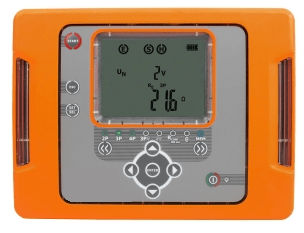
The meter also provides some very useful functions such as the measurement of the resistance of the auxiliary electrodes RS and RH, the measurement of interference voltages or the measurement in the presence of interference voltages in networks with a frequency of 50 Hz and 60 Hz.
It allows you to select the maximum measurement voltage (25 V and 50 V) and to enter the distance between the electrodes for resistivity. The instrument has a memory of 990 measurements (10 banks of 99 cells) and offers the possibility of calibrating the current clamps. Of course, data transmission to a computer (USB) is possible and the device indicates the battery charge level. Regarding the built-in battery, its efficiency is worth highlighting, since it is an innovative solution for this type of device and it can even be charged in the car if it runs flat, so that measurements can be completed in the field.
For more information about the instrument, please visit the following link: