According to the IEC60270 standard, partial discharges are dielectric discharges in a localized area of a dielectric insulation system. This electrical insulation system is under the stress of the voltage and the partial discharges deteriorate the insulation of a transformer and can cause its failure.
It is important to perform partial diagnostic discharge measurements to detect discharges that begin to follow in their early stages and locate their origin.
The partial discharge is accompanied by several phenomena, the detection method of the PD can use any of the following phenomena: through the light that it gives off, electromagnetic radiation (EMI), acoustic generation, dielectric, chemical reaction or electrical pulses.

Acoustic detection
The DP can be accompanied by sound generation. The acoustic wave is due to the expansion of gases near the discharge. This acoustic signal can be detected by piezoelectric transducers. The main frequency used for acoustic detection ranges from 20 kHz to 100 kHz.
The advantage of acoustic detection is immunity against electrical interference. The immunity against electrical interference does not mean that there is no acoustic noise in the environment, there may be acoustic noise, but it does not affect the measurement.
The main characteristics of this measurement method can be summarized as:
- It is a non-invasive measurement method.
- It can detect the tracking of the surface.
- It can detect loose components.
- Can detect electrical floating shields or other components.
- It can detect non-electrical problems, such as pressure leaks.
- It can detect partial discharges in several components.
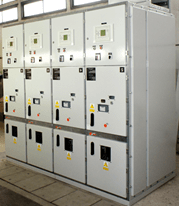
Electrical detection
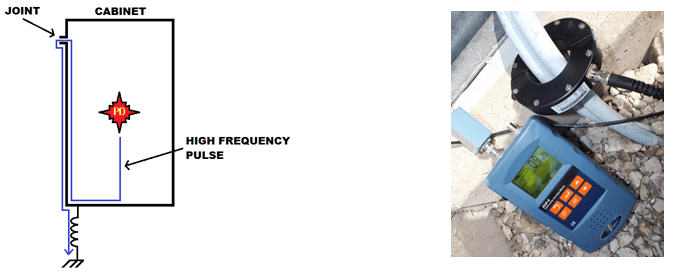
If a partial discharge occurs in the phase-to-ground isolation of an element of the high-voltage plant, such as a metal-clad cabinet, a small amount of electrical charge is transferred from the high-voltage conductor to the grounded metal cladding. .
Because this cabinet is grounded with a wire, it is possible to measure the current that passes through that wire with a high frequency current transformer (HFCT) which is an inductive coupling sensor.
Transient earth voltages (TEV) are voltage spikes induced on the surface of the surrounding metal work. The TEV occurs because the partial discharge creates current peaks in the conductor and a small amount of this energy is transferred to the metallic liner connected to the ground.
The TEV pulses are composed of high frequency components and for them, the metallurgy connected to earth presents a considerable impedance to ground. Therefore, voltage peaks are generated. These will remain on the inner surface of the surrounding metal structures at a depth of approximately 0.5 um in steel at 100 MHz. This high frequency current will rotate around the external surface because there is an electrical discontinuity in the metallic carpentry.
The TEV magnitude is a function of the magnitude of the discharge and attenuation of the propagation path. The attenuation of the propagation path is itself a function of the internal structure of the switching device.
Detection of the EMI method
The partial discharge will emit electromagnetic waves. EMI can be captured by antenna and converted, in function of its power, in dB.
Chemical detection
This method is used in transformers through the analysis of dissolved gases (DGA). The method is also applicable in the Isolated Gas Substation (GIS) where the analysis and detection of SF6 gas components can be used.
| Energy level | Phenomenon | Gas |
|---|---|---|
| High | Arcing | Acetylene — C2H2 |
| Medium | Heating | Ethylene — C2H4 |
| Ethane — C2H6 | ||
| Methane — CH4 | ||
| Low | Internal discharges | Hydrogen — H2 |
| Indication or fault | Characteristic gases |
|---|---|
| Cellulose aging | CO, CO2, H2O |
| Mineral oil decomposition | H2, CH4, C2H2, C2H4, C2H6 |
| Leaks in oil expansion systems, gaskets, welds, etc. | CO2, O2, H2O |
| Thermal faults — cellulose | H2, CO, CO2, CH4, O2 |
| Thermal faults in oil at 150 °C – 300 °C | H2, CH4, C2H6; C2H4 (trace) |
| Thermal faults in oil at 300 °C – 700 °C | H2, CH4, C2H4, C2H6; C2H2 (trace) |
| Thermal faults in oil at 700 °C | H2, CH4, C2H2, C2H4 |
| Partial discharge | H2, CH4; C2H2 (trace) |
| Arcing | H2, CH4, C2H2, C2H4 |
More information about our partial discharge detectors:
Related articles: