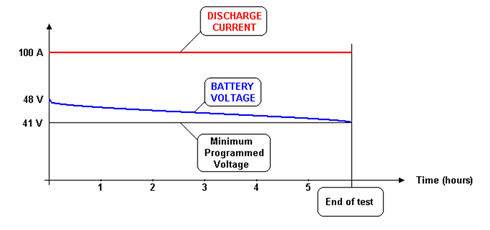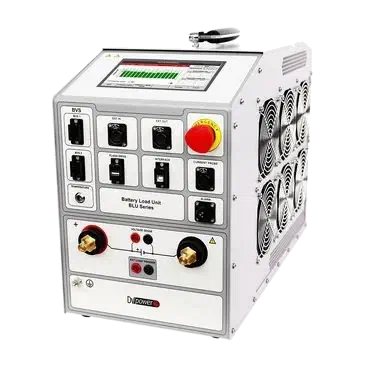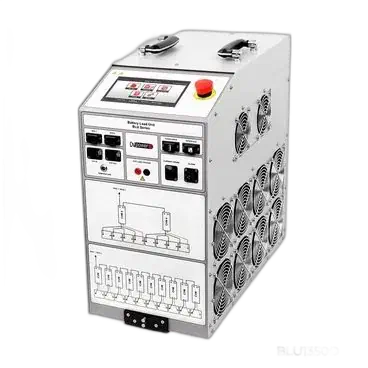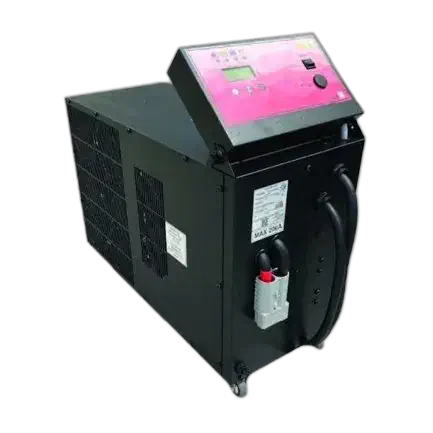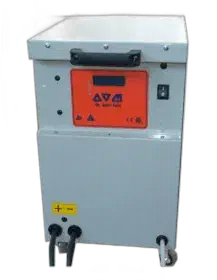
The Amperis Battery Discharger BDC checks the real capacity of any industrial battery by discharging it at constant current, records the whole curve and stops on its own when the programmed minimum voltage or time is reached.
Advantages
Constant current from an IGBT regulator
The high-frequency IGBT regulator holds the discharge current at the programmed value, adjustable from zero to the maximum of each model, while the battery voltage stays under control.
Any battery, from 48 to 600 V
The range covers seven models, from 48 V and 200 A to 600 V and 15 A, and works with lead-acid, Ni-Cd or lithium batteries without changing instrument.
It stops on its own and keeps the test
The discharge ends at the programmed minimum voltage or maximum duration; the built-in datalogger keeps the complete curve and the measured values stay on screen.
From test to report
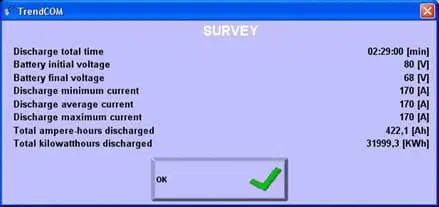
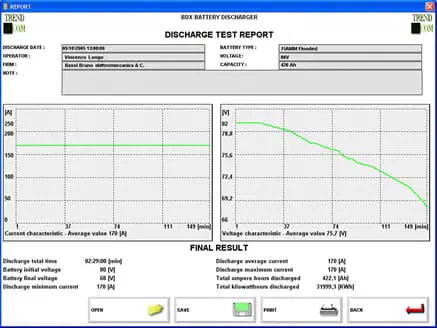
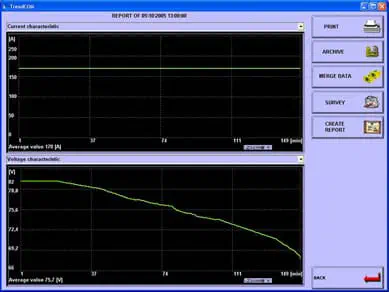
The PC interface (miniUSB) downloads the curve to the analysis software, which plots voltage, current, power, capacity and energy, produces reports with graphs and exports to spreadsheets.
No current ceiling
Units in parallel add up their discharge current and their files merge into a single report, so the test capability has no limit.
Applications
- Capacity testing of stationary battery banks in substations and power plants.
- Acceptance and periodic tests to IEEE 450, IEEE 1188 and IEC 60896.
- Battery recovery and characterisation in the workshop.
- Quality control in battery manufacturing.
About the product
The unit comes in a B1 cabinet of 326 × 765 × 483 mm on heavy-duty castors, with a double enclosure for thermal insulation and air cooling. Electronic protection covers soft start, reverse polarity and over-temperature, and the digital display shows battery voltage and current, elapsed time, discharged capacity and the programmed values.
It runs from a single-phase supply of 120 or 230 V AC ±10 %, with IP21 protection as standard and IP54 on request. It carries CE marking and complies with the electromagnetic compatibility standards IEC EN 61000-6-2 and 61000-6-4 and the safety standards IEC EN 50178 and IEC EN 62040-1, under an ISO 9001:2008 quality system.
Model range
| Model | Battery voltage (V) | Discharge current (A) |
|---|---|---|
| BDC-048-200 | 48 | 200 |
| BDC-096-200 | 96 | 200 |
| BDC-135-150 | 135 | 150 |
| BDC-240-075 | 240 | 75 |
| BDC-400-040 | 400 | 40 |
| BDC-500-025 | 500 | 25 |
| BDC-600-015 | 600 | 15 |
Technical specifications
| Discharge principle | High-frequency IGBT regulator, constant current adjustable from zero to the model maximum |
| Battery types | All: lead-acid, Ni-Cd and lithium |
| Battery voltage | 48 to 600 V depending on model |
| Discharge current | Up to 200 A depending on model; unlimited by paralleling units |
| Automatic stop | On programmed minimum voltage or maximum test time |
| Data | Built-in datalogger, PC interface (miniUSB) and analysis software with automatic reports |
| Protections | Soft start, reverse polarity and over-temperature |
| Supply | Single phase 120 or 230 V AC ±10 % |
| Protection degree | IP21 standard; IP54 optional |
| Operating conditions | −10 °C to +45 °C; humidity < 75 %; altitude > 2000 m to EN 62040-3 |
| Dimensions (B1 cabinet) | 326 × 765 × 483 mm, on castors |
Frequently asked questions
Which batteries can it test?
Any industrial lead-acid, Ni-Cd or lithium battery, with nominal voltages from 48 to 600 V depending on the model.
How is the real capacity obtained?
The unit discharges at constant current and counts the ampere-hours delivered down to the programmed end voltage: that figure is the battery's real capacity.
Can the maximum current of a model be exceeded?
Yes. Units working in parallel add up their current and their records combine into a single report.
Is a PC needed during the test?
No. The built-in datalogger keeps the complete curve and the data is downloaded afterwards through the miniUSB interface.