Battery dischargers for capacity testing
Showing 6 of 6
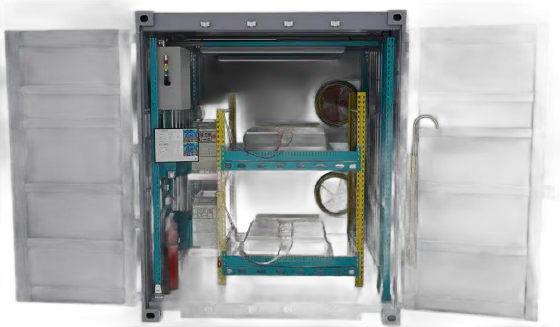
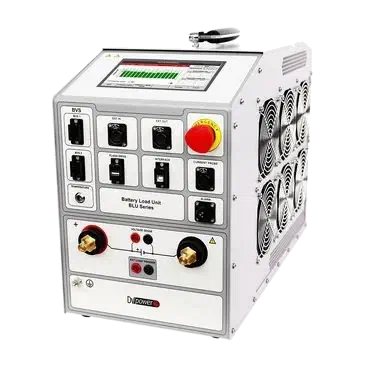
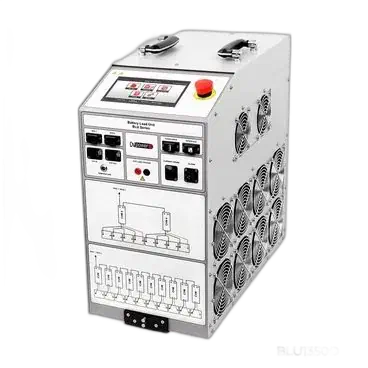
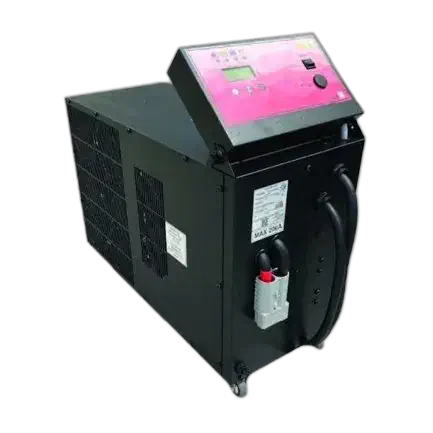
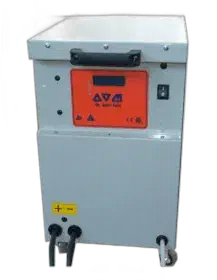
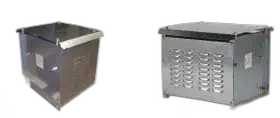
Battery dischargers apply a controlled constant-current discharge to measure the real capacity of a stationary bank. It is the only test that proves how many minutes the battery will support a mains outage: float voltage and internal impedance are useful indicators, but they do not replace the capacity test.
What do they measure and how?
The unit switches in a regulated resistor bank and holds the discharge current constant while logging string voltage, cell voltages and elapsed time. The test ends at the specified end voltage (typically 1.75 V per lead-acid cell). Capacity is calculated against the rated regime (C5, C8 or C10) and judged against the IEEE 450 replacement criterion: replace below 80 %.
How to choose the right unit
- Discharge current and voltage: cover your banks’ test regimes (24–250 V DC are common).
- Portability: the BLU portable dischargers suit multi-site campaigns; AC resistance banks and containerised systems handle high power.
- Full cycles: the XD battery cycler automates discharge and recharge; the BLUD combines both duties.
- Per-cell logging: essential for finding the weak cells in a string.
Describe your bank at info@amperis.com and we will point you to the model.
Applications
- Acceptance and periodic tests of substation battery banks.
- Autonomy verification in power plants, telecom sites and data centres.
- Requalifying batteries after long storage.
Applicable standards
- IEEE 450: vented lead-acid batteries.
- IEEE 1188: VRLA batteries.
- IEEE 1106: nickel-cadmium batteries.
Frequently asked questions
How often should a capacity test be run?
IEEE 450 recommends an acceptance test, another within the first two years, then periodic intervals that shorten — down to yearly — once capacity approaches 85–80 %.
Does discharging harm the battery?
A controlled discharge to the standard end voltage is part of the bank’s design life. The real risk is the opposite: finding out during an outage that the bank had no capacity left.
Can I test without losing backup?
Yes: test redundant strings one at a time, use a temporary bank, or use equipment that can reconnect the battery instantly if an alarm occurs mid-test.
Resources and contact
Pair with battery testers for quarterly impedance checks. Quotations: info@amperis.com · +34 982 20 99 20.
Related calculator
- Sizing, autonomy and capacity test IEEE 485-2020 · IEEE 450-2020 · IEC 60896-21:2004 · IEC 61056-1:2012
- Battery life forecast: state of health (SOH) and remaining life calculator IEEE 450-2020 · IEEE 1188-2005 · IEEE 2962-2025 · IEC 60896
Battery charger and discharger selector Enter your battery's chemistry, voltage and capacity and get the charger, discharger or regeneration set that covers your specification. You can send us the selection with the technical report attached. Open the selector and find my equipment Close the selector
Undecided between several models? Compare them side by side: Battery discharge testers compared · Battery chargers and rectifiers compared · Battery testers compared