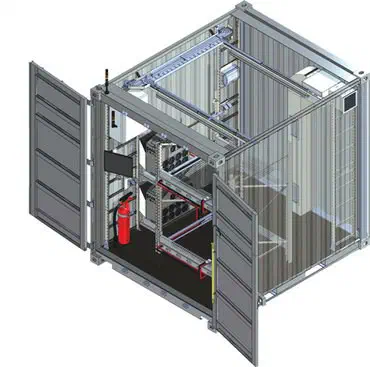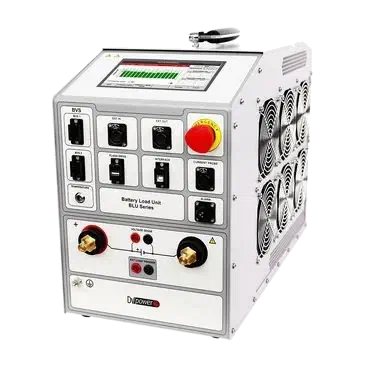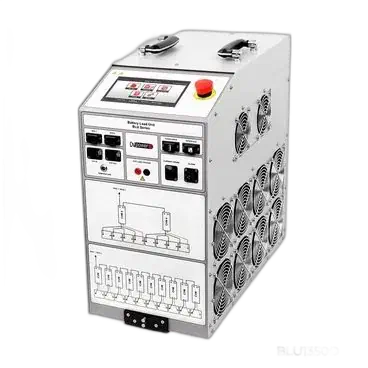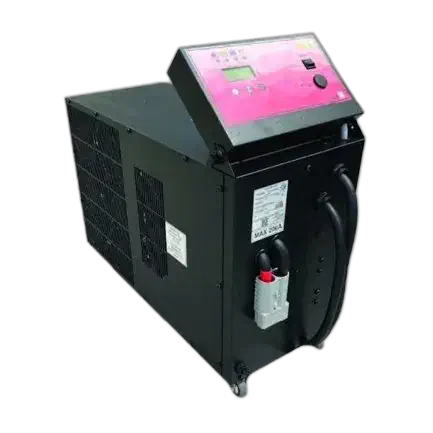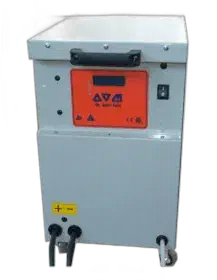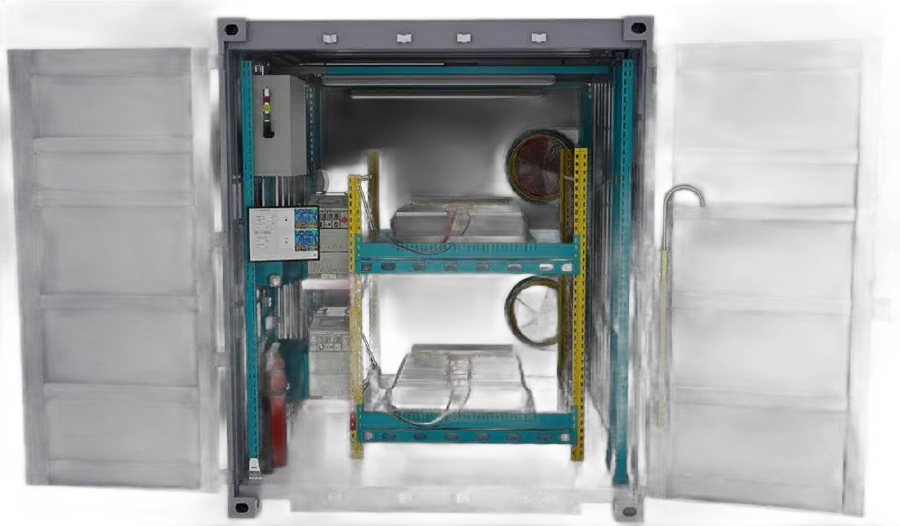
The BDCS gathers in a 10-foot shipping container everything needed to extract the residual energy from battery packs: two BLU700C discharge units, a central PLC control, thermal monitoring with automatic shutdown and forced ventilation.
Advantages
Discharging happens outside the workshop
Housed in a closed container, the process runs outdoors, away from the working areas, and the whole system can be moved or relocated like any standard container.
Two battery packs at a time
The two-level rack, with 1325 × 1100 mm shelves and a 1000 kg loading capacity, holds two packs that are discharged simultaneously by two BLU700C units delivering up to 260 A and 42.0 kW each.
Thermal monitoring with automatic stop
Two built-in thermal cameras follow the process; if the temperature exceeds the value set by the operator, the discharge stops on its own and the alarm towers give visual and audible warnings.
Safety coordinated by a PLC
The central control gathers the inputs from the cameras, the gas detection sensor and the emergency stop button, and reacts by halting the process whenever necessary.
Operation from a single screen
An industrial computer with a 15-inch display concentrates the setup of the discharge parameters and the live feed from the two thermal cameras.
Applications
- Discharging battery packs before recycling, extracting the residual energy in a controlled way.
- End-of-life management of electric vehicle and stationary battery packs.
- Recycling plants and waste managers that need a documented, safe and repeatable process.
- Preparing batteries for transport or storage with reduced energy levels.
About the product
The container measures 2991 × 2438 × 2591 mm and weighs about 900 kg. The discharge units measure voltage from 0 to 705 V DC and current from 0 to 300 A DC with an accuracy of ±0.5% of reading, and the peak power demand of the system is around 3500 W. The set operates from -20 to +40 °C with humidity up to 95%, non-condensing, while the integrated ventilation dissipates the heat generated during discharge.
The main design can be adapted to each customer's needs, both in the number of units and in their power. Available accessories: additional BLU-C series discharge units, zero-voltage discharge modules and connection cables.
Technical specifications
| Container | 10-foot; 2991 × 2438 × 2591 mm |
| Total weight | About 900 kg |
| Discharge units | 2 × BLU700C, governed by the central control |
| Maximum current and power | 260 A and 42.0 kW per unit |
| Voltage measurement | 0 to 705 V DC; ±0.5% of reading ±0.1 V |
| Current measurement | 0 to 300 A DC; ±0.5% of reading ±0.2 A |
| Battery rack | 2 levels; 1325 × 1100 mm shelves; 1000 kg |
| Operating temperature | -20 to +40 °C; humidity up to 95% |
Frequently asked questions
Why must batteries be discharged before recycling?
Because packs keep residual energy that can cause fires or arcing during dismantling; extracting it in a controlled way makes the later stages safe.
Can it work outdoors?
Yes. The system is designed to operate outside within its 10-foot container, from -20 to +40 °C.
How is the pack temperature supervised?
Two thermal cameras watch the discharge; once the configured temperature value is exceeded, the process stops automatically.
What happens if gas is released inside the container?
The gas detection sensor informs the PLC, which triggers the visual and audible alarms and halts the discharge.
Can the configuration be adapted?
Yes. The main design, with two BLU700C units, can be adjusted in the number and power of the units according to the customer's needs.