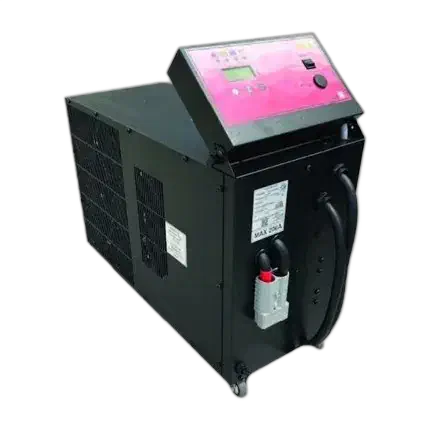
Programmable battery discharger and analyzer for capacity testing, up to 20 kW and 200 A
Measuring the real capacity of an industrial lead-acid, lithium or sodium-ion battery means discharging it at constant current down to the cut-off voltage and recording the ampere-hours it actually delivers. The XD does this with an active electronic load that keeps the current constant from the first to the last second, whatever the battery voltage, up to 200 A and 20 kW on 12 to 135 V DC batteries (up to 180 V DC with the XD100/12); it records the discharge curve, stops on its own at the programmed cut-off voltage, saves every test in its datalogger and, paired with the XMV charger, works as an automatic cycler.
XD Series key data
- Models: XD200/12.US, for an 85 to 135 V AC single-phase supply, and XD200/12.EU, for 230 V AC, both with 200 A on 12 to 135 V DC batteries; XD100/12, for 230 V AC, with 100 A on 12 to 180 V DC batteries. All three XD models discharge up to 20 kW.
- Test principle: active electronic load with constant discharge current regardless of battery voltage; DC output voltage range 10 to 140 V DC (10 to 200 V DC on the XD100/12).
- Chemistries: lead-acid (vented, gel, AGM, TPPL), lithium (LFP, NMC, LTO), sodium-ion and supercapacitors through a single interface.
- Results: the XD records the discharge curve, calculates the ampere-hours actually delivered and saves every test in the integrated datalogger, exported by USB to generate professional reports and certificates.
- Test safety: automatic stop at the programmed cut-off voltage, constant thermal monitoring of the battery and protection against over-temperature and reverse polarity.
- Flexibility: customised profiles that simulate real duty cycles, several XD units in parallel for high-capacity batteries and the XD-Combo version, which cycles charge and discharge with the XMV charger for research, validation and regeneration.
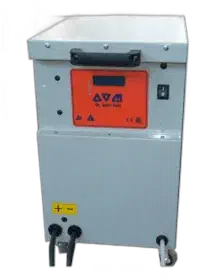
- Installation: portable unit in a 335 × 690 × 530 mm TD cabinet (756 mm with the keyboard raised), adjustable control panel, forced cooling and 800 W AC input power.
- Standards: XD200/12.US to UL 1564 (4th edition, 2015) and CSA C22.2 No. 107.2-01; XD200/12.EU and XD100/12 to IEC 60335-1:2010, EN IEC 61000-6-2:2019, EN 61000-6-4 and RoHS 2011/65/EU.
Advantages
Objective data on every battery
The active electronic load keeps the discharge current constant from the first to the last second, regardless of battery voltage, for capacity tests on batteries of 12-96 V DC (24-220 V DC in the MV version).
From test to certificate
During the test the system records the discharge curve and calculates the ampere-hours actually delivered; every test is saved in the integrated datalogger and exported by USB to generate professional reports.
Universal compatibility
It operates on lead-acid (vented, gel, AGM, TPPL), lithium (LFP, NMC, LTO), sodium-ion and supercapacitors through a single interface.
Safe and automatic
The test stops automatically at the programmed cut-off voltage, with constant thermal monitoring and protection against overheating and reverse polarity.
Scales with the job
Several XD units connect in parallel to test very high-capacity batteries, and customised profiles simulate real duty cycles.
Applications
- Capacity tests compliant with international standards.
- Data-driven predictive maintenance of battery fleets.
- Multi-brand service centres and test laboratories.
- Charge-discharge cycling paired with an XMV charger (XD-Combo version).
About the product
The XD runs on single-phase 230 V or 85-135 V AC, features forced cooling and an adjustable control panel with fast programming; paired with the XMV charger, the XD-Combo version works as an automatic battery cycler for research, validation and regeneration, and a PC software application completes the system for advanced data analysis.
Technical specifications
| Model | XD200/12.US | XD200/12.EU | XD100/12 |
|---|---|---|---|
| Maximum DC power | 20 kW | 20 kW | 20 kW |
| Nominal battery voltage | 12-135 V DC | 12-135 V DC | 12-180 V DC |
| DC output voltage range | 10-140 V DC | 10-140 V DC | 10-200 V DC |
| Max DC current | 200 A | 200 A | 100 A |
| AC input voltage | 1×85-135 V AC | 1×230 V AC | 1×230 V AC |
| Cabinet type | TD | TD | TD |
| DC connectors | Battery port, charger port | Battery port, charger port | Battery port, charger port |
| AC input power | 800 W | 800 W | 800 W |
| Safety standards | UL 1564 4th ed. 2015; CSA C22.2 No. 107.2-01 R2016 | IEC 60335-1:2010; EN IEC 61000-6-2:2019; EN 61000-6-4:2007/A1:2011; RoHS 2011/65/EU | IEC 60335-1:2010; EN IEC 61000-6-2:2019; EN 61000-6-4:2007/A1:2011; RoHS 2011/65/EU |
Dimensions
| Width | 335 mm |
| Depth | 690 mm |
| Height | 530 (756 with raised keyboard) mm |
Frequently asked questions
Which XD model do I need?
It depends on the supply and the battery. The XD200/12.US runs from 85 to 135 V AC and the XD200/12.EU from 230 V AC; both discharge up to 200 A on 12 to 135 V DC batteries. The XD100/12, also on 230 V AC, reaches 180 V DC batteries at 100 A. All three deliver 20 kW of discharge power.
Can the XD reproduce the real load of an application?
Yes. Besides constant-current discharge, the XD accepts customised profiles that simulate real duty cycles; in every case it records the curve, calculates the ampere-hours delivered and stops at the programmed cut-off voltage.
What does it measure?
The real capacity in ampere-hours delivered during a constant-current discharge, together with the voltage-versus-time discharge curve.
Which chemistries does it support?
Lead-acid (VLA, gel, AGM, TPPL), lithium (LFP, NMC, LTO), sodium-ion and supercapacitors.
How are results documented?
Every test is stored in the integrated datalogger and exported by USB to generate professional test certificates.
Can it test very large batteries?
Yes. Several XD units connect in parallel to reach the required discharge capacity.
Can it also charge?
Paired with an XMV charger, the XD-Combo version works as an automatic charge-discharge cycler.