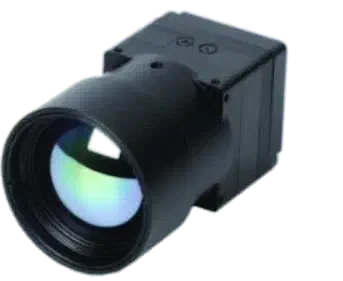
Mini infrared module for OEM integration, 640 × 512
Adding thermal imaging to a drone or an embedded device calls for an OEM thermal core rather than a complete camera: a small, low-power module with simple interfaces that the integrator builds into their own design. The IR-SF641 provides an uncooled 640 × 512 VOx detector with 12 µm pitch and NETD ≤ 30 mK at 50 Hz over 8-14 µm, in 26 × 26 mm and 22 g without lens, with PAL or NTSC video output, UART control at TTL 3.3 V and a single 5 V DC supply.
The SF series brings together three thermal cores with the same uncooled VOx detector of 640 × 512 and 12 µm pixel pitch: the SF641, with analogue and 16-bit digital video and lenses up to 75 mm; the SF643, with LVCMOS and MIPI CSI-2 outputs at 1 W; and the SF740, at 120 Hz for fast-moving scenes. All three run from a single 5 V DC supply.
IR-SF641 key data
- Detector: uncooled 640 × 512 VOx, 12 µm pixel pitch, 8-14 µm band, NETD ≤ 30 mK and 50 Hz.
- Lenses: athermalised fixed focal length of 9, 13, 25, 35, 50 or 75 mm on the IR-SF641 and 9, 13 or 25 mm on the IR-SF641R; they hold focus regardless of ambient temperature.
- Interfaces: 1 analogue PAL or NTSC video channel, UART control (TTL 3.3 V) and reserved user I/O on a 16-bit connector.
- Image processing: DDE digital detail enhancement, polarity switch, noise reduction and 1.0-8.0× digital zoom.
- Calibration and adjustment: automatic calibration at power-on and manual on demand; manual brightness and gain, auto brightness with manual gain, or full auto.
- Size and power: 26 × 26 mm and 22 g without lens, from a single 5 V DC supply.
- Applications: drones and airborne platforms, industrial temperature measurement systems, security control and outdoor sighting.
SF643 key data
- Thermal sensitivity (NETD): ≤ 40 mK.
- Frame rate: 50 Hz.
- Lenses (athermalised, focus-free): 9, 13, 25 or 35 mm (50 and 70 mm on request).
- Polarity, palettes, flip: polarity switch.
- Non-uniformity correction: manual, plus automatic at power-on.
- Analogue video: 1 channel, PAL or NTSC.
- Digital video: LVCMOS (TTL 1.8 V, BT656), 16-bit YUV or 14-bit RAW; MIPI CSI-2, 16-bit YUV or 14-bit RAW.
- USB: USB Type-C with expansion board.
- Power supply: 5 V DC.
- Power consumption: 1 W (without expansion board).
- Operating temperature: -20 °C to +60 °C (-40 °C on request).
- Size (without lens): 26 × 26 mm.
- Weight (without lens): 22 g.
SF740 key data
- Frame rate: 120 Hz.
- Lenses (athermalised, focus-free): 9.1, 13, 25 or 35 mm.
- Polarity, palettes, flip: colour reversal; 14 palettes; vertical, horizontal and mirror flip.
- Non-uniformity correction: manual, automatic at power-on and scheduled during operation (interval settable).
- Digital video: LVCMOS, 16-bit YUV or 14-bit RAW; MIPI, 16-bit YUV or 14-bit RAW.
- USB: USB 3.x Type-C with expansion board.
- Connector and mounting: board-to-board connector (DF40C-70DP-0.4V); 8 × M1.6 threaded holes on 4 sides.
- Power supply: 5 V DC (4-5 V; 4-6 V with USB expansion board).
- Power consumption: 1.4 W (without expansion board).
- Operating temperature: -40 °C to +60 °C.
- Size (without lens): 32 × 32 mm; depth 34.6 / 37.1 / 48.8 / 60.8 mm with 9.1 / 13 / 25 / 35 mm lens.
- Weight (without lens): 30 g (also without lens mount).
Advantages
A thermal core, not a camera
Designed for integration: analogue PAL/NTSC video output, UART control (TTL 3.3 V), reserved user I/O and 5 V DC supply for platforms with tight volume and power budgets.
Detail where it matters
The 12 µm pixel-pitch detector delivers ≤ 30 mK sensitivity at 50 Hz over the 8-14 µm band, with DDE digital detail enhancement and noise reduction.
Optics that ignore temperature
Athermalised fixed lenses from 9 to 75 mm hold focus in high- and low-temperature environments; the IR-SF641R variant offers the compact 9-25 mm set.
Self-managed image
Automatic calibration at power-on, manual calibration on demand, polarity switch, 1-8× digital zoom and automatic or manual brightness and gain.
Applications
- Drones and airborne platforms.
- Industrial temperature measurement systems.
- Security control and outdoor sighting.
- High-volume applications with strict power requirements.
About the product
The IR-SF641 and IR-SF641R share detector, processing and interfaces; they differ in the available lens sets. As an integration module, the electrical interface concentrates power, analogue video and user I/O on a 16-bit connector.
All three modules offer DDE digital detail enhancement, polarity switch, 1-8× digital zoom, automatic calibration at power-on and UART control at TTL 3.3 V with reserved user I/O. The SF641 reaches ≤ 30 mK and operates from -40 °C to +70 °C; its SF641R variant keeps the compact 9, 13 and 25 mm lens set and works from -20 °C to +60 °C. The SF643 (≤ 40 mK) and the SF740 accept a USB expansion board that speeds up evaluation and development on a PC.
Technical specifications
| SF641 | SF643 | SF740 | |
|---|---|---|---|
| Detector | Uncooled VOx microbolometer, 640 × 512, 12 µm pixel pitch | ||
| Spectral range | 8-14 µm | ||
| Thermal sensitivity (NETD) | ≤ 30 mK | ≤ 40 mK | — |
| Frame rate | 50 Hz | 50 Hz | 120 Hz |
| Lenses (athermalised, focus-free) | 9, 13, 25, 35, 50 or 75 mm (SF641R: 9, 13 or 25 mm) | 9, 13, 25 or 35 mm (50 and 70 mm on request) | 9.1, 13, 25 or 35 mm |
| Detail enhancement | Digital detail enhancement (DDE) | ||
| Brightness, gain and contrast | Manual; auto brightness with manual gain; fully automatic | Manual; auto brightness with manual gain; fully automatic | Brightness and contrast, manual or automatic |
| Polarity, palettes, flip | Polarity switch | Polarity switch | Colour reversal; 14 palettes; vertical, horizontal and mirror flip |
| Digital zoom | 1-8× | 1-8× | 1-8×, continuous |
| Non-uniformity correction | Manual, plus automatic at power-on | Manual, plus automatic at power-on | Manual, automatic at power-on and scheduled during operation (interval settable) |
| Noise reduction | Yes | Yes | — |
| Analogue video | 1 channel, PAL or NTSC | 1 channel, PAL or NTSC | — |
| Digital video | 16-bit digital video | LVCMOS (TTL 1.8 V, BT656), 16-bit YUV or 14-bit RAW; MIPI CSI-2, 16-bit YUV or 14-bit RAW | LVCMOS, 16-bit YUV or 14-bit RAW; MIPI, 16-bit YUV or 14-bit RAW |
| USB | — | USB Type-C with expansion board | USB 3.x Type-C with expansion board |
| Control | UART (TTL 3.3 V) | ||
| User I/O | Reserved | Reserved | Reserved, configurable to the application |
| Connector and mounting | Single interface: power, analogue video, 16-bit digital video and user I/O | — | Board-to-board connector (DF40C-70DP-0.4V); 8 × M1.6 threaded holes on 4 sides |
| Power supply | 5 V DC | 5 V DC | 5 V DC (4-5 V; 4-6 V with USB expansion board) |
| Power consumption | — | 1 W (without expansion board) | 1.4 W (without expansion board) |
| Operating temperature | -40 °C to +70 °C (SF641R: -20 °C to +60 °C) | -20 °C to +60 °C (-40 °C on request) | -40 °C to +60 °C |
| Storage temperature | -45 °C to +75 °C | -45 °C to +70 °C | -45 °C to +70 °C |
| Size (without lens) | 26 × 26 mm | 26 × 26 mm | 32 × 32 mm; depth 34.6 / 37.1 / 48.8 / 60.8 mm with 9.1 / 13 / 25 / 35 mm lens |
| Weight (without lens) | 22 g | 22 g | 30 g (also without lens mount) |
| Shock and vibration | — | — | GB/T 2423.5-2019 and GB/T 2423.10-2019 |
— Not specified for this model. Specifications subject to change without notice.
Frequently asked questions
Which module should I choose?
The SF641 for analogue video and long focal lengths up to 75 mm; the SF643 for a direct digital connection to a processor through LVCMOS or MIPI CSI-2 at 1 W; and the SF740 when the scene moves fast and 120 Hz is needed.
Which 640 × 512 thermal module is best for integrating into a drone?
A small, light one with a low-voltage supply. The IR-SF641 measures 26 × 26 mm and weighs 22 g without lens, runs from 5 V DC and delivers PAL or NTSC video from a 640 × 512 VOx detector with NETD ≤ 30 mK at 50 Hz.
Which focal length should I choose for the IR-SF641?
It depends on the field and the viewing distance: the IR-SF641 takes athermalised fixed lenses of 9, 13, 25, 35, 50 or 75 mm, and the IR-SF641R 9, 13 or 25 mm. Short focal lengths cover a wider field, long ones bring distant targets closer.
What is the difference between the IR-SF641 and the 641R?
The lens set: 9 to 75 mm in the IR-SF641 and the compact 9, 13 and 25 mm set in the IR-SF641R; detector and interfaces are shared.
How does it integrate into a system?
Via one PAL or NTSC analogue video channel and a UART control line at TTL 3.3 V, with reserved user I/O and a single 5 V DC supply.
Does it need refocusing with temperature changes?
No. The athermalised fixed lenses keep focus in high- and low-temperature environments.
How is the image calibrated?
Automatically at power-on and manually on demand, with automatic or manual brightness and gain control.
Is it a complete camera?
No. It is an OEM thermal core: it provides the detector, the processing and the interfaces, and the integrator adds the housing, the power supply and the application electronics. That is why it fits drones, embedded systems and industrial equipment with very tight volume and power budgets.