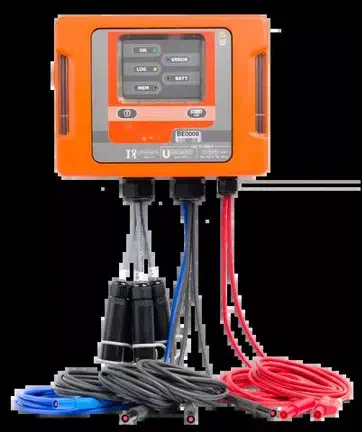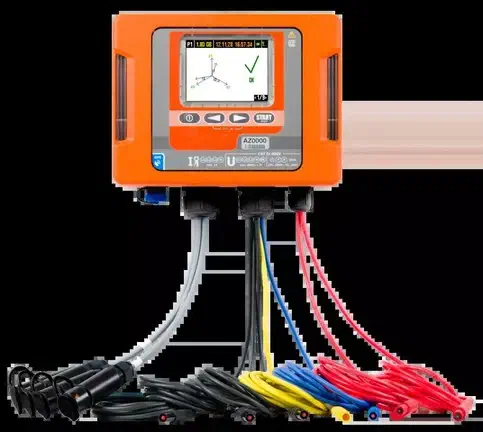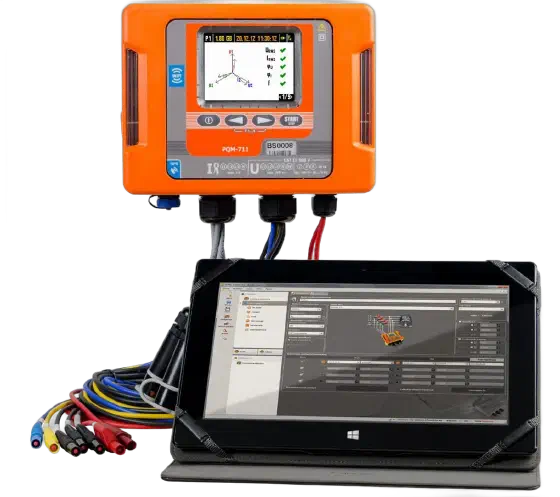
Documenting supply quality with evidential value while also capturing switching and lightning surges calls for a class A analyser to IEC 61000-4-30 with a transient recorder and a GPS-synchronised clock. The APQM-711 measures in class A, to ±0.1% of Unom and ±0.01 Hz, with class F1 flicker per IEC 61000-4-15 and harmonics and interharmonics to the 50th order; its transient recorder samples phenomena up to ±8000 V at 10 MHz, and the whole instrument is operated remotely over Wi-Fi or the built-in GSM 4G LTE modem.
APQM-711 key data
- Class and standards: class A per IEC 61000-4-30 (Ed. 3, 2015) and PQI-A-PO classification per IEC 62586-1/-2; harmonics and interharmonics per IEC 61000-4-7 class I; class F1 flicker per IEC 61000-4-15; reports to EN 50160.
- Voltage and frequency: 5 inputs (L1, L2, L3, N and PE) up to 760 V or 1000 V RMS to earth depending on the version, to ±0.1% of Unom between 0 and 45 °C; frequency from 40 to 70 Hz to ±0.01 Hz; CAT IV 600 V.
- Current: 4 inputs for rigid or flexible clamps up to 6000 A, ±0.1% of Inom without clamps.
- Transients: 4 channels referred to PE up to ±8000 V, selectable sampling from 100 kHz to 10 MHz (100 ns between samples), 2.5 MHz bandwidth, triggering by amplitude (50–5000 V) or slew rate dV/dt, and ±(5% + 25 V) accuracy.
- Harmonics and other parameters: harmonics and interharmonics from DC to the 50th order to ±0.05% of Unom (or ±5% of the measured value from 1% of Unom), K factor from 1 to 50, PST from 0.2 to 10 to ±5%, unbalance from 0 to 20% to ±0.15% and ripple control signals from 5 to 3000 Hz.
- Events: dips, swells, interruptions and rapid voltage changes (RVC) to ±0.2% of Unom, with waveforms up to 1 s at 10.24 kHz and half-cycle RMS plots up to 30 s.
- Communication and time: Wi-Fi IEEE 802.11b/g/n (up to 300 kB/s at 10 m), GSM 4G LTE modem (2G/3G on early units) and USB with card read-out at several MB/s; built-in GPS with a drift below ±0.3 s/day if the signal is lost and a position-change alert.
- Field installation: supply from the measured network at 100…690 V AC or 140…690 V DC, 4.4 Ah Li-ion battery (about 1.5 h), heater, IP65, -20 to +55 °C, 8 GB card expandable to 32 GB, 200 × 180 × 77 mm and 1.6 kg.
Advantages
Evidence-grade measurements
Readings taken with the class A algorithms hold up in disputes with the utility and in contractual audits; unbalance is resolved to ±0.15% and powers are computed after Budeanu and IEEE 1459.
A microscope for transients
Sampling at 10 MHz makes switching and lightning surges up to ±8000 V visible with their complete waveform, down to a minimum recorded duration of 650 ns.
Operated from anywhere
The built-in GSM 4G LTE modem and the Wi-Fi module allow the analyser to be configured, followed live and downloaded from a PC or tablet, far from the zone of electromagnetic disturbances.
GPS with anti-theft alert
The GPS receiver synchronises the real-time clock of the records and sends an SMS notification if the instrument changes position during an unattended campaign.
Applications
- Certifiable power quality analysis in industry and distribution.
- Unattended measurement campaigns at substations and wide networks.
- Photovoltaic and wind farms analysed in four quadrants.
- Investigation of switching and lightning transients.
About the product
The APQM-711 has a 3.5-inch colour LCD (320 × 240 pixels) with four keys that shows the measurement on 10 screens, and it is also operated remotely from the PC analysis software (Windows) or the mobile application (Android), which show waveforms, phasors, harmonics and interharmonics up to the 50th order and the event list in real time. Voltage and current events are recorded with waveforms up to 1 s and 30 s half-cycle RMS graphs.
It covers networks from 64/110 V to 480/830 V — that is, from 110 to 1000 V — in DC and from 40 to 70 Hz, with five voltage inputs and four current inputs accepting clamps up to 6 kA. Control signals up to 3000 Hz and the K factor of transformers complete the measurement, and reports follow EN 50160, IEEE 519 and NEC 220.87.
Available accessories: marked leads, crocodile clips, the AC-16 splitter, the AZ-3 power adapter, M4/M6 voltage adapters, a GPS antenna with GSM repeater, carrying case and calibration certificate; optionally flexible clamps from 1.5 to 6 kA, C-4A to C-7A clamps and ASX-1 piercing adapters; the Pro version adds four F-3A flexible clamps.
Technical specifications
| Measurement class | Class A per IEC 61000-4-30 |
| Voltage inputs | 5; networks from 110 to 1000 V; ±0.1% Unom |
| Transients | ±8000 V; 10 MHz sampling; from 650 ns |
| Current inputs | 4; up to 6 kA depending on the clamp |
| Harmonics | Orders 1…50 and interharmonics; K factor |
| Flicker | PST/PLT class A per IEC 61000-4-15 |
| Communications | GSM 4G LTE, Wi-Fi, GPS with anti-theft alert |
| Operation | 3.5-inch colour LCD (320 × 240) and 4 keys; PC software (Windows) and mobile app (Android) |
| Frequency and unbalance | 40…70 Hz, ±0.01 Hz; unbalance 0…20%, ±0.15% |
| Transient accuracy | ±(5% + 25 V); amplitude (50…5000 V) or dV/dt trigger |
| Power and environment | 100…690 V AC / 140…690 V DC; battery; IP65; -20…+55 °C |
Frequently asked questions
Can the APQM-711 be installed outdoors?
Yes. It is IP65 rated, operates from -20 to +55 °C with an internal heater and is powered from the measured network at 100…690 V AC (140…690 V DC); its 4.4 Ah Li-ion battery keeps recording for about 1.5 hours during an outage.
What is the difference between the APQM-711 and the APQM-703?
Both are class A per IEC 61000-4-30 and record ±8000 V transients with 10 MHz sampling; the APQM-711 communicates over Wi-Fi IEEE 802.11b/g/n and a GSM modem, whereas the APQM-703 uses a 433 MHz radio instead of Wi-Fi. The APQM-710 is the version of the APQM-711 without the transient recorder.
When is class A worth it over class S?
Whenever the result must carry evidential weight — utility claims, supply contracts, audits — since class A of IEC 61000-4-30 guarantees standardised methods, uncertainty and time synchronisation.
How is the APQM-711 operated?
On the instrument itself, with its 3.5-inch colour LCD (320 × 240 pixels) and four keys showing the measurement on 10 screens; and remotely, from the PC software or the Android application: both configure the instrument, display the measurement in real time and download the records over Wi-Fi or the integrated 4G LTE modem.
What can the transient recorder capture?
Phenomena up to ±8000 V sampled at 10 MHz, with a minimum duration of 650 ns, each one linked to its complete waveform in the event list.
Which networks does it measure?
Networks from 64/110 V to 480/830 V, in DC and AC from 40 to 70 Hz, including star, delta and Aron configurations, with or without transducers.