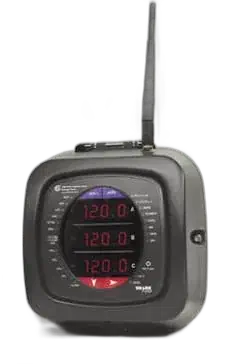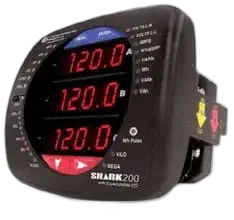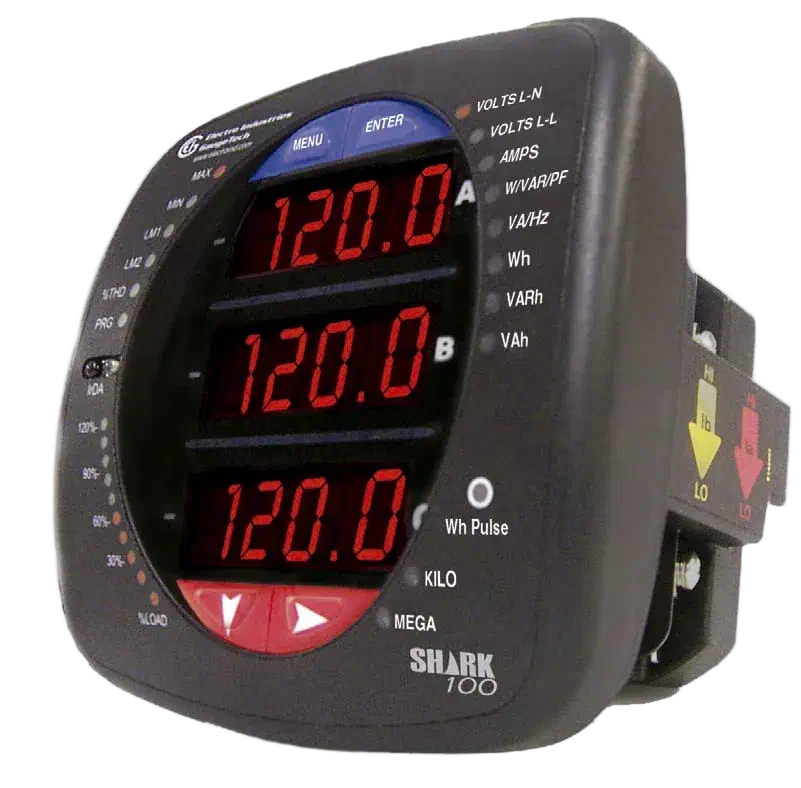
A panel meter fit for revenue metering must be certified to ANSI C12.20 class 0.2 and IEC 62053-22 class 0.2S, and it helps if it fits the cut-out of the analogue instrument it replaces. The Shark 100 meets both classes thanks to sampling at over 400 samples per cycle with a 24-bit converter, measures voltage and current to 0.1 % and power and energy to 0.2 % of reading, and mounts in an ANSI C39.1 4-inch round or 92 mm DIN square cut-out with only 9.04 cm of depth.
Shark 100 key data
- Certified accuracy: ANSI C12.20 class 0.2 and IEC 62053-22 class 0.2S; voltage and current to 0.1 %, active, reactive and apparent power, energy and power factor to 0.2 % of reading, frequency to 0.01 Hz over (45-65) Hz and THD to 5.0 %.
- Measurement: RMS with over 400 samples per cycle on all channels simultaneously; voltage, current, power, power factor, frequency, maximum demand and energy with 5 to 8 programmable digits, with watts, VAR and VA updated every 6 cycles.
- Voltage inputs: universal (20-416) V line to neutral and (0-721) V line to line, programmable to any PT ratio, working on 69, 120, 230, 277 and 347 V systems and with IEEE C37.90.1 surge withstand.
- Current inputs: Class 10 (0.005-10) A for 5 A CTs and Class 2 (0.001-2) A for 1 A CTs; they withstand 100 A for 10 s, 300 A for 3 s and 500 A for 1 s, with CT lead pass-through or pass-through bars that do not open the circuit under fault.
- V-Switch keys: V1 measures voltage and current; V2 adds power, power factor and frequency; V3, energy counters and DNP3; V4, THD and limit alarms; they are activated in the field without removing the Shark 100.
- Communication: standard IrDA optical port; optional RS485 with Modbus RTU/ASCII and DNP3 or 10/100BaseT Ethernet with Modbus TCP/IP, both with KYZ energy pulse.
- Mounting and environment: ANSI C39.1 4-inch round or 92 mm DIN square cut-out, 12.32 x 12.32 cm faceplate and 9.04 cm depth; -20 to +70 °C, IP30, NEMA 12 faceplate, 2500 V isolation and Shark 100T transducer version for DIN rail.
Advantages
Accuracy first
ANSI C12.20 class 0.2 and IEC 62053-22 class 0.2S accuracy, with a bright red LED display, auto-scroll mode and a percentage of load bar.
High isolation voltage inputs
Universal input up to 416 V line to neutral and 721 V line to line, programmable to any PT ratio; one unit works on 69, 120, 230, 277 and 347 V systems.
Short-circuit safe current inputs
The CT lead can pass through the meter with no termination, or terminate on rugged pass-through bars without risk of opening the circuit under fault.
Easy to install and use
Faceplate programming or set-up from a PC, a phasor diagram on the display, and colour-coordinated terminals.
V-Switch key technology
V1 measures voltage and current; V2 adds power and frequency; V3 adds energy counters and DNP3; V4 adds THD and limit alarms.
Applications
- Utility, commercial, industrial and campus metering, and submetering.
- Substations and power generation plants.
- Direct replacement of analogue panel meters, reusing the existing CT and PT wiring.
About the product
The meter fits an ANSI C39.1 4-inch round cut-out or a 92 mm DIN square cut-out, with a 12.32 x 12.32 cm faceplate and a depth of 9.04 cm. A transducer version, the Shark 100T, is also available without a display, mounted on DIN rail, with the RS485 port fitted as standard. Communication includes standard IrDA and, as an option, RS485 with Modbus and DNP3 or 10/100BaseT Ethernet with Modbus TCP/IP. It is powered by (90-265) V AC or (100-370) V DC, or by (18-60) V DC, with all inputs and outputs galvanically isolated to 2500 V.
Technical specifications
| Accuracy | ANSI C12.20 class 0.2; IEC 62053-22 class 0.2S |
| Voltage inputs | (20-416) V line to neutral; (0-721) V line to line |
| Current inputs | Class 10: (0.005-10) A; Class 2: (0.001-2) A |
| Isolation | 2500 V on all inputs and outputs |
| Communication | Standard IrDA; optional RS485 or 10/100BaseT Ethernet |
| Dimensions | 12.32 x 12.32 cm; 9.04 cm depth |
| Panel cut-out | 4-inch ANSI round or 92 mm DIN square |
| Environmental rating | -20 to +70 °C; up to 95% RH non-condensing; IP30 |
| Accuracy by quantity | Voltage and current 0.1 %; power, energy and PF 0.2 %; frequency 0.01 Hz; THD 5.0 % |
| Sensing and update rate | RMS, over 400 samples/cycle; W, VAR and VA every 6 cycles |
| Auxiliary power supply | (90-265) V AC or (100-370) V DC, 5 VA max.; optional (18-60) V DC |
Frequently asked questions
What accuracy does the Shark 100 achieve for each quantity?
Voltage and current to 0.1 %, active, reactive and apparent power, energy and power factor to 0.2 % of reading, frequency to 0.01 Hz over (45-65) Hz and THD to 5.0 %. These figures apply to 3-element WYE and 2-element Delta connections; for 2.5-element connections add 0.1 % of full scale plus one digit.
How much fault current can the Shark 100 inputs withstand?
100 A for 10 s, 300 A for 3 s and 500 A for 1 s at 23 °C, and 20 A continuously on both screw and pass-through connections. The pick-up current is 5 mA and the burden 0.005 VA per phase at 11 A.
What accuracy class does the Shark 100 hold?
Class 0.2 under ANSI C12.20 and class 0.2S under IEC 62053-22, with sampling of over 400 samples per cycle and a 24-bit converter.
What is the difference between the V-Switch keys?
V1 measures voltage and current; V2 adds power and frequency; V3 adds energy counters and DNP3; V4 adds THD and alarms.
How does the meter avoid becoming a CT failure point?
The CT lead can pass through the meter with no termination, or terminate on pass-through bars that do not open the circuit under fault.
What communication options are supported?
Standard IrDA, plus optional RS485 with Modbus and DNP3 or 10/100BaseT Ethernet with Modbus TCP/IP.