Shark Series: energy and power meters
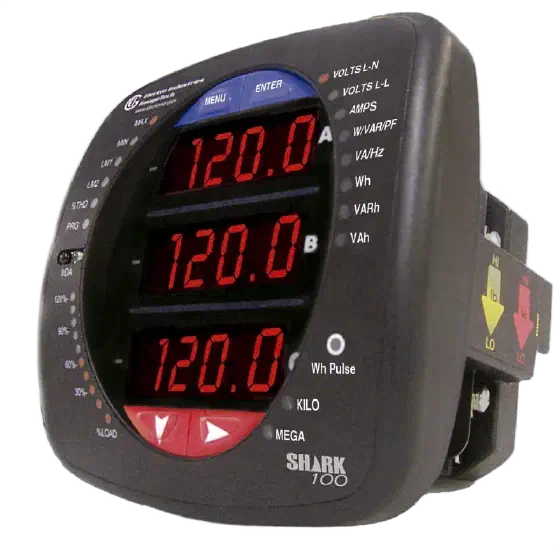
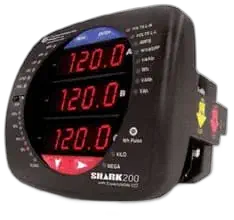
Shark Series meters are compact panel instruments for measuring energy and electrical parameters in distribution boards, MCCs and feeders. They solve the submetering problem: knowing how much energy each line, workshop or tenant uses without relying on the main utility meter.
What do they measure and how?
A Shark measures voltages, currents, power, power factor, frequency and active/reactive energy on single- and three-phase systems, with revenue-grade accuracy (typical reference: class 0.2 per ANSI C12.20). Readings appear on the local display and are served over standard communications to SCADA or energy management systems.
Choosing the right model
- Shark 100: essential submetering with serial communications.
- Shark 100-S: variant for direct integration into existing communication networks.
- Shark 200: adds data logging and expandable I/O modules.
Before ordering, confirm CT ratios, protocol (e.g. Modbus) and whether you need on-board logging. Advice: info@amperis.com.
Applications
- Feeder- or area-level submetering in industrial plants and logistics centres.
- Tenant billing allocation in commercial buildings.
- Feeding measurements into energy management systems (ISO 50001) and SCADA.
- Monitoring auxiliary services in substations.
Applicable standards
- ANSI C12.20 / IEC 62053-22: metering accuracy classes.
- IEC 61557-12: power metering and monitoring devices.
- ISO 50001: energy management framework.
Frequently asked questions
How does a Shark differ from a portable analyser?
A Shark is permanently installed and continuously measures one point; a portable analyser moves between points for temporary campaigns. For ongoing energy management, fixed metering is the right approach.
Can third-party systems read it?
Yes. The series communicates over open protocols widely used in industry, so any SCADA, BMS or energy software can poll its registers without proprietary gateways.
Which current transformers does it need?
Standard 5 A (or 1 A) secondary CTs. Select the ratio for the feeder’s maximum current and match the CT class so overall accuracy is not degraded.
Resources and contact
For disturbance analysis see the APQM Series; for high-end metering see the Nexus Series. Quotations: info@amperis.com · +34 982 20 99 20.
Related calculator
- THD, K-factor, unbalance and power-factor correction EN 50160 · IEC 61000-4-30:2015
- Motors to IEC 60034-1:2022: temperature rise, supply and tolerances IEC 60034-1:2022