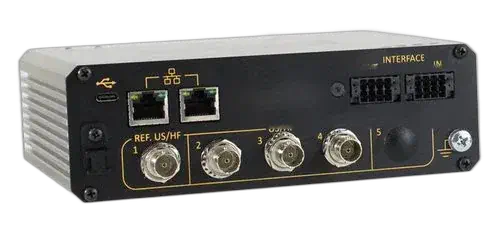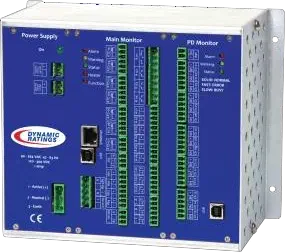
The APD-ANNUNCIATOR remotely detects partial discharge activity inside energised cabinets, combining transient earth voltage (TEV), acoustic and high-frequency current sensors with an analysis module that raises a local and remote alarm before an insulation fault damages the switchgear equipment.
Advantages
Simultaneous detection with several sensor technologies
The module combines TEV detection with contact or airborne acoustic detection, and also accepts high-frequency current sensors to compare technologies and reduce false positives.
Simple installation without interrupting service
Sensors are held magnetically on the cabinet surface or mounted on a DIN rail, with no need to disconnect the installation or drill the enclosure, with no supply outage.
Cascaded monitoring of several cabinets
Several modules can be daisy-chained using standard Ethernet cable, carrying data and power together, monitoring numerous distribution cabinets with minimal cabling.
Configurable local and remote alarm
Each channel accepts a user-defined threshold, with a led indicator and remote alerting via SCADA, web interface, SMS or e-mail.
Applications
- Continuous partial discharge monitoring in medium-voltage cells and in-service switchgear cabinets.
- Early detection of insulation faults in dry-type transformers and ring main units (RMUs).
- Integration with SCADA systems for trend monitoring and remote alarm generation.
- Substation installations, field applications and remote sites with limited access.
About the product
The APD-ANNUNCIATOR is mounted on a DIN rail or held with magnets on the cabinet surface. Each module accepts up to three channels and processes the acoustic and high-frequency signals, applying validation algorithms that separate real discharge activity from ambient noise.
Configuration and data retrieval are carried out via USB or through a web interface, which graphs the evolution of the activity and manages alarms. The unit includes Modbus connectivity for the installation's SCADA system and supports an optional cellular modem for remote alerting.
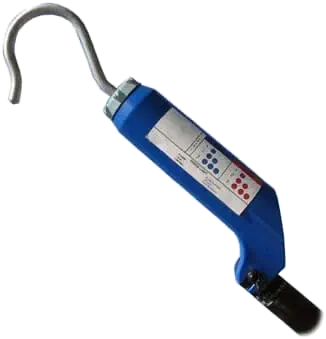
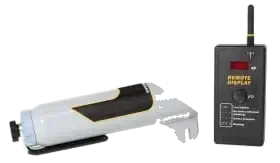
Available accessories: combined TEV and contact acoustic sensor, a version with airborne acoustic pick-up, high-frequency current clamps with 20 mm and 60 mm openings and IP66 protection, a portable sensor tester, and a cloud-based remote access solution.
Technical specifications
| Compatible sensors | Transient earth voltage (TEV), acoustic and high-frequency current (HFCT) |
| Input channels | 3 acoustic and 3 high-frequency channels per module |
| Acoustic bandwidth | 30 kHz to 88 kHz; 40 dB dynamic range |
| High-frequency bandwidth | 10 MHz to 1.0 GHz; 40 dB dynamic range |
| Power supply | 9 to 24 VDC; 1.2 W max. |
| Protection rating | IP65 with dust boots installed |
| Operating temperature | -30°C to 50°C |
| Weight and dimensions | 0.51 kg; 201 x 87 x 53 mm |
Frequently asked questions
Which sensor technologies does the unit combine?
It combines TEV detection, contact or airborne acoustic detection and, optionally, high-frequency current sensors, with up to three channels of each type per module.
Does the installation need to be shut down to fit it?
No. Sensors are fixed magnetically or on a DIN rail on the in-service cabinet, with no need to disconnect the installation or drill the enclosure.
Can several cabinets be monitored at the same time?
Yes, several modules can be daisy-chained using Ethernet cable, carrying data and power together, with minimal cabling.
How are alarms received?
Through a local led indicator, and remotely via SCADA, web interface, SMS or e-mail, according to each channel's threshold.
What protection rating does the unit offer?
IP65 with the dust boots installed, with an operating temperature range of -30°C to 50°C.