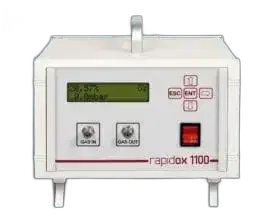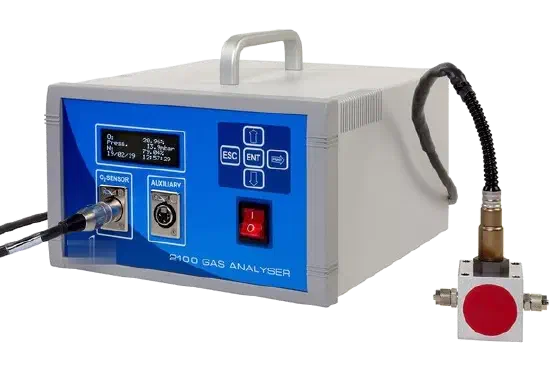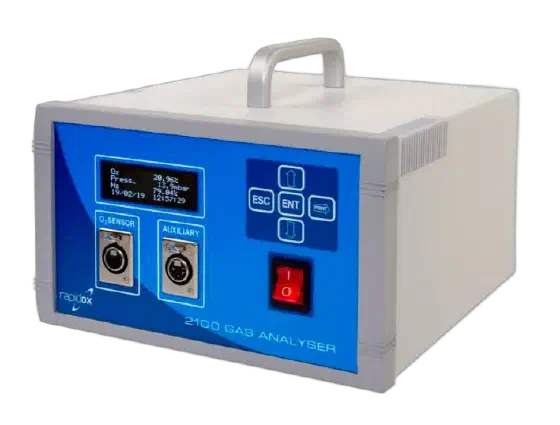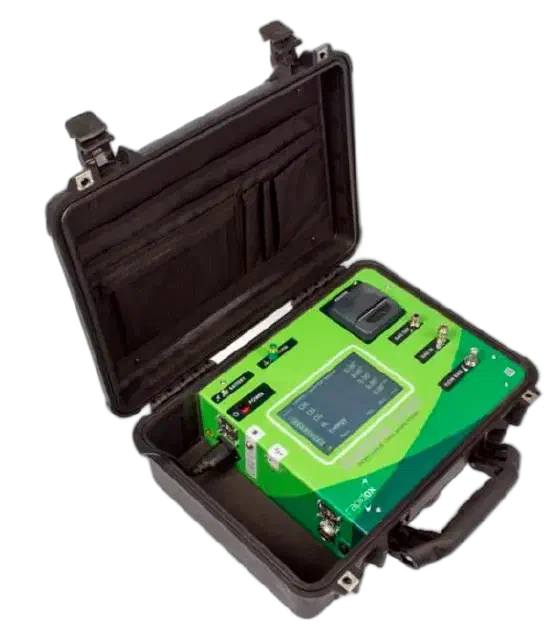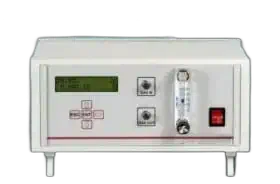
Single-, dual- and triple-gas bench analyser with independent temperature input
Analysing oxygen together with one or two further gases —CO2, CO, H2 or moisture, for example— in the laboratory or the process takes a multigas analyser that combines sensors of different technologies in one instrument. The Rapidox 3100Z measures up to three gases simultaneously: oxygen with a zirconia cell from 10E-20 ppm to 30 % at ±1 %, and the others with infrared, electrochemical, capacitance or thermal conductivity sensors; a type K thermocouple records temperature up to 1250 °C, and four programmable alarms and per-sensor outputs connect it to the process.
Rapidox 3100Z key data
- Configuration: one, two or three simultaneous gases, typically oxygen plus one or two gases from CO2, CO, H2, H2O, C2H4, Cl2, CH4, N2O, NO, NH3, SO2 and O3; not every combination is possible because of interference and cross-sensitivity.
- Oxygen: zirconia sensor from 10E-20 ppm to 30 % O2 with ±1 % accuracy.
- Sensor technologies: infrared for CO2, CH4, CO, C2H4, N2O and SO2; electrochemical for CO, Cl2, NH3 and SO2, among others; tunable laser diode for CH4; capacitance for the H2O dewpoint (−65 °C or −100 °C to +20 °C) and thermal conductivity for H2 and He, with ranges from 0-10 ppm to 0-100 % depending on the sensor.
- Temperature: type K thermocouple, 0-1250 °C with ±1 °C, displayed and logged simultaneously with the gas analysis.
- Sampling: front-panel flow gauge with needle valve, optional long-life 0-1 L/min pump or operation under flowing gas; sample gas up to 60 °C and 4 mm ID / 6 mm OD nipple connections.
- Alarms and outputs: four programmable volt-free alarm circuits (high or low, open or closed contact), 0-5 V and 4-20 mA analogue outputs per sensor, RS232 (RS485 optional) with Modbus RTU.
- Formats: bench unit of 150 × 350 × 263 mm and 5 kg with front connections, or 19″ 4U rack unit of 132 × 482 × 365 mm and 6.5 kg, with rear connections and a recessed back-lit flow gauge for flush mounting in glass-door cabinets.
- Operation: 2-5 min warm-up at 20 °C, 5 °C to 35 °C and 900 to 1,100 mbar absolute, four-line OLED display, 90-260 V AC, UL/ETL certification UL-61010-1 and EMC Directive 2004/108/EC.
Advantages
Up to three gases in one instrument
Configurations pair oxygen with one or two additional gases chosen from O2, CO2, CO, H2, H2O, C2H4, Cl2, CH4, N2O, NO, NH3, SO2 and O3. Oxygen is read by a zirconia cell covering 10E-20 ppm to 30 % with ±1 % accuracy.
Temperature logged with the gas
A type K thermocouple input adds an independent temperature channel up to 1,250 °C; readings appear on screen and are recorded together with the gas data.
Straightforward integration
Four programmable volt-free alarm circuits, analogue outputs per sensor (0-5 V and 4-20 mA) and RS232/RS485 Modbus RTU links connect the analyser to the process; the supplied software adds live graphing and Excel-compatible logging.
Adjustable sampling
A front flow gauge with needle valve sets the test-gas flow, and the optional long-life pump draws 0-1 L/min; without the pump, the unit runs under flowing gas conditions.
Two formats
Available as a bench instrument (5 kg) or as a 19″ rack-mounted unit (6.5 kg), powered from any mains voltage between 90-260 V AC.
Applications
- Glove boxes, inert-gas blanketing and controlled atmospheres.
- Heat treatment, manufacturing and combustion processes.
- Universities, research institutes and R&D laboratories.
- Biogas, syngas, chemical, food, medical and pharmaceutical duties.
About the product
Calibration is performed by the user with selectable gases, and an internal pressure sensor keeps the response fast and stable. Password protection is standard; the instrument holds UL/ETL certification UL-61010-1 and complies with EMC Directive 2004/108/EC.
Warm-up takes 2-5 min at 20 °C, with ambient limits of 5-35 °C and 900-1,100 mbar. Available accessories: calibration kit and service, thermal printer, multiplex sampling system, gas recovery bag and gas filters.
Technical specifications
| Gases measured | Up to 3 simultaneously: O2, CO2, CO, H2, H2O, C2H4, Cl2, CH4, N2O, NO, NH3, SO2, O3 |
| Oxygen sensor | Zirconia, 10E-20 ppm to 30 %, ±1 % |
| Temperature input | Type K, 0-1,250 °C, ±1 °C |
| Outputs | 0-5 V, 4-20 mA, RS232/RS485 Modbus RTU |
| Formats | Bench (5 kg) or 19″ rack (6.5 kg) |
| Supply voltage | 90-260 V AC, 50/60 Hz |
| Sensor technologies | Zirconia (O2), infrared, electrochemical, tunable laser diode (CH4), capacitance (H2O), thermal conductivity (H2, He) |
| Sample | Gas up to 60 °C; optional 0-1 L/min pump; 4 mm ID / 6 mm OD connections |
| Operating conditions | 5 °C to 35 °C; 900-1,100 mbar absolute; 2-5 min warm-up at 20 °C |
Frequently asked questions
Which sensor technology is used for each gas?
The Rapidox 3100Z measures oxygen with zirconia; CO2, CH4, CO, C2H4, N2O and SO2 with infrared; CO, Cl2, NH3 and SO2 also with electrochemical sensors; CH4 additionally with a tunable laser diode; moisture with a capacitance dewpoint sensor; and H2 and He by thermal conductivity. Not every combination is possible because of interference and cross-sensitivity.
How often must the sensors be calibrated and replaced?
According to the Rapidox 3100Z sensor matrix, the calibration interval is 12 months for almost all sensors and 6 months for the electrochemical Cl2 sensor. Life is 24 months for zirconia, over 60 months for infrared, over 36 months for the capacitance moisture sensor and 12 to 24 months for electrochemical sensors.
Which gases can be analysed?
Up to three gases simultaneously, combining oxygen with gases such as CO2, CO, H2, H2O, C2H4, Cl2, CH4, N2O, NO, NH3, SO2 or O3.
Can temperature be measured as well?
Yes. A type K thermocouple input records temperatures up to 1,250 °C simultaneously with the gas analysis.
How is the analyser integrated into a process?
Through four programmable alarm circuits, analogue outputs per sensor and RS232/RS485 Modbus RTU communications.
How are results documented?
The supplied software provides live graphing and Excel-compatible data logging.