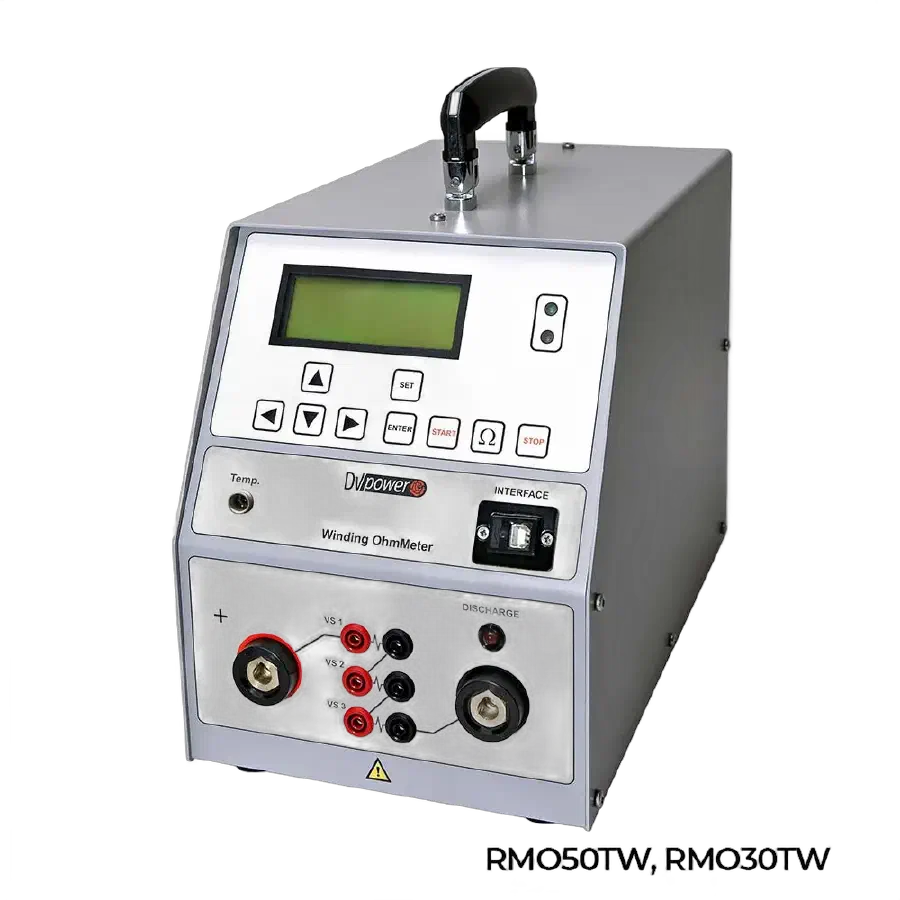
The essential winding ohmmeter: three channels, 55 V output and only 8 kg
Measuring the winding resistance of transformers, motors and generators without carrying a heavy instrument only takes a three-channel ohmmeter with ripple-free DC current, automatic discharge and tap changer verification. The RMO-TW series offers this in an 8 to 8.5 kg metal case: 5 mA to 50 A DC depending on model at up to 55 V DC, a 0.1 µΩ to 100 kΩ range with ±(0.1% of reading + 0.1% of full scale) typical accuracy up to 2 kΩ, three windings in series measured at once and detection of tap changer interruptions with 4 ms sampling.
Models in the series
| RMO10TW | RMO20TW | RMO30TW | RMO50TW | |
|---|---|---|---|---|
| Test current | 5 mA – 10 A | 5 mA – 20 A | 5 mA – 30 A | 5 mA – 50 A |
| Output power | 500 W | 750 W | 850 W | 1000 W |
| Weight | 8 kg | 8 kg | 8.5 kg | 8.5 kg |
| Quote for the RMO10TW → | Quote for the RMO20TW → | Quote for the RMO30TW → | Quote for the RMO50TW → |
RMO-TW key data
- Models and current: RMO10TW, RMO20TW, RMO30TW and RMO50TW, with 10, 20, 30 or 50 A DC maximum and 500, 750, 850 or 1000 W output; all four inject at up to 55 V DC.
- Resistance accuracy: RMO-TW measures from 0.1 µΩ to 100 kΩ with ±(0.1% rdg + 0.1% FS) typical up to 1.999 kΩ, ±(0.2% + 0.1% FS) from 2 to 9.999 kΩ and ±(1% + 1% FS) from 10 to 99.99 kΩ; guaranteed, ±(0.2% + 0.2% FS) up to 9.999 kΩ; best resolution 0.1 µΩ.
- Three measuring channels: RMO-TW tests primary, secondary and tertiary windings connected in series at once, or the three phases of a motor or generator stator.
- Tap changer: it measures at every position without discharging between taps, detects current interruptions with 4 ms sampling and has a dedicated mode for de-energized tap changers (DETC).
- Discharge and demagnetization: automatic discharge circuit at the end of each measurement and demagnetization by polarity reversal with decreasing magnitude.
- Temperature and data: Pt100 channel from -50 to +180 °C, 1000-measurement memory (5000 optional), USB as standard with optional RS232 and Bluetooth.
- Portable: RMO-TW measures 198 × 250 × 350 mm, weighs 8 to 8.5 kg and runs on 90–264 V AC, 50/60 Hz (2250 VA).
Advantages
Three windings in a single measurement
The independent channels test primary, secondary and tertiary windings connected in series at once; saturating the core through the winding with the most turns shortens stabilisation and the whole test.
Tap changer verification
Resistance is measured at every tap position without discharging between taps: if the current is interrupted during switching, the device detects it and warns the operator.
De-energized taps too (DETC)
A dedicated mode walks through the positions of de-energized tap changers within the same test, with criteria separate from on-load tap changers.
Automatic discharge and demagnetization
The discharge circuit governs the stored energy at the end of the measurement, and demagnetization removes remanent magnetism by reversing polarity with decreasing magnitude.
Applications
- Winding resistance of power and distribution transformers and autotransformers.
- Verification of on-load and de-energized tap changers.
- Rotating machines: motor and generator stators through the three channels.
- Non-inductive resistive objects: busbars, splices and joints.
- Heat Run test with resistance and temperature extrapolation.
About the product
The measuring range spans 0.1 µΩ to 100 kΩ with a typical accuracy of ±(0.1% of reading + 0.1% of full scale) up to 2 kΩ and a best resolution of 0.1 µΩ; a Pt100 channel measures temperature from -50 to +180 °C. The memory keeps 1000 measurements (5000 optional) and the PC software controls the test over USB and exports reports to Excel, PDF or Word.
Accessories: current and sense cables with TTA clamps, temperature probes, verification shunt, Bluetooth module, optional built-in thermal printer, bags and transport cases with or without wheels.
Technical specifications
| Models | RMO10TW, RMO20TW, RMO30TW and RMO50TW |
| Test current | 5 mA – 50 A DC depending on model |
| Output voltage | Up to 55 V DC |
| Measuring range | 0.1 µΩ – 100 kΩ |
| Typical accuracy | ±(0.1% rdg + 0.1% FS) up to 2 kΩ |
| OLTC verification | 4 ms sampling |
| Power supply | 90 – 264 V AC, 50/60 Hz; 2250 VA |
| Dimensions and weight | 198 × 250 × 350 mm; 8 – 8.5 kg |
| Typical accuracy from 2 to 100 kΩ | ±(0.2% rdg + 0.1% FS) from 2 to 9.999 kΩ; ±(1% rdg + 1% FS) from 10 to 99.99 kΩ |
| Guaranteed accuracy | ±(0.2% rdg + 0.2% FS) from 0.1 µΩ to 9.999 kΩ; ±(2.5% rdg + 2.5% FS) from 10 to 99.99 kΩ |
Frequently asked questions
Which lightweight winding resistance meter suits transformers, motors and generators?
A three-channel unit with enough current and automatic discharge. RMO-TW weighs 8 to 8.5 kg, delivers 5 mA to 50 A DC at up to 55 V DC and measures three windings in series or the three phases of a stator at once; the 10 A RMO10TW covers small machines and the 50 A, 1000 W RMO50TW the higher-power transformers.
How accurate is RMO-TW for winding resistance?
Typical accuracy is ±(0.1% of reading + 0.1% of full scale) from 0.1 µΩ to 1.999 kΩ, ±(0.2% + 0.1%) from 2 to 9.999 kΩ and ±(1% + 1%) from 10 to 99.99 kΩ. Guaranteed accuracy is ±(0.2% + 0.2%) up to 9.999 kΩ and ±(2.5% + 2.5%) above, on all four models.
Which model should I choose?
It depends on the transformer size: the higher the power and the lower the winding resistance, the more current helps; the RMO50TW reaches 50 A with 1000 W of output and the RMO10TW covers small machines with 10 A.
How does it differ from the RMO-TD series?
The RMO-TW verifies the tap changer by detecting interruptions with 4 ms sampling, but it lacks the 0.1 ms DVtest dynamic analysis, the motor current channel and the OLTC control unit of the RMO-TD.
Does it measure rotating machines?
Yes. By connecting the three stator phases in series, the three channels measure the three resistances in one go.
How does it handle the energy stored in the winding?
The automatic discharge circuit dissipates it in a controlled way after each measurement, before the wiring is touched.
What PC interface does it offer?
USB as standard, with optional RS232 and Bluetooth; the included software plots the results and assembles the reports.