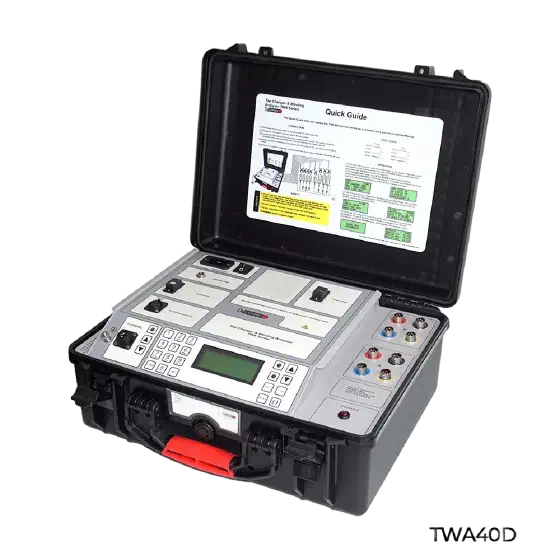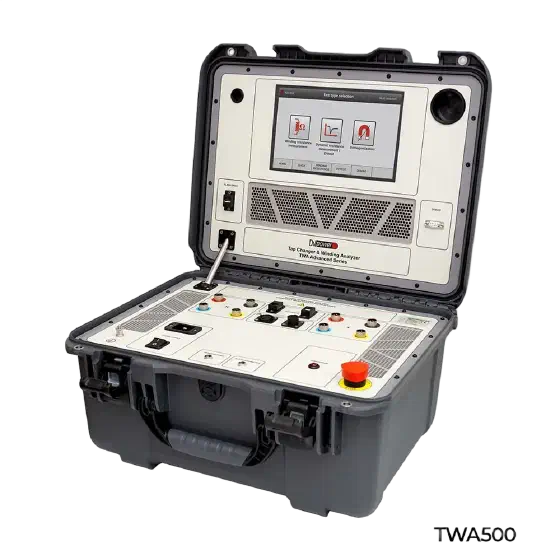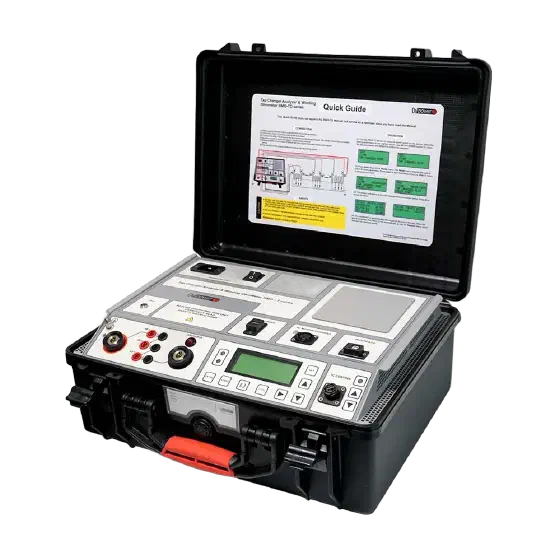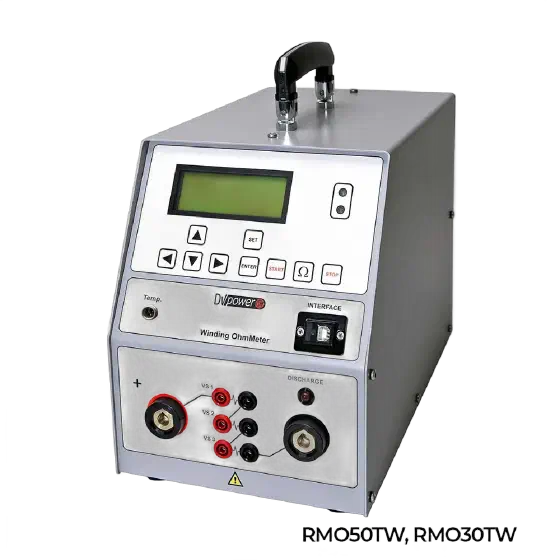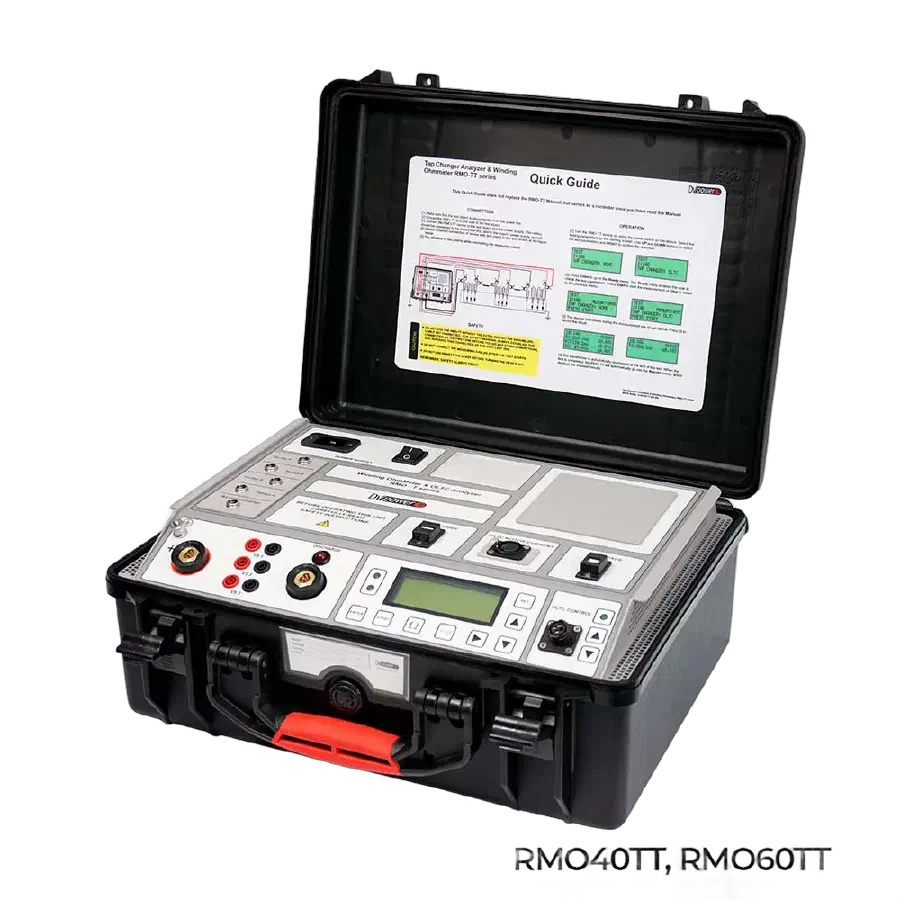
The most complete field diagnosis of a power transformer calls for a high-current ohmmeter that analyses the on-load tap changer through both dynamic resistance and vibration. The RMO-TT series measures winding resistance with up to 100 A DC (RMO100TT, with 55 V and 1300 W) and ±(0.1% of reading + 0.1% of full scale) typical accuracy up to 2 kΩ, records the DVtest with 0.1 ms sampling, the motor current and the vibration with a ±50 g ICP accelerometer, tracks four Pt100 temperatures during the Heat Run test and demagnetizes the core when finished.
RMO-TT key data
- Models and current: RMO40TT, RMO60TT and RMO100TT, from 5 mA to 100 A DC depending on model; RMO100TT, the only one in the series reaching 100 A, delivers 55 V and 1300 W in 15.5 kg (13.5 kg for the other two).
- Resistance accuracy: RMO-TT measures from 0.1 µΩ to 100 kΩ with ±(0.1% rdg + 0.1% FS) typical up to 1.999 kΩ, ±(0.2% + 0.1% FS) from 2 to 9.999 kΩ and ±(1% + 1% FS) from 10 to 99.99 kΩ; guaranteed, ±(0.2% + 0.2% FS) up to 9.999 kΩ.
- Tap changer DVtest: dynamic resistance with 0.1 ms sampling and tap changer motor current on a dedicated channel, overlaid on the same graph by the PC software.
- Vibration: RMO-TT uses a ±50 g, 100 mV/g ICP accelerometer fixed to the external tap changer tank, which records the mechanical signature of every operation and reveals looseness or wear without opening it.
- Temperature: four Pt100 channels from -50 to +180 °C track oil and windings during the Heat Run test, with hot-spot extrapolation to the switch-off instant.
- OLTC control: the built-in unit changes taps and the software chains measurement and switching through every position without operator intervention; three measuring channels and automatic single-phase demagnetization.
- Data: RMO-TT stores 1000 measurements (5000 optional), is controlled over USB and exports reports to Excel, PDF or Word.
Advantages
One hundred amps in portable format
The RMO100TT generates 100 A DC with 55 V output and 1300 W: ample current for very low resistance windings, in a 15.5 kg case that remains field-ready.
The tap changer watched two ways
The DVtest records dynamic resistance with 0.1 ms sampling and, in addition, an accelerometer on the tap changer tank turns every operation into a vibration signature comparable over time.
Four temperatures at once
The four Pt100 channels track the oil and winding temperatures during the Heat Run test, and the software extrapolates the hot spot to the switch-off instant.
OLTC control and automatic testing
The built-in tap changer control unit drives the OLTC from the device, and the complete per-tap measuring sequence can be programmed and run unattended from the PC.
Applications
- Winding resistance of power and distribution transformers and autotransformers.
- Dynamic (DVtest) and vibration analysis of on-load tap changers.
- Recording of the tap changer motor current on a dedicated channel.
- Generators, motors, busbars and high-current joints.
- Heat Run test and automatic single-phase demagnetization.
About the product
The measuring range extends from 0.1 µΩ to 100 kΩ with a typical accuracy of ±(0.1% of reading + 0.1% of full scale) up to 2 kΩ. The memory takes 1000 measurements (5000 optional) and the PC software controls the device over USB, overlays dynamic resistance, motor current and vibration graphs, and exports reports to Excel, PDF or Word.
Accessories: current and sense cables with TTA clamps, ICP accelerometer with cable, tap changer control cable, temperature probes, verification shunt, optional thermal printer, Bluetooth and transport cases.
Technical specifications
| Models | RMO40TT, RMO60TT and RMO100TT |
| Test current | 5 mA – 100 A DC depending on model |
| Measuring range | 0.1 µΩ – 100 kΩ |
| Typical accuracy | ±(0.1% rdg + 0.1% FS) up to 2 kΩ |
| DVtest (DRM) | 0.1 ms sampling |
| Vibration | ICP accelerometer, ±50 g |
| Temperature | 4 Pt100 channels, -50 to +180 °C |
| Weight | 13.5 kg; 15.5 kg for the RMO100TT |
| Typical accuracy from 2 to 100 kΩ | ±(0.2% rdg + 0.1% FS) from 2 to 9.999 kΩ; ±(1% rdg + 1% FS) from 10 to 99.99 kΩ |
| Guaranteed accuracy | ±(0.2% rdg + 0.2% FS) from 0.1 µΩ to 9.999 kΩ; ±(2.5% rdg + 2.5% FS) from 10 to 99.99 kΩ |
| Accelerometer sensitivity | 100 mV/g |
Frequently asked questions
How can an on-load tap changer be diagnosed without opening it?
By combining dynamic resistance with vibration measurement. RMO-TT records the DVtest with 0.1 ms sampling and, with a ±50 g ICP accelerometer fixed to the external tank, the vibration signature of every operation, plus the motor current, all in the same test and with built-in OLTC control.
How accurate is RMO-TT for winding resistance?
Typical accuracy is ±(0.1% of reading + 0.1% of full scale) from 0.1 µΩ to 1.999 kΩ, ±(0.2% + 0.1%) from 2 to 9.999 kΩ and ±(1% + 1%) from 10 to 99.99 kΩ. Guaranteed accuracy is ±(0.2% + 0.2%) up to 9.999 kΩ and ±(2.5% + 2.5%) above, with up to 100 A DC on RMO100TT.
What does the vibration measurement add?
A non-intrusive diagnostic path: the accelerometer fixed to the external tap changer tank records the mechanical signature of every operation, reveals looseness or wear and verifies the operating time without opening the tap changer.
When is the 100 A model worthwhile?
On large transformers with very low resistances, where a high current stabilises the reading sooner; it is the only portable of the series reaching 100 A DC.
Can the complete tap changer test run automatically?
Yes. The built-in control unit changes the taps and the software chains measurement and switching through every position without operator intervention.
How does it differ from the RMO-TD?
It shares the DVtest and the OLTC control, but adds the vibration channel, four temperature channels instead of one and the 100 A model.
How is the transformer left after the test?
Demagnetized: the device applies alternating current of decreasing magnitude generated by polarity reversal until the remanent flux is cancelled.