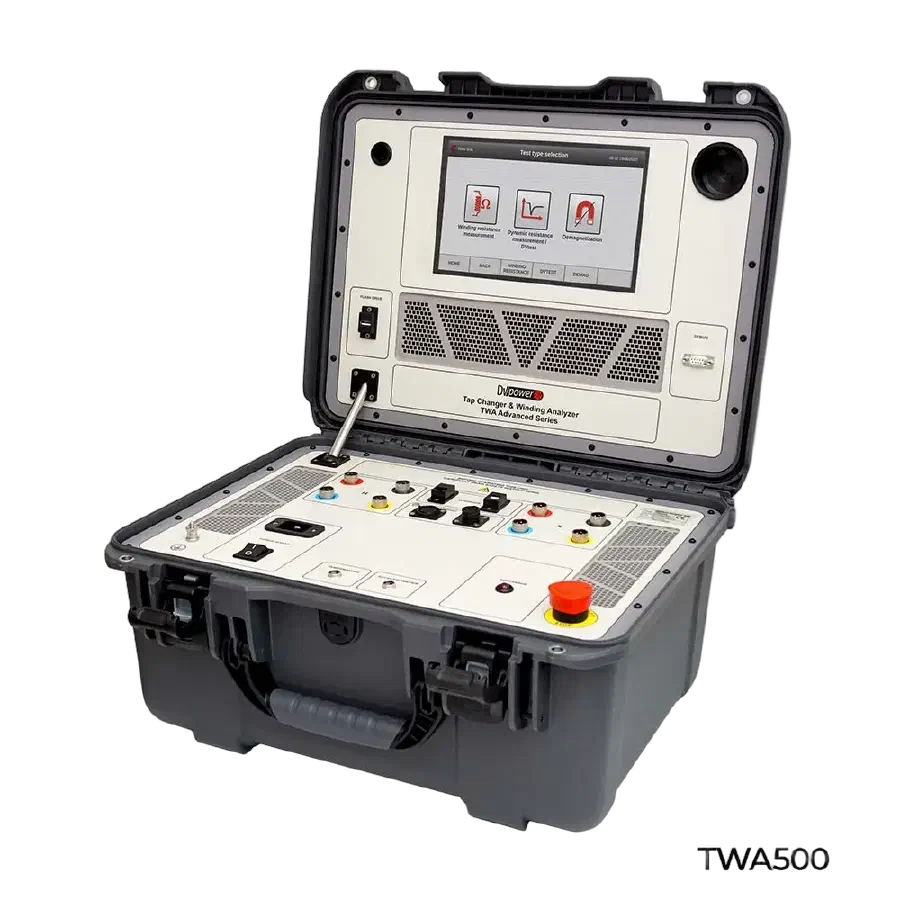
Three-phase winding resistance analyzer with a touch screen, simultaneous DVtest and a fully automatic test
A thorough diagnosis of a transformer with an on-load tap changer calls for an analyzer that measures all six windings from a single connection and simultaneously records the dynamic resistance of all three phases, the motor current and the tap changer vibration. The TWA Advanced series does this under IEC 60076-1 with DC current from 5 mA to 25 A at up to 55 V DC (up to 40 A DC during synchronisation check), a 0.1 µΩ to 10 kΩ range with ±(0.1% of reading + 0.1% of full scale) typical accuracy up to 1.999 kΩ and DVtest with 0.1 ms resolution on one phase or all three at once, stepping through the tap changer positions fully automatically from the touch screen.
TWA Advanced Series key data
- Models: TWA500, with a 10.1 inch touch screen (505 × 257 × 409 mm, 13.5 kg), and TWA400, with a 7 inch screen and thermal printer (543 × 218 × 427 mm, 15.0 kg); test current and DVtest are the same on both.
- Resistance accuracy: TWA Advanced measures from 0.1 µΩ to 10 kΩ with ±(0.1% of reading + 0.1% of full scale) typical up to 1.999 kΩ and ±(0.2% + 0.1%) from 2 to 9.999 kΩ; guaranteed accuracy is ±(0.2% + 0.2%).
- Test current: 5 mA to 25 A DC at up to 55 V DC; in Quick YN mode it measures all three phases of a YN-connected winding at once with a combined current of up to 40 A DC.
- Tap changer DVtest: 0.1 ms resolution, on one phase or all three at once, with the motor current and, with the optional ±50 g ICP accelerometer, the mechanism vibration.
- Fully automatic test: the tap changer control unit built into TWA Advanced steps through the selected positions and detects when each reading has stabilised, without a computer.
- Memory and interfaces: 32 GB for test templates and results, with USB or Ethernet output; the PC software is optional.
- Six windings in one connection: the H and X leads are shared with TRT, so a single connection chains several tests without rewiring the transformer.
Advantages
Fully automatic test across several positions
The tap-changer control unit, built into the instrument, steps through the selected positions without operator intervention and automatically detects when each reading has stabilised, from the touch screen itself.
Simultaneous DVtest, with motor current and vibration
The TWA500 and TWA400 models record DVtest with a 0.1 ms resolution, on one phase or all three at once, together with the tap-changer motor current and, with an optional accelerometer, its vibration.
Quick YN mode for three simultaneous phases
On a YN-connected winding, the instrument measures all three phases at once and checks the synchronisation between them, with a combined current of up to 40 A DC.
Touch screen, 32 GB of memory and dual interface
A 10.1 inch (TWA500) or 7 inch (TWA400) touch screen stores test templates and results in 32 GB of memory, with USB or Ethernet output.
Applications
- Commissioning and maintenance of power and distribution transformers and autotransformers with an on-load tap changer.
- Tap-changer condition assessment combining simultaneous DVtest, motor current and mechanism vibration.
- Synchronisation check between the phases of a three-phase tap changer.
- Fully automatic test mode across several tap-changer positions, without manual intervention.
About the product
The Advanced range comprises two models, TWA500 and TWA400, which share almost every feature - resistance range, test current, DVtest resolution and the motor and vibration channels - and differ only in touch screen size, 10.1 inches versus 7, and in the built-in thermal printer, exclusive to TWA400.
Both models share their H and X leads with TRT, so a single connection chains several tests together without rewiring the transformer. Accessories available: H and X cable sets with TTA clamps, a 30/300 A current clamp, an ICP accelerometer, a temperature sensor, a transport case and, for TWA400, a 58 mm thermal printer.
Technical specifications
| Models | TWA500 and TWA400 |
| Measurement | Three-phase, six windings, with a single cable connection |
| Resistance range / accuracy | 0.1 μΩ - 10 kΩ; from ±0.1% of reading |
| Test current | 5 mA - 25 A DC; up to 40 A DC during synchronisation check |
| DVtest resolution | 0.1 ms, on one phase or all three at once |
| Display / internal memory | 10.1 in (TWA500) or 7 in (TWA400) touch screen; 32 GB |
| Dimensions and weight | 505 × 257 × 409 mm, 13.5 kg (TWA500); 543 × 218 × 427 mm, 15.0 kg (TWA400) |
| Typical accuracy | ±(0.1% rdg + 0.1% FS) from 0.1 µΩ to 1.999 kΩ; ±(0.2% rdg + 0.1% FS) from 2 to 9.999 kΩ |
| Guaranteed accuracy | ±(0.2% rdg + 0.2% FS) |
| Vibration (optional) | ICP accelerometer, ±50 g; 0.1 ms resolution |
Frequently asked questions
Which instrument can assess the on-load tap changer as well as the winding resistance?
One that records dynamic resistance, motor current and vibration in the same test. The TWA Advanced series performs the DVtest with 0.1 ms resolution on all three phases at once, adds the motor current and, with the ±50 g ICP accelerometer, the vibration, and checks the synchronisation between phases at up to 40 A DC.
How accurate is the TWA Advanced series for winding resistance?
Typical accuracy is ±(0.1% of reading + 0.1% of full scale) from 0.1 µΩ to 1.999 kΩ and ±(0.2% + 0.1%) from 2 to 9.999 kΩ, with ±(0.2% + 0.2%) guaranteed. The range spans 0.1 µΩ to 10 kΩ on TWA500 and TWA400, with a test current of 5 mA to 25 A DC.
What is the difference between TWA500 and TWA400?
Mainly the touch screen size - 10.1 inches versus 7 - and the optional thermal printer, exclusive to TWA400; test current and DVtest are the same on both models.
How does it differ from the TWA Standard range?
The Advanced range adds a touch screen with test templates, a fully automatic mode, a vibration channel, 32 GB of memory and Ethernet; the Standard range uses an LCD screen and stores 500 records.
What is the tap-changer synchronisation check?
A test that measures the dynamic resistance of all three phases at once during switching, with a combined current of up to 40 A DC, to confirm that the taps change in a synchronised way.
Is a computer needed for the automatic mode?
No: the touch screen already includes the test templates and the automatic mode; the PC software is optional and is used to prepare and analyse the results in more detail.