The industrial rectifier is designed to supply safe, stabilised direct current to the services which, because of their characteristics, require a reliable and uninterrupted power supply in the event of a possible mains failure. It is used for all applications that require a direct current source.
Industrial power supplies are based on an industrial rectifier that stands out for its robustness and reliability, designed to feed critical DC loads or to charge any type of battery. Industrial power supplies are based on the standardised SCR and IGBT power converter technologies, in order to provide high reliability and efficiency at a contained cost. It is a safe unit with digital control technology that adapts to any type and technology of battery and to any voltage and current.
The Amperis ASR rectifier/charger combines the connection of different devices. It is designed to supply direct current to critical applications, where the load: must be free from harmonic distortion, must be electrically isolated from the supply source and must be permanently powered. Its most outstanding parts:
- Transformer: electrical device by means of which the AC voltage is reduced. That is to say, it converts alternating electrical energy at one voltage into alternating energy at another voltage level, by means of electromagnetic induction. The frequency is the same.
- Rectifier: it is a device that transforms alternating current into direct current. What it does is convert the sinusoidal alternating signal into a direct signal. Rectifier circuits suitable for industrial applications are protected against overvoltages both at the input and at the output. The full-wave rectifier is designed to operate from one to three supply phases; this AC/DC converter uses silicon controlled rectifiers SCR (the SCR is a type of thyristor through which current flows during half of the positive AC half-cycle and blocks half of the negative cycle). This results in a rectified voltage.
- Filter: filtering of the signal by means of capacitors, stabilising it. The aim is for the ripples to disappear (the ripple must be as small as possible). A regulator eliminates the ripple oscillation. A stabilised direct voltage is obtained.
The high harmonic content generates a low power factor, which therefore has to be reduced since it means an inefficient use of electrical energy. The control of the output parameters is obtained by regulation by means of 6- or 12-pulse thyristors and the resulting ripple is filtered.
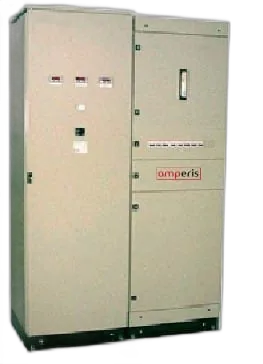
Basically, the unit is made up of a stabilised charger that supplies the quality and reliable energy demanded by the services and at the same time manages the charging of the batteries (always keeping them in optimum charge conditions for the service). The regulation and control circuits and the alarms are efficiently integrated. It uses latest generation microprocessors. It offers great reliability guaranteed by thyristor technology, it ensures the user a quality DC supply and its design with front access makes it easy to carry out maintenance tasks.
The functions of the ASR battery rectifier/charger are:
- Recharging of batteries.
- Keeping the battery charged (float charge).
- Feeding constant DC consumption:
Standard output voltages: Nominal voltages of 24,48,220 V DC
Maximum output current: 10,20,30,40,50,100,150,200,320,500 A
Its applications are: industry, telecommunications, transport, mining, petrochemicals, etc.
The charger can work in two charging positions:
- Recharge a partially or totally discharged battery
- Carry out the maintenance charge of a battery and at the same time feed the consumers.
After a power cut the batteries start to discharge, supplying energy. Once the primary power has been restored and with the batteries discharged, the rectifier delivers constant current to the batteries until the float voltage value is reached, and from that moment on the rectifier switches to constant voltage.
The system has a complete user interface for easy adjustment of the system and indication of operating values, statuses and alarms. The microprocessor-based control unit makes it possible to define the fundamental parameters of the unit, to monitor them, to set the necessary alarms and to allow the variables to be displayed.
For more information about the battery rectifier: