As we know, proper battery maintenance helps to optimise its life cycle. The charger is the unit in charge of recharging the battery until the extracted energy is completely recovered, which is why it is of great importance in optimising the service life of the battery. Verifying that the charging operation is carried out properly means that the battery charges faster and takes longer to discharge; in this way, electric traction vehicles (electric trucks, forklifts, golf carts, materials handling equipment, etc.) whose battery is recharged will operate under optimum conditions.
Therefore, the charger working properly is essential in order to charge the battery. It must be kept in a safe place so that it does not deteriorate, it must not be left near moving vehicles and the cables must be properly stowed so that they are not crushed under the wheels.
But verifying the correct operation of the charger has been a constant problem for the technical services and maintenance teams of these units. In order to carry out this test they had to have at least one battery available, which was a problem.
In addition, it is not appropriate to test the battery charger using a battery, since it is complicated both to adjust the charging options and to simulate different working conditions. However, the Amperis battery simulator eliminates the need to connect a battery to the charger in order to test it and makes it possible to know the state of the battery in order to carry out better maintenance and the necessary repairs, optimising the daily capacity and the service life of the battery.
The unit is a simple and flexible electronic device, designed to test battery chargers of any voltage and power quickly. Simulating the behaviour of a battery during the charging process and giving the technician the possibility of checking the performance of any charger safely and accurately.
The uses of the battery simulator are summarised below:
• testing battery chargers (current or voltage chargers of any type) eliminating the need to connect a battery to the charger in order to test it; it simulates the behaviour of a battery during the charging process and gives the technician the possibility of carrying out complete tests of any charger quickly, safely and accurately.
• discharging batteries (over 24V)
• other uses (determining the capacity of the battery or identifying faulty batteries or cells in battery sets).
Its outstanding features include the IGBT high-frequency regulator (which allows the unit to work with constant current and voltage), the programmable digital panel, its robust, compact and portable construction (it has wheels)and the intelligent protection system.
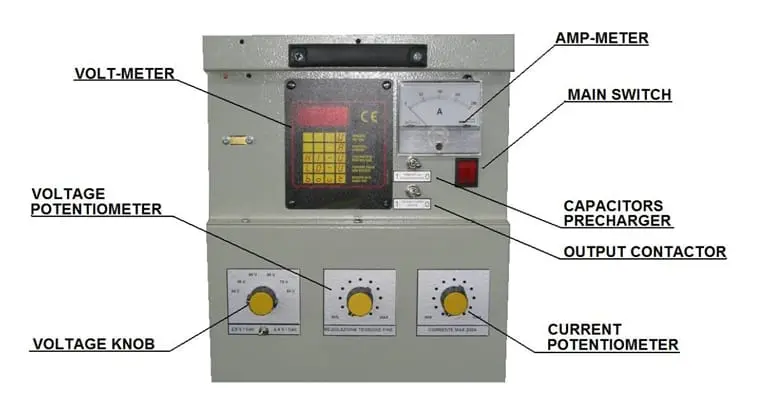
On the front panel of the unit we can find the following elements:
–Digital Voltmeter.
–Analogue ammeter.
–Test voltage selector (12-24-36-48-72-80 V)
–Voltage fine-adjustment potentiometer.
–Current selection potentiometer (0-200 A)
The steps to test a battery charger by means of the Amperis battery simulator are the following:
First the user selects the voltage of the battery to be simulated, using the potentiometer for the voltage adjustment, while the digital display shows the current value. An independent potentiometer is available to select the maximum current that the unit can absorb.
Once the voltage has been selected, the user connects the charger to be tested to the simulator input; the charger will detect that a battery has been connected and will start the charging process. The unit keeps the voltage constant at the selected value, while the analogue ammeter indicates the current supplied by the charger (If the current tends to exceed the maximum value set, the unit increases the voltage in order to limit the current).
In order to simulate the behaviour under any load condition, the user has the advantage of being able to modify the current and the voltage freely. The real curve of the charger is obtained in a few minutes.
Special features, for maximum reliability and flexibility:
• It has a self-test of the power electronic circuits under load, and performs an automatic stop in the event of a fault.
• It has thermal protection of all the electronic components and of the resistor bank in the event of overtemperature (for example: if there are problems with the fans or blocked air ducts, the unit switches to stand-by mode).
• It has a double 2 mm steel casing in order to achieve maximum thermal insulation: during operation, the outer part of the casing is kept at a low temperature (maximum temperature <10°C) and cooling is carried out by forced ventilation.
• Its 4 hard rubber-covered wheels allow it to be moved without difficulty.
As regards the input voltage, the range is wide, 85-135 or 180-250 VAC, the frequency can be 50 or 60Hz, the alternating current input is single-phase and the maximum power is 250W.
All these features and specifications make the Amperis battery simulator the perfect solution for testing the operation of any industrial battery charger.