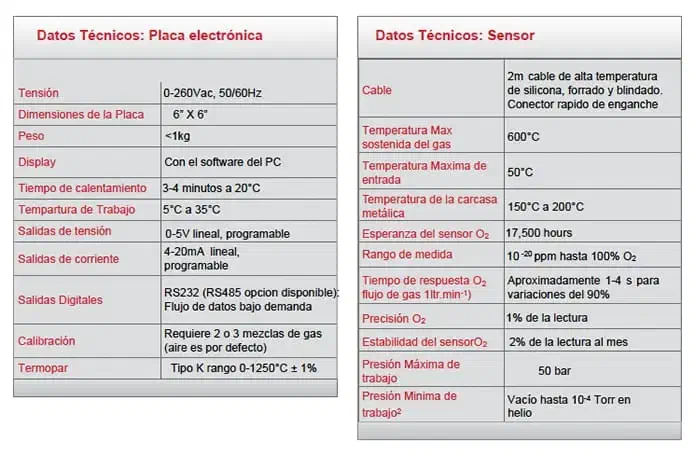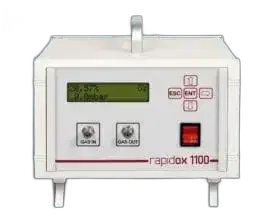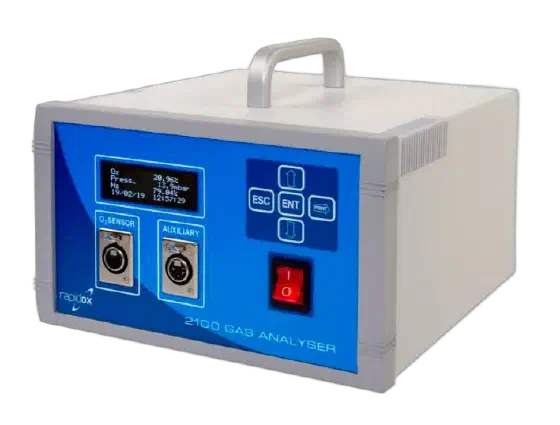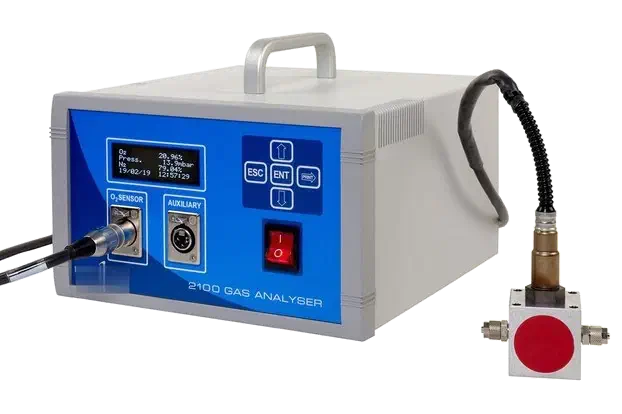
When oxygen has to be measured inside the process itself —a furnace, a vacuum chamber or a hot gas line— the job calls for an analyser with a remote sensor rather than one that extracts the sample. The Rapidox 2100 places its zirconia sensor on a cable up to 25 m from the instrument, in gases up to 650 °C, and measures 10E-20 ppm to 30 % O2 with ±1 % of the actual concentration or 0.5 ppm, reaching 90 % of the reading in approximately 4 s; a standard type K thermocouple reads the sample temperature at the same time.
Rapidox 2100 key data
- Oxygen measurement: zirconia sensor from 10E-20 ppm to 30 % O2, accuracy of ±1 % of the actual concentration or 0.5 ppm (whichever is greater), 90 % response in approx. 4 s and a life above 17,500 h.
- In-process sensor: 2 m high-temperature cable, shielded with a quick-release plug, extendable to 25 m; gas up to 650 °C, working pressure up to 10 bar (200 bar burst) and vacuum-tight below 10E-4 Torr.
- Sample: flow rate of 0.1 to 4 L/min (1 L/min recommended), with static gas and vacuum also allowed.
- Electrochemical alternative: for high oxygen levels, up to 100 % O2, or samples containing VOC, flammable gases, CO, H2 or He.
- Auxiliary measurements: standard type K thermocouple, 0-1250 °C and ±1 °C; optional pressure sensor (−1 to 0 bar vacuum, 0-5 and 0-10 bar gauge) and H2O sensor (−100 °C to +20 °C dewpoint), both on 2 m cables.
- Alarms and outputs: programmable high and low alarm relays, configurable 0-5 V (min. 5 kΩ load) and 4-20 mA (max. 500 Ω load) outputs, RS232 (RS485 optional) and Modbus RTU/Ethernet.
- Installation: 250 × 263 × 150 mm and 3.5 kg with sensor, 300 mm × 4U panel mount or IP65 wall housing, 20 × 4 character OLED display, 60 s warm-up at 20 °C and 90-260 V AC supply with 30 W maximum consumption.
- Compliance: UL/ETL certification UL-61010-1 and EMC Directive 2004/108/EC; operation from 5 °C to 35 °C and 900 to 1,100 mbar absolute.
Advantages
The sensor goes to the process
The zirconia sensor sits on a remote cable inside a metal manifold, flowing the sample over its surface or coupling vacuum-tight to the sampling point. Optional extension cables reach a total of 25 m.
Two sensing technologies
Zirconia covers inert atmospheres, high temperature and vacuum down to the low ppm range; where high oxygen levels or samples with VOC, flammable gases, CO, H2 or He rule it out, an electrochemical sensor covers 1 ppm to 1 % or up to 100 % O2.
More than one measurement
The type K thermocouple (0-1250 °C) is standard, and optional auxiliary pressure, vacuum and dewpoint sensors turn the analyser into a multi-measurement instrument.
Ready for the control room
Programmable high/low alarm relays, 0-5 V and 4-20 mA outputs and RS232/RS485 with Modbus RTU/Ethernet feed readings to SCADA and PLC systems; the Windows software adds live graphing and Excel-compatible logging.
Flexible installation
Panel-mount, wall-mount IP65 or OEM configurations, operating on any worldwide mains voltage (90-260 V AC).
Applications
- Additive manufacturing and metal heat treatment.
- Combustion, chemical processes and controlled atmospheres.
- Glove boxes and gas quality control in manufacturing.
- Research and development.
About the product
The Rapidox 2100 is a fixed-installation oxygen analyser for continuous duty, with password protection and user calibration with up to five gas compositions. It complies with EMC Directive 2004/108/EC and carries UL/ETL certification UL-61010-1.
Available accessories: calibration kit, calibration service, multiplex sampling system, sample pump, gas recovery bag, wall-mount cabinet, stainless probe, vacuum fittings, filters and thermal printer.
Technical specifications
| O2 range | 10E-20 ppm to 30 % (zirconia) or 0-100 % (electrochemical) |
| Sensor location | Remote, up to 25 m with extension cables |
| Thermocouple | Type K, 0-1250 °C, ±1 °C (included) |
| Warm-up time | 60 s at 20 °C |
| Outputs | 0-5 V, 4-20 mA, RS232/RS485, Modbus RTU/Ethernet |
| Alarms | High and low, programmable relays |
| Supply | 90-260 V AC, 50/60 Hz |
| Dimensions and weight | 250 × 263 × 150 mm; 3.5 kg with sensor |
| Accuracy and response (zirconia) | ±1 % of the actual concentration or 0.5 ppm (whichever is greater); 90 % in approx. 4 s |
| Sample and pressure | 0.1-4 L/min (1 L/min recommended); up to 10 bar; vacuum-tight below 10E-4 Torr |
| Optional sensors | Pressure: −1 to 0 bar, 0-5 and 0-10 bar; H2O: −100 °C to +20 °C dewpoint |
Frequently asked questions
How accurately does it measure oxygen at trace levels?
With a zirconia sensor, the Rapidox 2100 measures 10E-20 ppm to 30 % O2 with an accuracy of ±1 % of the actual concentration or 0.5 ppm, whichever is greater, and reaches 90 % of the reading in approximately 4 s. Sensor life exceeds 17,500 h.
Can it measure under vacuum or in pressurised gas?
Yes. With a zirconia sensor, the Rapidox 2100 manifold is vacuum-tight below 10E-4 Torr and withstands up to 10 bar working pressure (200 bar burst), with gas up to 650 °C and a sample flow of 0.1 to 4 L/min or static gas.
Where is the oxygen measured?
Directly in the process: the zirconia sensor sits on a remote cable up to 25 m from the instrument, inside a manifold that also allows vacuum-tight coupling.
Which sensor should be chosen?
Zirconia for inert atmospheres, high temperature and low ppm ranges; electrochemical when the sample carries VOC, flammable gases, CO, H2 or He, or for readings up to 100 % O2.
Can it be integrated into another system?
Yes. Besides the analogue and digital outputs, an OEM version is available for integration into products or processes.
How is calibration performed?
By the user, with up to five selectable gas compositions; air is the default reference.