Summary:
Abstract:
The breakdown voltage of insulating oil decreases under the influences of moisture, acidity, particles and pressure.
Introduction:
The breakdown voltage of a mineral insulating oil was investigated under the influences of moisture, acidity, pressure and particles. The IEC156/95 standards (VDE0370/Part5/96 and ASTM D1816) specify the test conditions to be followed by oil test sets. Moisture provides charge carriers, therefore a moisture saturation from 0 to 20% decreases the breakdown voltage from 72 to 61 kV.
Acid as a degradation product also reduces the dielectric strength for the same reason. It is not the total acid number TAN, but rather the lower effect of molecular acids, the greater the decrease will be. Since the breakdown process starts with a microscopic bubble, an increasing pressure also increases the breakdown voltage. The observed asymptotic behaviour seems to reach a maximum final value of the breakdown voltage at around 150 kV. Low pressure supports the generation of bubbles, reducing the available dielectric strength. Dry particles (cellulose fibre) reduce the breakdown voltage only under low pressure; almost no influence was observed at atmospheric pressure.
Mineral oil, breakdown, particles, acidity, moisture, pressure
Breakdown in insulating oil
- Introduction
The insulating oil in power transformers serves as a heat transfer medium and as a liquid insulator, two reasons that motivated the investigation of its insulating properties: firstly, power transformers are usually operated under ageing conditions. As the moisture content in the oil increases, the ageing or degradation products dissolve and the particles disperse. Secondly, transformers are operated under new environmental conditions, where low and high pressures occur. Safe service and maintenance require a meticulous investigation of these influences.
Theoretical considerations
Insulating liquids derive their dielectric strength from their higher density compared with gases. The breakdown process starts with a microscopic bubble, an area with long distances between corpuscles, where ions and electrons can start avalanches. These microscopic bubbles are caused by current impulses at an electrode. The following current impulse injects charge carriers into the bubble, leading to current amplification and finally to breakdown [1]. From these considerations, the following is expected:
- Moisture provides charge carriers and therefore reduces the available dielectric strength.
- Oxidation products such as acid also provide charge carriers through dissociation. In addition, they are surface active, lowering the surface tension. They thus support the evolution of the bubble, followed by a decrease in dielectric strength.
- Pressure also influences the evolution of the bubble. With increasing pressure, the breakdown voltage should increase. For pressures below atmospheric pressure the breakdown voltage should decrease.
- Particles will move into areas of high field stress depending on their permittivity relative to that of the oil. A decrease in the breakdown voltage is expected if they are highly conductive or wet.
- Influence of moisture and acidity
- Measuring device
A conventional dielectric test system, the Portatest oil test set, measured the breakdown voltage at different moisture and acidity contents. The system works fully automatically, which is very convenient for long test periods. The special advantage is a fast detection of the breakdown and the disconnection of the current in less than 1ms, which together with a low energy in the test circuit prevents the carbonisation of the mineral oil; even hundreds of tests on the same oil sample did not reduce the breakdown voltage due to combustion products.
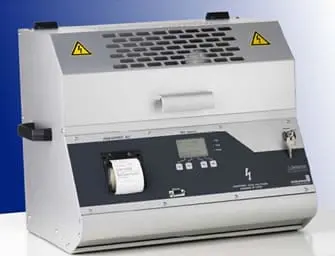
Figure 1: A Portatest automatic test set for insulating liquids
The tests were carried out in accordance with IEC156/95 Figure II (VDE0370/Teil5/96 and ASTM D1816), i.e. spherical electrodes with a radius of 25mm. Figure 1 shows the automatic test system. An automatic potentiometric titration system "Titrino SM 702 with exchange unit 806" made by Metrohm measured the acidity of the oils (Figure 2). Here the Total Acid Number TAN was determined by a volumetric titration with potash to neutralise the carboxylic acids.
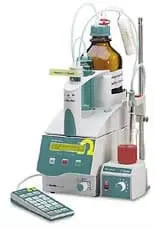
Figure 2
The moisture of the oils was determined as the moisture content relative to saturation (RS in %) by Vaisala HMP 228 capacitive sensors. In order to obtain reliable results, the sensors were carefully calibrated with saturated salt solutions of lithium chloride and sodium chloride. The moisture content relative to saturation (%) provides more information about the crucial effects of moisture on the breakdown voltage than the conventional use of the moisture content relative to weight in ppm. It was therefore checked by measuring the moisture in ppm. Nevertheless this value can be calculated by absorption isotherms as published in [2].