1 kV insulation testers for LV installations
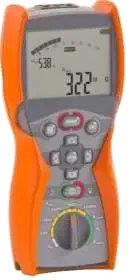
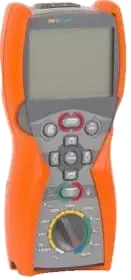
Insulation resistance testers up to 1 kV verify the dielectric integrity of low-voltage assets — building wiring, control and signalling circuits, switchboards and photovoltaic strings. The Amperis range for the electrical sector includes portable instruments that detect moisture ingress, ageing, contamination and wiring faults before they cause nuisance trips or shock hazards.
What it measures and how it works
The tester applies a stable DC voltage — typically 50, 100, 250, 500 or 1000 V — and measures the resulting leakage current to derive insulation resistance, from a few kΩ up to several GΩ. Selectable voltages let you match the asset’s rating. Beyond a single spot reading, a timed measurement and the dielectric absorption ratio (DAR, the 60 s / 30 s ratio) expose damp or contaminated insulation that a continuity check alone would miss.
How to choose the right tester
- Match the test voltage to the asset: 250–500 V for 230/400 V circuits, 1000 V for industrial LV up to 1 kV.
- Choose a portable, battery-powered unit with a rugged IP-rated case for field verification.
- Require a live-circuit warning, automatic discharge and a guard terminal to reject surface leakage.
- Check for internal memory plus Bluetooth or USB export to build compliance records.
- Testing solar arrays? Pick a model with a dedicated photovoltaic insulation mode.
Not sure which range suits your installation? Contact our engineers for a tailored recommendation.
Applications
The 1 kV range is the standard tool for commissioning and preventive maintenance of low-voltage systems:
- Building and industrial electrical installations
- Distribution boards and final circuits
- Control, instrumentation and signalling cabling
- Telecom and data wiring
- Photovoltaic DC strings and LV battery banks
Applicable standards
Amperis instruments are referenced to IEC/EN standards (not national PN/PL designations) and support the relevant installation codes:
- IEC/EN 61557-2 — performance of insulation resistance measuring equipment
- IEC/EN 61010-1 — safety of electrical test and measurement equipment
- IEC/EN 61326-1 — electromagnetic compatibility (EMC)
- IEC 60364-6 — verification of low-voltage installations
- IEC 62446-1 — insulation testing of photovoltaic arrays
Frequently asked questions
What test voltage should I use on a 400 V circuit?
For circuits up to 500 V, IEC 60364-6 specifies a 500 V DC test with a minimum acceptable insulation resistance of 1 MΩ. Drop to 250 V where sensitive electronics are connected.
Can a 1 kV tester check photovoltaic strings?
Yes, if it offers a PV mode. IEC 62446-1 requires an insulation resistance measurement of the array to confirm safe isolation between live conductors and earth during commissioning.
What counts as a healthy reading?
On LV wiring, values well above the 1 MΩ minimum — often hundreds of MΩ — indicate dry, intact insulation. A steady downward trend across periodic tests is the real warning sign.
Technical resources
Compare the rest of the range — up to 2.5 kV, up to 5 kV and the dielectric test sets — or explore our multifunction installation testers. Request a quote and we will match the instrument to your a
Electrical test instrument selector Tell us what you need to measure and on which installation —insulation, earth, loop, RCDs, micro-ohmmeter and other measurements— and get the instrument that covers your specification, with its standard accessories and the ones worth adding. You can send us the selection with the technical report attached. Open the selector and find my equipment Close the selector
Undecided between several models? Compare them side by side: Insulation resistance testers compared · Multifunction installation testers compared · Earth resistance testers compared · Loop impedance testers compared