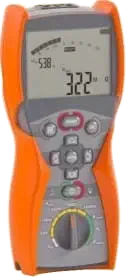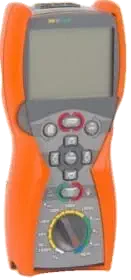
Verifying low-voltage installations, cables, motors and telecom circuits calls for a 1 kV megohmmeter that matches the test voltage to each circuit, calculates the absorption coefficients and stores the results for the test report. The AMIC-30 applies any voltage from 50 to 1000 V in 10 V steps, measures up to 100 GΩ at 1000 V with ±(3% m.v. + 8 digits), gives the DAR and PI coefficients from the t1, t2 and t3 times, checks continuity with more than 200 mA in both directions per EN 61557-4 and keeps 990 memory cells of results that are sent to the PC wirelessly.
AMIC-30 key data
- Test voltage: the AMIC-30 offers fixed values of 50, 100, 250, 500 and 1000 V or any voltage in between in 10 V steps, with a nominal measuring current of 1 mA and the actual voltage on the display.
- Insulation ranges (IEC 61557-2): 50 kΩ…250 MΩ at 50 V, 100 kΩ…500 MΩ at 100 V, 250 kΩ…2 GΩ at 250 V, 500 kΩ…20 GΩ at 500 V and 1 MΩ…100 GΩ at 1000 V.
- Insulation accuracy: ±(3% m.v. + 8 digits) up to 999.9 MΩ and ±(4% m.v. + 6 digits) from 1 to 100 GΩ; with the WS-04 adapter, ±(5% m.v. + 8 digits) and ±(6% m.v. + 6 digits).
- Absorption coefficients: readings at the t1, t2 and t3 times and calculation of Ab1 (DAR) and Ab2 (PI); in DAR/PI mode the default times are t1 = 30 s and t2 = 60 s, and in Ab1/Ab2 mode 15 s and 60 s.
- Continuity: 0.10…1999 Ω per EN 61557-4 with more than 200 mA in both directions and the average resistance displayed, ±(2% m.v. + 3 digits) up to 199.9 Ω; low-current resistance at 5 to 15 mA with ±(3% m.v. + 3 digits).
- Capacitance and voltage: capacitance from 1 nF to 9.99 µF with ±(5% m.v. + 10 digits), measured while the object is discharged, and AC/DC voltage from 0 to 600 V with ±(2% m.v. + 6 digits) up to 299.9 V.
- Memory and environment: 990 cells in 10 banks of 99 with wireless transmission, CAT IV 600 V (CAT III 1000 V), IP67, operation from -10 to +50 °C and about 0.6 kg.
Advantages
A test voltage for every object
Besides the fixed 50, 100, 250, 500 and 1000 V settings, the voltage can be freely configured from 50 to 1000 V in 10 V steps, so electrical, control, telecommunication and ICT circuits are always tested at their proper voltage, with the actual value shown during the test.
Complete insulation diagnosis
The meter reads RISO or leakage current continuously, times T1, T2 and T3 from 1 to 600 s for one or two absorption coefficients, measures the capacitance of the object and discharges it automatically at the end of each test.
More than a megohmmeter
Continuity of protective conductors and equipotential bonding is tested with a current above 200 mA in both directions per EN 61557-4, and the meter also measures resistance with low current and AC/DC voltages up to 600 V.
Repeatable socket testing
The dedicated UNI-Schuko adapter configures the tested pairs directly from the socket, and the GUARD terminal of the three-lead method diverts the surface leakage of contaminated insulation.
Applications
- Insulation testing in single- and multi-family buildings and public facilities.
- Cables, motors and transformers in workshops and small plants.
- Telecommunication, control and ICT circuits tested at low voltages.
About the product
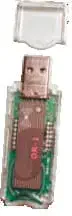
The AMIC-30 is a compact insulation meter for technicians who test installations day after day: up to 100 GΩ at 1000 V, resolution from 0.1 kΩ and a basic accuracy of ±(3% m.v. + 8 digits). Its 990-cell memory sends the results wirelessly to the PC through the supplied USB receiver, where the reader software archives the measurements.
The 500 V and 1000 V settings match the requirements for power supply lines and, with the optional PRS-1 probe, for floors and walls where the insulation of the stand protects against electric shock. The meter runs on four AA batteries, weighs about 0.6 kg and works from -10 to +50 °C.
Available accessories: test leads, pin probes, crocodile clip, carrying case, straps, batteries and calibration certificate; optionally the WS-04 UNI-Schuko adapter, the PRS-1 probe, three-phase adapters and 5 m leads.
Technical specifications
| Test voltage | 50…1000 V, in 10 V steps or fixed values |
| Insulation resistance | Up to 100 GΩ (UN = 1000 V); ±(3% m.v. + 8 digits) |
| Continuity RCONT | >200 mA per EN 61557-4; 0.10…1999 Ω |
| Voltage measurement | AC/DC 0…600 V; 45…65 Hz |
| Capacitance | 1 nF…9.99 µF, measured during RISO |
| Memory and interface | 990 cells; wireless USB receiver |
| Safety | CAT IV 600 V (CAT III 1000 V); IP67 |
| Dimensions and weight | 200 × 100 × 60 mm; approx. 0.6 kg |
| Ranges per voltage (IEC 61557-2) | 250 MΩ (50 V), 500 MΩ (100 V), 2 GΩ (250 V), 20 GΩ (500 V), 100 GΩ (1000 V) |
| Accuracy above 1 GΩ | ±(4% m.v. + 6 digits); with WS-04 adapter: ±(6% m.v. + 6 digits) |
| Continuity and capacitance accuracy | ±(2% m.v. + 3 digits) up to 199.9 Ω; capacitance ±(5% m.v. + 10 digits) |
Frequently asked questions
Does the AMIC-30 calculate the polarization index (PI) and DAR?
Yes. The AMIC-30 records the resistance at the t1, t2 and t3 times and shows Ab1 (DAR) and Ab2 (PI), together with the capacitance and leakage current of the object; in DAR/PI mode the default times are t1 = 30 s and t2 = 60 s.
How accurate is the AMIC-30 when testing at sockets with the WS-04 adapter?
With the WS-04 adapter the insulation accuracy is ±(5% m.v. + 8 digits) up to 999.9 MΩ and ±(6% m.v. + 6 digits) in the GΩ range, compared with ±(3% m.v. + 8 digits) and ±(4% m.v. + 6 digits) with the test leads.
What measuring range does each voltage give?
From 50 kΩ…250 MΩ at 50 V up to 1000 kΩ…100 GΩ at 1000 V, following IEC 61557-2, with the range growing with the test voltage.
Can it test continuity of protective conductors?
Yes. The RCONT function drives more than 200 mA in both directions per EN 61557-4, with ±(2% m.v. + 3 digits) accuracy up to 199.9 Ω.
How are results documented?
Up to 990 memory cells store the readings, which are sent wirelessly to the PC through the included USB receiver and processed with the reader software.
Does it detect live circuits?
Yes. It is protected against measuring energised objects and its voltmeter reads AC and DC voltages up to 600 V before the test.