2.5 kV insulation testers for motors & cables
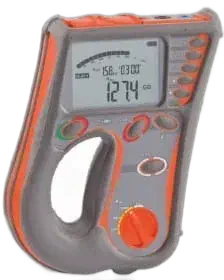
Insulation resistance testers up to 2.5 kV are the everyday diagnostic tool for rotating machines and industrial cabling. They apply a controlled DC voltage to motor and generator windings, LV/MV cables and switchgear, then track how the insulation responds over time to reveal moisture, contamination and thermal ageing. The Amperis range for the electrical sector includes field-ready 2.5 kV instruments for predictive maintenance teams.
What it measures and how it works
At up to 2500 V DC the tester reads insulation resistance into the GΩ–TΩ range and, crucially, plots its behaviour over time. The polarization index (PI, the 10 min / 1 min ratio) and the dielectric absorption ratio (DAR) separate healthy insulation, which keeps absorbing charge, from wet or degraded insulation that quickly stabilises. Temperature correction to a 40 °C reference makes successive tests directly comparable.
How to choose the right tester
- Confirm the voltage covers your assets: 2.5 kV suits most LV motors, small generators and control cables.
- Insist on automatic PI and DAR calculation so trends are logged, not hand-timed.
- Look for temperature compensation and a guard terminal to strip surface-leakage error.
- For noisy plant environments, choose an instrument with interference filtering.
- Prioritise on-board memory and PC software for fleet trending across maintenance cycles.
Unsure whether 2.5 kV or a higher range fits your machines? Talk to our engineers.
Applications
The 2.5 kV range targets industrial rotating plant and distribution assets:
- LV motor and small generator windings
- Industrial power and control cables
- LV switchgear and busbar systems
- Pumps, compressors and machine-tool drives
- Acceptance and routine maintenance testing
Applicable standards
Amperis instruments are referenced to IEC/EN standards rather than national PN/PL variants:
- IEC/EN 61010-1 — instrument safety
- IEC/EN 61326-1 — electromagnetic compatibility (EMC)
- IEEE 43 — insulation resistance and PI for rotating machinery
- IEC 60034-27-4 — off-line insulation resistance of machine windings
- ANSI/NETA ATS — field acceptance testing values
Frequently asked questions
What polarization index indicates good insulation?
Under IEEE 43, a PI of 2.0 or higher is generally acceptable for Class B, F and H insulation; 1.5 is the floor for Class A. A PI below those values, or a falling trend, points to moisture or ageing.
Why correct readings to 40 °C?
Insulation resistance roughly halves for every 10 °C rise, so raw values are misleading. Correcting to the 40 °C reference in IEEE 43 lets you compare today’s test with last year’s on equal terms.
PI or DAR — which should I run?
DAR (a 60 s test) is a fast screen; PI (10 min) is the fuller diagnostic for large machines. Use DAR for quick checks and PI when commissioning or trending critical motors.
Technical resources
Move up to 5 kV or 10 kV for medium- and high-voltage assets, step down to 1 kV testers, or pair winding diagnostics with our transformer test equipment. Request a quote for the right con