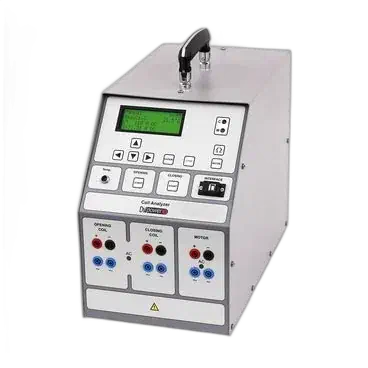
Testing a circuit breaker when the substation battery is not available, or checking it under undervoltage and overvoltage, calls for a regulated source that feeds the coils and the motor while measuring the auxiliary circuit. SAT40A II does it in an 11 kg instrument: four coil outputs of 10 to 300 V DC or 10 to 250 V AC with up to 15 A and ripple below 1 %, two motor outputs that withstand inrush currents up to 40 A, coil resistance measurement from 1 to 999 Ω and an automatic minimum trip voltage test per IEC 62271-100, IEC 56 and ANSI C37.09.
SAT40A II key data
- Coil outputs: 4 independent outputs (2 DC + 2 AC), 10 to 300 V DC or 10 to 250 V AC, up to 15 A; the DC output is filtered to a ripple below 1 % so that coil current curves stay clean and comparable.
- Motor outputs: DC and AC, with inrush current up to 40 A for spring-charging motors; they also serve as a continuous supply or a temporary battery charger.
- Measurement: voltage and current with ±(0.25 % rdg + 0.25 % FS) accuracy, coil current from 1 to 50 A DC; coil resistance from 1 to 999 Ω with 0.1 Ω resolution and ±(0.5 % rdg + 0.5 % FS) typical accuracy between 100 and 999 Ω.
- Tests: automatic minimum trip voltage per IEC 62271-100, IEC 56 and ANSI C37.09, with the voltage versus time graph in the PC software; motor current and spring mechanism charging time; operations under undervoltage and overvoltage; temperature rise of auxiliary equipment.
- Compatibility: powers coils and motors while testing with analyzers from any vendor; together with the CAT analyzers and the PC software it forms a single test system.
- Instrument: 11 kg, consumption up to 4000 VA from 90 to 264 V AC mains, memory for 1000 time- and date-stamped measurements, USB (RS232 and Bluetooth optional).
Advantages
Separate outputs for coils and motor
Four independent coil outputs, from 10 to 300 V DC or 10 to 250 V AC with up to 15 A, and two motor outputs that withstand inrush currents up to 40 A; the motor output also serves as a continuous supply or a temporary battery charger.
Regulated voltage with minimal ripple
The DC output is filtered with a ripple below 1%, so the coil current graphs recorded with a circuit breaker analyzer stay clean and comparable.
Testing away from nominal values
Since the instrument generates the voltage itself, the breaker can be checked under undervoltage and overvoltage conditions, something the substation battery does not allow.
Automatic minimum trip voltage
The test runs fully automatically according to IEC 62271-100, IEC 56 and ANSI C37.09, and with the PC software it is completed with the voltage versus time graph.
Applications
- LV, MV and HV circuit breakers during manufacturing, commissioning and maintenance.
- Power supply for coils and motors while testing with analyzers from any vendor.
- Coil resistance and current measurement per IEC 62271-100.
- Motor current and spring mechanism charging time.
- Temperature rise test of auxiliary and control equipment.
About the product
The instrument measures voltage and current with an accuracy of ±(0.25% + 0.25%) and coil resistance from 1 to 999 Ω with 0.1 Ω resolution. The memory keeps 1000 time-stamped measurements, communication is over USB (RS232 and Bluetooth optional) and, together with the CAT analyzers and the PC software, it forms a single test system. Accessories: cables with touch-proof connectors, temperature probe, Bluetooth module and transport bag.
Technical specifications
| Coil outputs | 4 (2 DC + 2 AC); 10 – 300 V DC / 10 – 250 V AC; up to 15 A |
| Motor outputs | DC and AC; inrush current up to 40 A |
| DC output ripple | Below 1% |
| Coil resistance | 1 – 999 Ω; resolution 0.1 Ω / 1 Ω |
| Accuracy (V, I) | ±(0.25% rdg + 0.25% FS) |
| Memory | 1000 time- and date-stamped measurements |
| Consumption | Up to 4000 VA; mains 90 – 264 V AC |
| Weight | 11 kg |
| Coil current measurement (DC) | 1 – 50 A; ±(0.25 % rdg + 0.25 % FS) |
| Coil resistance accuracy | ±(0.5 % rdg + 0.5 % FS) typical, from 100 to 999 Ω |
Frequently asked questions
How do I power circuit breaker coils when there is no substation battery?
With a regulated portable source that supplies the control voltage and withstands the motor inrush. SAT40A II delivers 10 to 300 V DC or 10 to 250 V AC with up to 15 A on four coil outputs, with ripple below 1 % on DC, and its motor outputs withstand inrush currents up to 40 A.
Which instrument measures the minimum trip voltage of a circuit breaker per IEC 62271-100?
One that generates a variable control voltage and records the value at which the coil operates. SAT40A II runs the test automatically per IEC 62271-100, IEC 56 and ANSI C37.09, documents the exact value and, with the PC software, adds the voltage versus time graph; voltage and current are measured with ±(0.25 % of reading + 0.25 % of full scale).
What is it for if the substation already has a battery?
To be independent of it: it powers the breaker in new or disconnected installations and also allows testing under undervoltage and overvoltage, conditions a fixed battery cannot offer.
Does it work with analyzers from other manufacturers?
Yes. The regulated outputs feed coils and motors whatever the analyzer; with the CAT devices it additionally forms one test system with common software.
What is the minimum trip voltage test?
It verifies that the coil trips at a voltage well below the battery's nominal value, as the standards require; the instrument runs it automatically and documents the exact value.
Why does the source ripple matter?
A high ripple distorts the coil current curve and hides mechanical defects; below 1% the curves can be analysed and compared between operations.