Coil testers for breakers & contactors
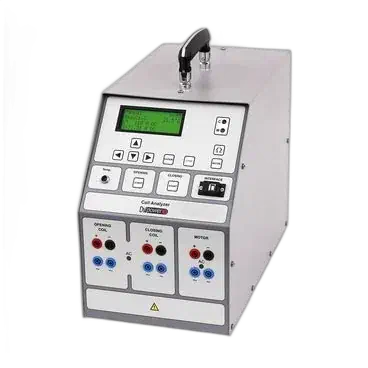
Coil testers (coil analysers) check the trip and close coils that operate circuit breakers and contactors — the actuators a protection scheme relies on to clear a fault. The Amperis range for the electrical sector includes coil analysers that capture coil behaviour and confirm the mechanism will operate when it is called upon.
What it measures and how it works
The analyser energises the coil and records its current signature over time, which reveals friction, a sticking plunger or armature problems long before the breaker fails to operate. It also measures coil resistance and the minimum pickup (operating) voltage — the lowest voltage at which the coil reliably acts. Read together with breaker timing, the coil current explains why an operation has become slow or erratic.
How to choose the right tester
- Confirm the current and voltage ranges for your coils.
- Look for current-signature capture and analysis, not just a resistance value.
- Prefer integration with a circuit-breaker analyser for combined timing and coil data.
- Check minimum-pickup-voltage testing.
- Prioritise logging and trend comparison.
Not sure which analyser fits your breakers? Do not hesitate to contact us.
Applications
- Circuit-breaker and contactor maintenance
- Protection-scheme commissioning
- After-fault verification of trip and close coils
- Predictive diagnostics of operating mechanisms
Applicable standards
Amperis instruments are referenced to the IEC/EN framework (not national PN/PL designations):
- IEC 62271-1 — common specifications, including auxiliary and control circuits and minimum operating voltage of releases
- IEC 62271-100 — high-voltage AC circuit-breakers
- IEC/EN 61010-1 — instrument safety
Frequently asked questions
Why test the operating coil?
A weak or sticking coil can delay or prevent tripping, defeating the protection scheme. The coil current signature exposes the problem before it causes a failure to operate.
What is the minimum pickup voltage?
It is the lowest control voltage at which the trip or close coil reliably operates, a value referenced in IEC 62271-1 to confirm the breaker will act even with a depressed battery voltage.
How does coil current relate to timing?
A change in the coil current signature often explains a change in breaker timing, so the two measurements are analysed together during maintenance.
Technical resources
Combine coil analysis with circuit-breaker testing and SF6 gas tools. Request a quote.