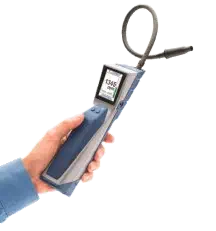
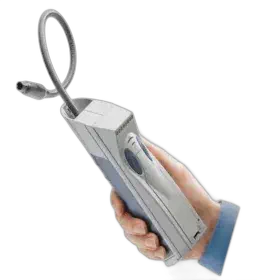
Locating SF6 leaks in switchgear and substation equipment calls for a detector that first narrows down the area by its ppm concentration and then pinpoints the exact spot, with a sensor that does not lose sensitivity over time. The D-TEK combines both functions in a 500 g handheld unit: its infrared refrigerant sensor detects SF6 as standard, with sensitivities tested to EN 14624:2020 down to 0.5 g/yr (R1234yf), lasts up to 2,000 hours and is replaced in the field without tools, and its lithium-ion battery runs about 8 hours in cloud hunting and about 10 hours in pinpoint mode.
D-TEK key data
- Operating modes: cloud hunting with ppm readout on the large LCD display, to narrow down the area of highest concentration, and classic pinpoint mode, to isolate the leaking joint or fitting.
- Detected gases: with the standard refrigerant sensor, SF6, ammonia and all CFCs, HCFCs, HFCs, HFOs and A2L blends; with optional sensors, CO2 (R744) and flammable refrigerants (R290, R600a and R441a).
- Sensitivity (EN 14624:2020): R134a 1 g/yr, R1234yf 0.5 g/yr and ammonia 3 g/yr; CO2 2 g/yr and R290 5 g/yr with the corresponding sensor. The datasheet does not publish a specific figure for SF6.
- Sensor: infrared, with a service life of up to 2,000 hours, sensitivity that does not degrade over time and tool-free field replacement; automatic or manual zeroing.
- Battery life: quick-charge, field-replaceable lithium-ion battery, about 8 h in cloud hunting and about 10 h in pinpoint mode; the D-TEK operates while charging over USB.
- Handling: 500 g, 43 cm flexible probe (69 cm extra-long probe and needle extension optional) and rugged carrying case.
- Certifications and warranty: EN 14624:2020, A2L certified, CE and UKCA; 2-year warranty. It is not ATEX certified.
Advantages
Two detectors in one
The cloud-hunting mode works like a portable monitor, showing ppm concentration on the large LCD to locate the leaking area fast; the pinpoint mode then isolates the exact source.
A sensor that lasts
The redesigned infrared sensor offers the longest service life in its class, does not lose sensitivity over time and is replaced in the field.
Broad gas coverage
Besides SF6, it detects traditional refrigerants and blends; CO2 and flammable gases are covered with the corresponding sensor.
Ready for the working day
Li-Ion battery with quick charge, automatic and manual zeroing and a rugged carrying case included.
Applications
- Locating SF6 leaks in switchgear and substation equipment.
- Maintenance of refrigeration and air-conditioning circuits.
- Periodic checks with portable-monitor coverage.
About the product
The D-TEK is a handheld leak detector with a flexible probe and a large, easy-to-read LCD display. The combination of cloud hunting and pinpointing shortens surveys: the display guides the operator to the area, and the probe isolates the leaking joint or fitting.
Technical specifications
| Sensor | Infrared, field-replaceable |
| Detected gases | SF6, refrigerants, blends; CO2 and flammables with the corresponding sensor |
| Modes | Cloud hunting with ppm; pinpoint |
| Display | Large LCD |
| Zeroing | Automatic and manual |
| Battery | Li-Ion, quick charge |
| Included | Rugged carrying case |
| Sensitivity (EN 14624:2020) | R134a: 1 g/yr; R1234yf: 0.5 g/yr; ammonia: 3 g/yr; CO2: 2 g/yr and R290: 5 g/yr with optional sensor |
| Sensor life and battery | Up to 2,000 h; battery about 8 h (cloud hunting) and 10 h (pinpoint) |
| Probe, weight and certifications | 43 cm (69 cm extra-long optional); 500 g; EN 14624:2020, A2L, CE |
Frequently asked questions
Which detector is best for locating SF6 leaks in a substation?
One that combines hunting the gas cloud with pinpointing the exact spot, and a sensor that does not lose sensitivity. The D-TEK shows the concentration in ppm to narrow down the area and then pinpoints the leak with the same instrument; it detects SF6 with the standard sensor and weighs 500 g. It is not ATEX certified, so local requirements must be checked before working in classified areas.
What comes with the D-TEK and how long does the battery last?
It is supplied with the infrared refrigerant sensor, lithium-ion battery, spare filters, AC wall charger, 12 V DC car charger, extra-long probe, earbuds and carrying case. The battery runs about 8 h in cloud hunting and about 10 h in pinpoint mode, and the unit keeps working while it charges over USB.
What is cloud-hunting mode?
A search mode that behaves like a portable monitor: it shows the concentration in ppm to signal the area containing the leak before switching to pinpoint mode.
Which gases does it detect?
SF6, traditional refrigerants and blends; CO2 and flammable gases with the corresponding sensor.
Does the sensor wear out?
Its service life is the longest in its class and sensitivity does not degrade over time; when replacement is due, it is done in the field.
How is the reading kept stable?
Through automatic zeroing, with a manual mode available on demand.