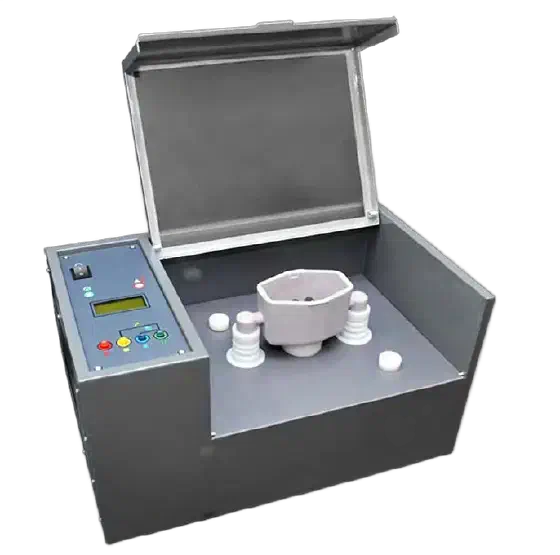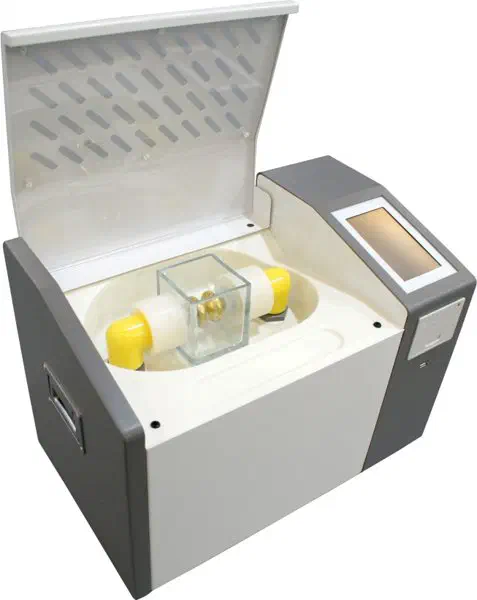
The AHZJQ-X1 measures the breakdown voltage (BDV) of transformer and insulating oils up to 80 kV at 50 Hz. After filling the cup and choosing the standard, it runs the whole sequence by itself, from standing and stirring to the last breakdown, and prints each value with the mean.
Advantages
The whole test from one key
Standing, stirring, voltage rise at a constant rate, breakdown detection, rest and repetition up to 10 breakdowns per cup run automatically, with mean, standard deviation and coefficient of variation at the end.
Standard or custom sequences
IEC 60156:2018, BS EN 60156, CEI EN 60156, VDE 0370-5, GB/T 507, DL/T 429.9 and DL/T 846.7 are preset; in custom mode the stop voltage (10-80 kV), rise rate (0.5-5.0 kV/s), stirring, standing, interval and number of breakdowns can be set.
Accurate high voltage
A 1.5 kVA step-up transformer with distortion below 3 % and ± 3 % accuracy, controlled by a microcontroller for an even rate of rise.
Results ready for the report
Built-in thermal printer, 100 results stored without power, export to a USB stick and optional RS-232, with sample number, standard and date on every record.
Applications
- Acceptance testing of new insulating oil.
- Periodic condition testing of oil from power and distribution transformers, reactors and tap changers.
- Checking oil after filtration, drying or regeneration.
- Oil laboratories of utilities, railways, petrochemical plants and industry.
About the product
The AHZJQ-X1 is operated from a colour touch screen with English and Chinese menus. During the test it shows the countdown of each phase and the rising voltage, and the operator can hold, raise or lower the voltage or skip the standing time. Over-voltage, over-current and limit protections and the high-voltage switch on the lid protect the operator. It runs from 230 V AC, draws 200 W and measures 460 × 280 × 320 mm.
Technical specifications
| Parameter | Value |
|---|---|
| Test voltage | 0-80 kV AC, 50 Hz |
| Voltage distortion | < 3 % |
| Step-up transformer capacity | 1.5 kVA |
| Measurement accuracy | ± 3 % |
| Rate of voltage rise | 0.5-5.0 kV/s, adjustable |
| Stop voltage (custom mode) | 10-80 kV, adjustable |
| Stirring time | 0-120 s, adjustable, or continuous stirring |
| Standing time before the first test | 0-15 min, adjustable |
| Interval between breakdowns | 0-5 min, adjustable |
| Number of breakdowns per cup | 1-10, adjustable |
| Test standards (selectable) | IEC 60156:2018, BS EN 60156, CEI EN 60156, VDE 0370-5:1996, GB/T 507-2002, DL/T 429.9-1991, DL/T 846.7-2016 and custom sequence |
| Electrodes | Spherical or mushroom, gap set with the supplied feeler gauge (2.5 mm in the standard sequence) |
| Results | Each breakdown value and the mean; standard deviation and coefficient of variation |
| Display and operation | Colour touch-screen LCD; English and Chinese menus |
| Memory | 100 test results, retained without power; search, print and delete |
| Printer | Built-in thermal printer: each breakdown value and the mean |
| Data interfaces | USB (export of all stored results to a USB stick); RS-232 optional |
| Other functions | Real-time clock, temperature display, sample number entry, automatic printing on/off |
| Protections | Over-voltage, over-current and limit protection; high-voltage interlock on the lid |
| Power supply | 230 V AC, 50/60 Hz |
| Power consumption | 200 W |
| Operating conditions | 0 °C to +45 °C; < 75 % RH |
| Dimensions | 460 × 280 × 320 mm |
| Supplied with | Main unit, oil cup, 2 elbows, 2 stirrers, feeler gauge, tweezers, power cord, 2 fuses, 2 rolls of printer paper, Allen key |
Specifications subject to change without notice.
Frequently asked questions
Which standards does it apply?
IEC 60156:2018, BS EN 60156, CEI EN 60156, VDE 0370-5:1996, GB/T 507-2002, DL/T 429.9-1991 and DL/T 846.7-2016, plus a fully configurable custom sequence.
How many breakdowns does it make per sample?
Between 1 and 10, as set by the standard or by the user, with an adjustable interval of 0 to 5 minutes between them.
How are the results documented?
Each breakdown value and the mean are printed on the built-in thermal printer; the 100 most recent results are kept in memory and can be exported to a USB stick.
What electrodes does it use?
Spherical or mushroom electrodes, with the gap set using the supplied feeler gauge (2.5 mm in the standard sequence).
How is the oil cup looked after?
It is cleaned with petroleum ether, rinsed with the oil to be tested and kept filled with clean insulating oil between tests; the electrode gap is checked before each use.