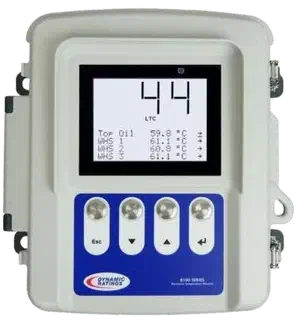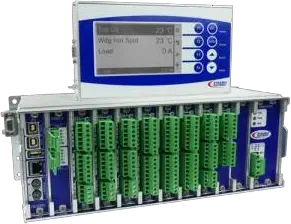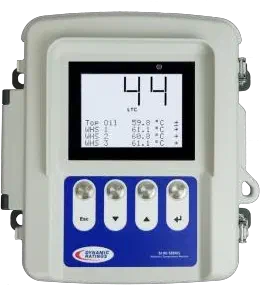
Replacing a transformer's mechanical top-oil and winding temperature gauges with a device that does not stick, calculates the hot spot and raises remote alarms calls for an electronic temperature monitor (ETM). The B100 replaces up to five gauges (top oil, LTC oil and up to three winding hot spots): it measures with two Pt100 RTDs and three current transformers, calculates the hot spot and the thermal ageing of the insulating paper, drives staged cooling with six relays and communicates over DNP3, Modbus or IEC 61850. It needs no recalibration, operates from -40 to +70°C and accepts an optional hydrogen, or hydrogen and moisture, sensor in the oil.
B100 key data
- Gauge replacement: the B100 replaces up to five mechanical gauges — top oil, LTC oil and up to three winding hot spots — and stores the history of temperatures and alarm activations.
- Inputs and outputs: 2 Pt100 RTDs (top oil and ambient), 3 CT inputs for load current, 1 digital input, 6 configurable relays, 2 analogue outputs and 1 system alarm relay; the minimum required is one top-oil RTD and one CT.
- Calculations: hot spot for up to 3 windings, LTC Delta T against top oil and accumulated thermal ageing of each winding, with up to 4 alarm levels per temperature input.
- Cooling: the B100 controls staged cooling from oil temperature, winding temperature or load current, schedules periodic fan exercise and has fail-safe contacts that turn cooling on if the unit has a problem.
- Hydrogen and moisture (optional): H2 sensor in oil or in the headspace, 25 to 5000 ppm (accuracy 20% of reading or 25 ppm, whichever is greater, in oil), or a combined sensor that adds moisture (0-95% RH, ±2%), pressure (0-205 kPa) and oil temperature (±0.1°C), in an IP68 housing.
- Display and setup: backlit LCD with 30 mm digits readable from 60 ft (18 m), in bright sunlight or at night; configured with four pushbuttons, with no computer or software.
- Communications: USB, 100Base-T (RJ45) or 100Base-FX fibre (SC or ST) Ethernet and optional RS-485 or serial fibre; DNP3, Modbus and IEC 61850, built-in web pages and the iBridge option over power wiring.
- Construction: IP66/NEMA-4 cast aluminium enclosure, 287 x 296 x 129 mm, or IP31/NEMA-2 panel versions; 48-240 VDC or 110-240 VAC; -40 to +70°C; service life beyond 20 years with no recalibration.
Advantages
Replaces mechanical gauges
Mechanical gauge needles stick over time. The B100 replaces up to five gauges — top oil, LTC oil and up to three winding hot spots — and stores the temperature and alarm history.
Day and night readable display
The backlit display, with 30 mm digits and a fifteen-segment bar graph, is clearly readable from up to 60 feet, in bright sunlight or at night, with no need to open the enclosure.
Configuration without a computer
The four front-panel pushbuttons let you configure alarms and setpoints in the field or remotely, with no software installation: the unit is up and running within minutes.
Built for the outdoors
The cast aluminium enclosure, rated IP66/NEMA-4, withstands water, dirt and temperatures from -40°C to 70°C, with a service life beyond twenty years and no recalibration.
Integrated secure communications
It connects to SCADA via DNP3, Modbus or IEC 61850 over Ethernet or RS-485/fibre, and supports the iBridge system to communicate over existing power wiring.
Applications
- Distribution, transmission and generation transformers, new or retrofit.
- Replacement of mechanical top oil, LTC oil and hot-spot gauges.
- Cooling control based on oil temperature, winding temperature or load current.
- Fleet monitoring with remote alarm notification.
About the product
The B100 provides two RTD inputs, three current inputs for load and hot-spot calculation, and configurable relay outputs for alarms, trips and cooling. The LTC Delta T analytic filters out false alarms, and the built-in web dashboard lets you view the data from any browser with no software licences.
It can be expanded with a hydrogen and/or moisture sensor for an all-in-one solution with remote notification of problems in the oil or insulating paper.
Accessories available: auxiliary current transformers CT-054 and CT-055 (1000:1, 5 A); magnetic-mount temperature sensors MMTS-3C and MMTS-3W; SE-060 RTD probe for a 1/2" NPT thermal well; and the iBridge communications system (CE-520/CE-530 and IND2000N to IND2100N couplers).
Technical specifications
| Inputs | 2 Pt100 RTDs; 3 CTs for load current; 1 digital input |
| Outputs | 6 digital relays; 2 analogue outputs; 1 system alarm relay |
| Calculations | Hot spot for up to 3 windings; LTC Delta T |
| Communications | DNP3, Modbus, IEC 61850; copper/fibre Ethernet, RS-485; USB; optional iBridge |
| Display | Backlit LCD, FSTN tempered glass with anti-UV coating; 30 mm digits; 20 x 4 character menu |
| Power supply | 48-240 VDC or 110-240 VAC, 50/60 Hz |
| Environmental conditions | -40 to +70°C; enclosure rated IP66/NEMA-4 |
| Dimensions | 287 x 296 x 129 mm; M20/M25 cable entries |
| Hydrogen sensor (optional) | H2 in oil or headspace: 25-5000 ppm; in oil, accuracy 20% of reading or 25 ppm and repeatability 10% or 15 ppm (whichever is greater) |
| H2 and moisture sensor (optional) | Moisture 0-95% RH (±2% RH) or 1-10,000 ppm; pressure 0-205 kPa (±2% FS); oil temperature -40 to +125°C (±0.1°C); RS-485 Modbus; IP68 |
| Ethernet and mounting | 100Base-T (RJ45) or 100Base-FX (SC or ST); IP66/NEMA-4 enclosure or IP31/NEMA-2 through-panel or surface panel mount |
Frequently asked questions
Should the B100 hydrogen sensor go in the oil or in the headspace?
Both options are available for the B100, with a 25 to 5000 ppm range. Hydrogen is the first fault gas generated and takes time to dissolve in oil, so it accumulates sooner in the headspace: a gas-space sensor typically responds faster, while the in-oil sensor measures dissolved gas with an accuracy of 20% of reading or 25 ppm.
What happens if the B100 itself fails?
The B100 runs continuous self-diagnostics, has a relay dedicated to the system alarm, and its fail-safe contacts turn the cooling on if the unit has a problem. Unlike the stuck needle of a mechanical gauge, which gives no warning, the B100 raises an alert so the problem can be corrected in time.
How many gauges does the B100 replace?
Up to five: top oil, LTC oil and up to three winding hot spots.
Does it need software to be configured?
No. It is configured with the front-panel pushbuttons or remotely, with no software installation, and is running within minutes.
Which communication protocols does it support?
DNP3, Modbus and IEC 61850 over Ethernet or RS-485/fibre, with a built-in web dashboard and, optionally, iBridge over existing wiring.
Can it control the cooling?
Yes. The output relays can be configured to drive cooling based on oil temperature, winding temperature or load current.
What additional sensors are available?
Hydrogen and/or moisture, to detect problematic conditions in the oil and insulating paper long before a fault occurs.
The Dynamic Ratings B100 is manufactured by Dynamic Ratings and distributed by Amperis.