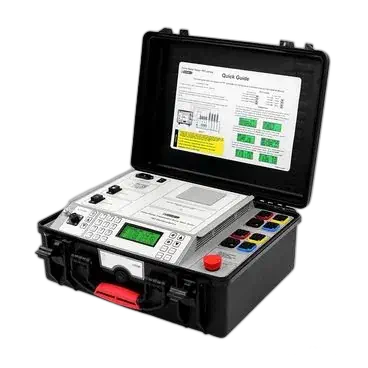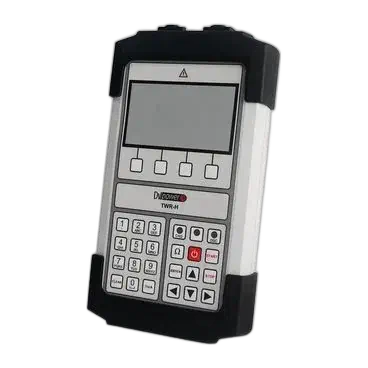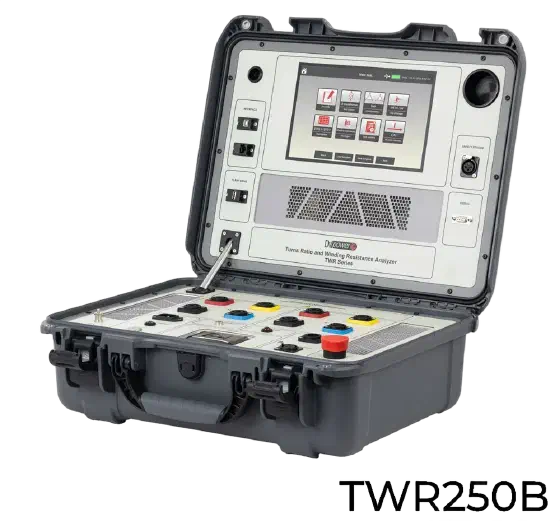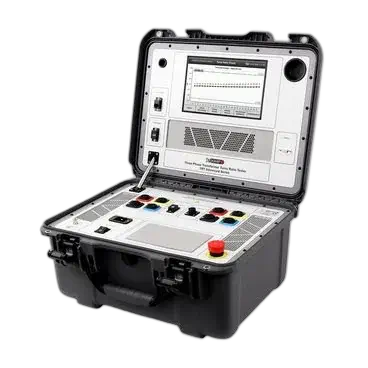
Turns ratio tester up to 500 V AC, with touch screen, true three-phase test voltage and an extension for capacitive voltage transformers
Measuring the turns ratio of large power transformers with the best accuracy calls for a high test voltage, accuracy far better than the ±0.5% tolerance of IEC 60076-1 and automated testing across every tap changer position. The TRT Advanced series tests at up to 500 V AC (TRT500), with ±0.03% typical and ±0.075% guaranteed accuracy at 250, 430 and 500 V for ratios 0.8 to 999; on three-phase transformers it applies either a true three-phase voltage (simultaneous test) or three single-phase voltages in turns (sequential test), and its touch screen stores test templates and steps through multiple tap positions in automatic mode without a PC. With the CVT20 auxiliary transformer, TRT500 also verifies capacitive voltage transformers at up to 5,000 V AC.
TRT Advanced series key data
- Models and test voltage: TRT500 up to 500 V AC, TRT400 up to 430 V AC, TRT250 up to 250 V AC and TRT100 up to 170 V AC; test voltages of 1, 8, 10, 40, 80, 100, 170, 250, 430 and 500 V AC depending on the model.
- Turns ratio: 0.8–50,000 range, 5-digit resolution. Accuracy for ratios 0.8 to 999: ±0.03% typical and ±0.075% guaranteed at 500, 430 and 250 V; ±0.05% typical and ±0.125% guaranteed from 1 to 100 V.
- Three-phase testing: simultaneous with a true three-phase voltage (the line voltage is selected and the result is the voltage ratio), sequential phase by phase (turns ratio) or both, with automatic vector group detection; the H and X leads are shared with the TWA winding analyzer for ratio, winding resistance, DVtest and demagnetization.
- Excitation current and phase shift: excitation current accuracy ±(0.25% of reading + 0.5 mA) typical; phase shift 0 to 360° with ±0.05° typical.
- Capacitive voltage transformers: with the CVT20 auxiliary transformer, TRT500 raises the test voltage up to 5,000 V AC, a test the Standard series does not cover.
- Screen and automation: 10.1 inch (TRT500) or 7 inch (rest) touch screen that stores test templates and runs the automatic mode across multiple tap-changer positions, with remote tap-changer control on all four models.
- Memory and interface: 32 GB SD card for tens of thousands of results and templates, USB and Ethernet; the PC software exports results to spreadsheet or PDF.
- Dimensions and weight: 505 × 257 × 409 mm and 10.5 kg (TRT500); 478 × 194 × 390 mm and 9 kg (TRT400, TRT250 and TRT100).
Advantages
Single-phase test voltage up to 500 V AC
TRT500 reaches 500 V AC, the highest in the range, for the best accuracy on large power transformers; TRT400, TRT250 and TRT100 cover 430, 250 and 170 V AC.
Extension to 5,000 V AC for capacitive voltage transformers
With the CVT20 auxiliary transformer, TRT500 also verifies capacitive voltage transformers, a test that requires several kilovolts and that the Standard range does not cover.
Test templates and automatic mode on the screen itself
The 7 or 10.1 inch touch screen stores test templates and runs the automatic mode across multiple tap-changer positions, a function previously available only from the PC.
Extended memory and Ethernet connection
A 32 GB SD card stores tens of thousands of results and templates, and the interface adds Ethernet alongside the standard USB port.
Applications
- Commissioning and maintenance of power, distribution and instrument transformers, with or without a tap changer.
- Testing of capacitive voltage transformers with TRT500 and the CVT20 auxiliary transformer.
- Testing of special transformers - phase-shifting, rectifier and arc-furnace units - with true three-phase test voltage.
- Field maintenance rounds using test templates stored beforehand in the instrument itself.
About the product
The range comprises four models - TRT500, TRT400, TRT250 and TRT100 - which share the 0.8 to 50,000 ratio range and automatic vector group detection, and differ in maximum test voltage and screen size, 10.1 inches on TRT500 and 7 inches on the rest.
All four include remote tap-changer control, 32 GB of internal memory and a USB and Ethernet interface; the PC software creates test templates and exports results to spreadsheet or PDF. Accessories available: H and X cable sets in several lengths, transport cases, TRTC verification calibrator, built-in thermal printer and, for TRT500, the CVT20 auxiliary transformer.
Technical specifications
| Models | TRT500, TRT400, TRT250 and TRT100 |
| Test voltage source | Single-phase and true three-phase |
| Maximum test voltage | 500/430/250/170 V AC (TRT500/400/250/100) |
| Turns ratio range / accuracy | 0.8 - 50,000; from ±0.03% |
| Display | Touch screen, 10.1 in (TRT500) or 7 in (rest) |
| Internal memory | 32 GB SD card |
| Interface | USB and Ethernet |
| Dimensions and weight | 505×257×409 mm, 10.5 kg (TRT500); 478×194×390 mm, 9 kg (rest) |
| Turns ratio accuracy | ±0.03% typical, ±0.075% guaranteed (500/430/250 V, ratio 0.8 - 999); ±0.05% typical, ±0.125% guaranteed (1 - 100 V) |
| Excitation and phase shift accuracy | ±(0.25% rdg + 0.5 mA) typical; phase shift 0 - 360°, ±0.05° typical |
Frequently asked questions
What test voltage is best for measuring the turns ratio of a large power transformer?
A high one, which gives the best accuracy on large power transformers. TRT500 from the TRT Advanced series tests at up to 500 V AC (TRT400 up to 430 V and TRT250 up to 250 V), and at those voltages its accuracy for ratios 0.8 to 999 is ±0.03% typical and ±0.075% guaranteed, compared with ±0.05% typical from 1 to 100 V.
What is the difference between the TRT Advanced and TRT Standard series?
TRT Advanced reaches 500 V AC, against 250 V AC on the Standard, and adds a touch screen with templates and automatic mode, a 32 GB SD card and Ethernet; with the CVT20 it also tests capacitive voltage transformers at up to 5,000 V AC, which the Standard does not cover. Both share the 0.8 to 50,000 ratio range, simultaneous (true three-phase) and sequential three-phase testing (on the Standard, TRT33 and TRT63 only) and ±0.03% typical accuracy at 250 V.
What is the practical difference between the four Advanced series models?
Mainly the maximum test voltage - 170, 250, 430 and 500 V AC on TRT100, TRT250, TRT400 and TRT500 - and screen size, larger on TRT500.
How are capacitive voltage transformers tested?
By connecting the CVT20 auxiliary transformer to TRT500, which raises the test voltage up to 5,000 V AC.
Is the PC software needed to automate testing across multiple tap-changer positions?
No: the touch screen already includes test templates and an automatic mode that steps through the positions without manual intervention.
Can the same leads be used as the TWA winding analyzer?
Yes: TRT Advanced shares its H and X leads with the TWA, so a single connection to the bushings covers the ratio test, winding resistance, DVtest and demagnetization.