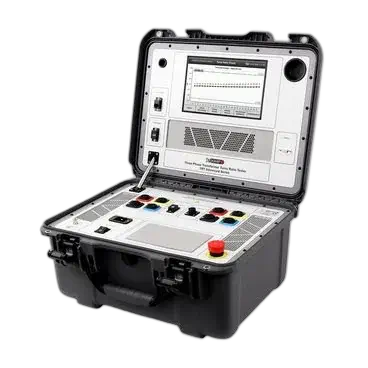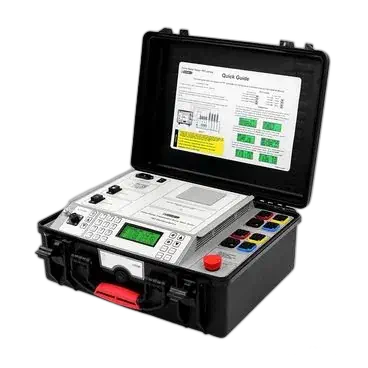
Single- and three-phase turns ratio tester with true three-phase test voltage and tap changer control
Verifying the turns ratio of power, distribution and instrument transformers calls for a tester far more accurate than the ±0.5% tolerance of IEC 60076-1, with vector group detection and, where a tap changer is fitted, control of it. The TRT Standard series measures turns ratio from 0.8 to 50,000 with ±0.03% typical accuracy at 250 V (TRT63) or ±0.05% between 1 and 100 V (TRT03 and TRT33), together with phase shift and excitation current; on three-phase transformers, TRT33 and TRT63 apply, from a single connection, either a true three-phase test voltage (simultaneous test) or three single-phase voltages in turns (sequential test), and a built-in unit operates the on-load tap changer remotely.
TRT Standard series key data
- Models and test voltage: TRT03, single-phase from 8 to 100 V AC; TRT33, single- and three-phase from 1 to 100 V AC; TRT63, single- and three-phase from 1 to 250 V AC. Nominal test voltages of 1, 8/10, 40, 80/100 and 250 V AC depending on the model.
- Turns ratio: 0.8–50,000 range, 5-digit resolution. Accuracy for ratios 0.8 to 999: ±0.03% typical and ±0.075% guaranteed at 250 V; ±0.05% typical and ±0.125% guaranteed from 1 to 100 V.
- High ratios: typical accuracy of ±0.05% from 1,000 to 3,999 and ±0.1% from 20,000 to 50,000, both at 250 V (TRT63).
- Three-phase testing: on TRT33 and TRT63, simultaneous with a true three-phase voltage (the line voltage is selected and the result is the voltage ratio), sequential phase by phase (turns ratio) or both in succession, without changing the leads; TRT03 tests single-phase only. Automatic vector group detection and magnetic balance test with the same wiring.
- Excitation current and phase shift: excitation current 0 to 2 A with ±(0.25% of reading + 0.5 mA) typical and ±(0.25% + 1 mA) guaranteed accuracy; phase shift 0 to 360° with ±0.05° typical and ±0.1° guaranteed.
- On-load tap changer: built-in control unit that operates it from the instrument itself, so one operator completes a multi-position test.
- Test records: internal memory for up to 10,000 tests, USB as standard and optional RS-232; the PC software exports reports to Excel, Word or PDF.
- In the field: 478 × 194 × 390 mm and 8 kg (TRT03, TRT33) or 9 kg (TRT63); shares the H and X leads with the TWA winding analyzer for ratio, winding resistance, DVtest and demagnetization.
Advantages
True three-phase test voltage
The TRT33 and TRT63 models apply a genuine three-phase voltage instead of switching a single phase across the three bushings, so special designs - phase-shifting, rectifier or arc-furnace transformers - can be tested without extra modules.
Automatic vector group detection and magnetic balance
Both tests run without altering the cable setup used for the ratio measurement, and results are shown numerically and graphically so core irregularities show up immediately.
One cable setup for six tests
TRT Standard shares its H and X leads with the TWA Winding Analyzer: a single connection to the bushings covers ratio, excitation current, phase angle, winding resistance, tap-changer DVtest and demagnetization.
Remote tap changer control
A built-in control unit drives the on-load tap changer from the instrument itself, so one operator completes a multi-position test without a second person at the OLTC cabinet.
Applications
- Commissioning and periodic testing of power and distribution transformers, with or without a tap changer.
- Ratio and polarity verification of current transformers, from a 1 V AC test voltage.
- Testing of special transformers: phase-shifting, rectifier and arc-furnace units.
- Field maintenance rounds combined with winding resistance testing, sharing the same leads.
About the product
The series covers three voltage levels: TRT03 outputs up to 100 V AC single-phase; TRT33 adds a true three-phase source up to 100 V AC; and TRT63 extends it to 250 V AC. All three share the 0.8 to 50,000 ratio range, with accuracy from ±0.03% and automatic vector group detection.
Results appear on a backlit LCD and are stored in an internal memory of up to 10,000 records, downloadable over USB or optional RS-232. The PC software mirrors the instrument's functions from a PC and exports reports to Excel, Word or PDF. Accessories available: H and X cable sets in several lengths, cable cases, TRTC calibrator, optional Bluetooth module and optional 58 mm thermal printer.
Technical specifications
| Models | TRT03, TRT33 and TRT63 (A/B/C mains variants) |
| Test voltage source | Single-phase (TRT03); single-phase and true three-phase (TRT33, TRT63) |
| Test voltage range | 8-100 V AC (TRT03); 1-100 V AC (TRT33); 1-250 V AC (TRT63) |
| Turns ratio range / accuracy | 0.8 - 50,000; from ±0.03% |
| Excitation current range | 0 - 2 A |
| Internal memory | Up to 10,000 test records |
| Interface | USB (standard); RS-232 (optional) |
| Dimensions and weight | 478 × 194 × 390 mm; 8 kg (TRT03, TRT33) or 9 kg (TRT63) |
| Turns ratio accuracy | ±0.03% typical, ±0.075% guaranteed (250 V, ratio 0.8 - 999); ±0.05% typical, ±0.125% guaranteed (1 - 100 V) |
| Accuracy at high ratios | ±0.05% typical (1,000 - 3,999) and ±0.1% typical (20,000 - 50,000), at 250 V |
| Excitation and phase shift accuracy | ±(0.25% rdg + 0.5 mA) typical; phase shift 0 - 360°, ±0.05° typical, ±0.1° guaranteed |
Frequently asked questions
Which turns ratio tester suits a three-phase transformer with an on-load tap changer?
One that tests all three phases without rewiring, detects the vector group and operates the tap changer remotely. TRT33 (up to 100 V AC) and TRT63 (up to 250 V AC) from the TRT Standard series are connected once, test three-phase simultaneously with a true three-phase voltage or phase by phase and, with their built-in control unit, step through multiple tap positions with a single operator; TRT63 reaches ±0.03% typical accuracy.
What turns ratio accuracy is needed to meet IEC 60076-1?
IEC 60076-1 allows a ±0.5% deviation of the ratio from the nameplate, so the tester must be considerably more accurate. The TRT Standard series guarantees ±0.075% at 250 V (TRT63) and ±0.125% from 1 to 100 V (TRT03 and TRT33) for ratios 0.8 to 999, between four and more than six times better than that tolerance; typical values are ±0.03% and ±0.05%.
What is the practical difference between TRT03, TRT33 and TRT63?
TRT03 only outputs single-phase voltage up to 100 V AC; TRT33 and TRT63 add a true three-phase source, and TRT63 reaches the highest voltage, 250 V AC.
What does “true three-phase test voltage” mean?
The instrument energises all three bushings at once instead of one phase at a time, which measures the real phase shift and tests transformers with irregular vector groups.
Can the same leads be used for winding resistance testing?
Yes: TRT Standard uses the same H and X cable sets as the TWA, so the leads stay connected for both tests.
How are test results documented?
Results are stored in the internal memory and downloaded over USB or RS-232; the PC software presents them numerically and graphically and exports to Excel, Word or PDF.