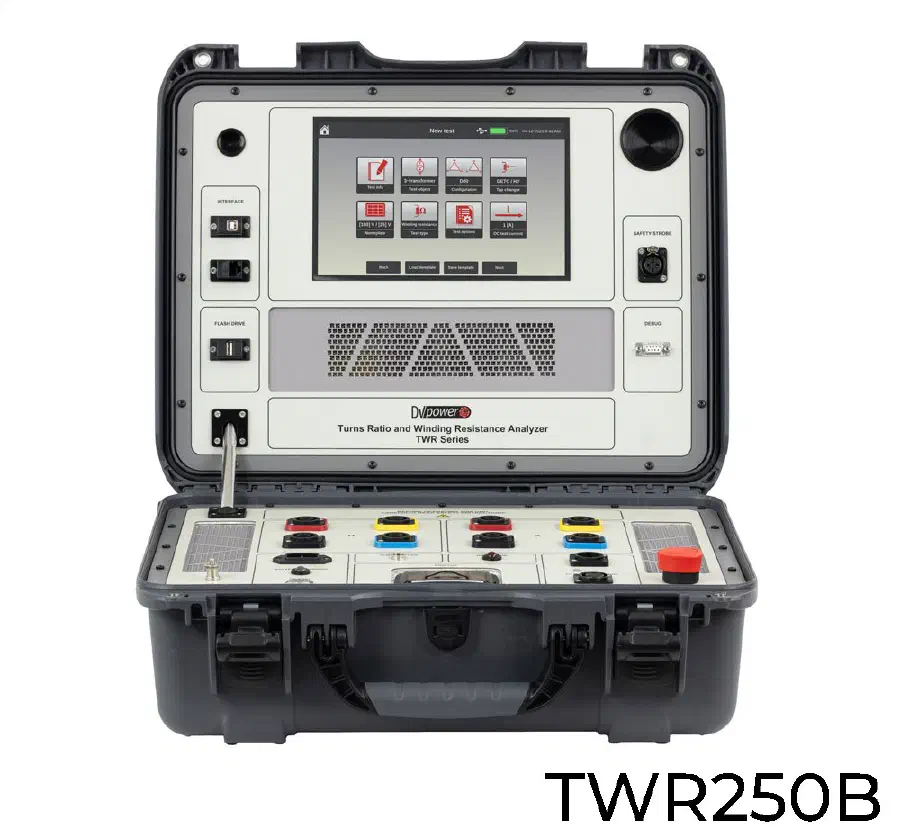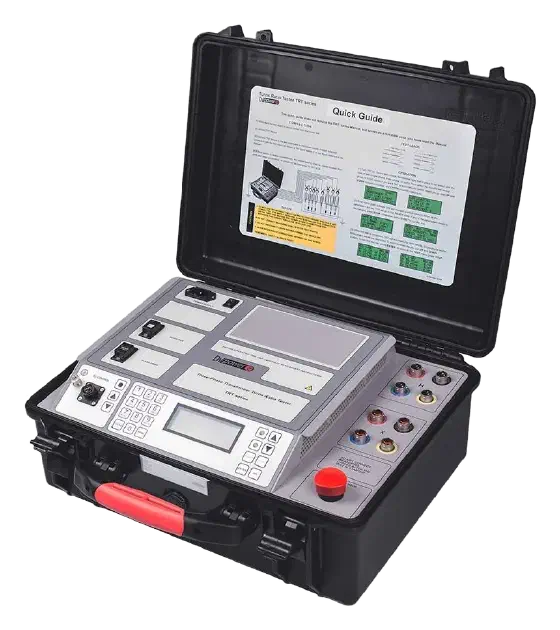
Three-phase turns ratio and winding resistance analyzer for power transformers, with a single connection
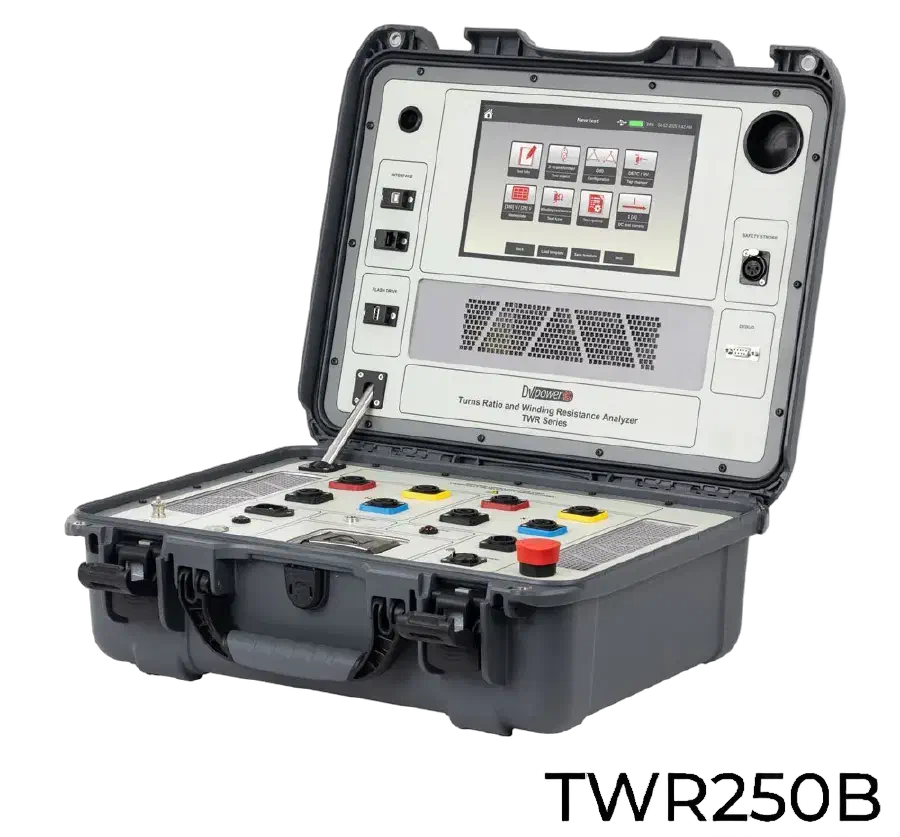
Testing three-phase power transformers calls for an analyzer that measures turns ratio with true three-phase excitation, with accuracy far better than the ±0.5 % tolerance of IEC 60076-1, and that controls the on-load tap changer. TWR250B does it from a single connection to all 6 or 8 terminals: turns ratio with ±0.03 % typical accuracy, three-phase simultaneous up to 200 V AC or phase by phase up to 250 V AC, and winding resistance up to 25 A DC, plus phase shift, excitation current, demagnetization and the tap changer dynamic test (DVtest), operating the tap changer remotely across multiple positions.
TWR250B key data
- Turns ratio: 0.8–50,000 range, 5-digit resolution; three-phase simultaneous test (line-to-line voltage ratio, up to 200 V AC), phase by phase (turns ratio, up to 250 V AC) or both in sequence. Accuracy at 250 V for ratios 0.8 to 999: ±0.03 % typical and ±0.075 % guaranteed.
- Winding resistance: ripple-free DC current from 5 mA to 25 A (up to 10 A on battery), up to 50 V; 0.1 µΩ–100 kΩ range; accuracy ±(0.1 % of reading + 0.1 % of full scale) typical and ±(0.2 % + 0.2 %) guaranteed up to 10 kΩ. Measures all six windings, HV and LV on the three limbs, in a single test.
- Phase shift and excitation current: 0 to 360° angle with ±0.05° typical accuracy; excitation current up to 2 A with ±(0.25 % + 0.5 mA) typical accuracy.
- Vector groups: automatic detection on three-phase transformers and autotransformers; wye-delta, delta-wye, delta-delta, wye-wye and delta-zigzag without changing the leads.
- On-load tap changer: built-in control unit that operates it remotely and automates ratio, resistance and DVtest (1 ms resolution) across multiple positions, with a single operator.
- Deviation from the nameplate: calculated automatically from the nameplate voltages, against the ±0.5 % tolerance of IEC 60076-1.
- In the field: 14.4 V, 6.8 Ah Li-ion battery, 11.0 kg, operation from −20 to +60 °C and 3-year warranty.
- Also for: single-phase transformers, current transformers (ratio, polarity and demagnetization), motors and generators.
Benefits
One connection for every test
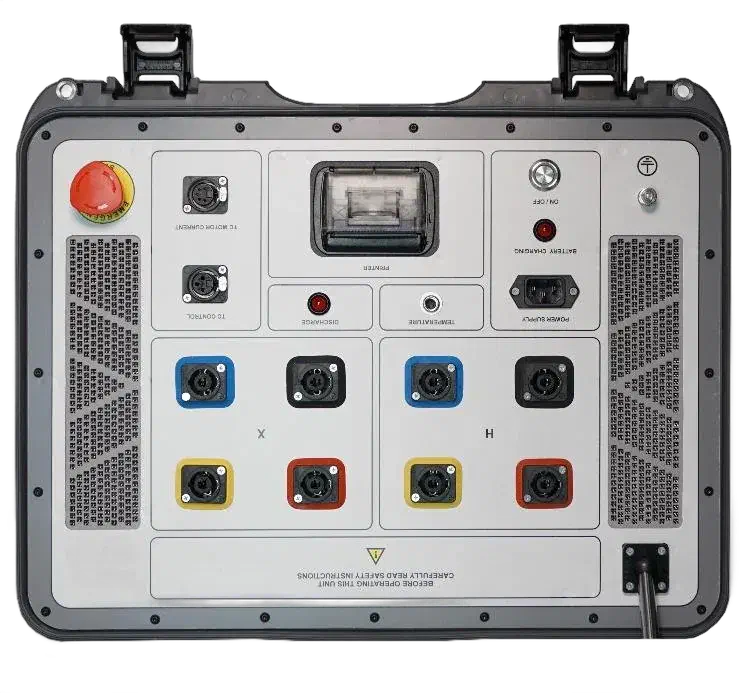
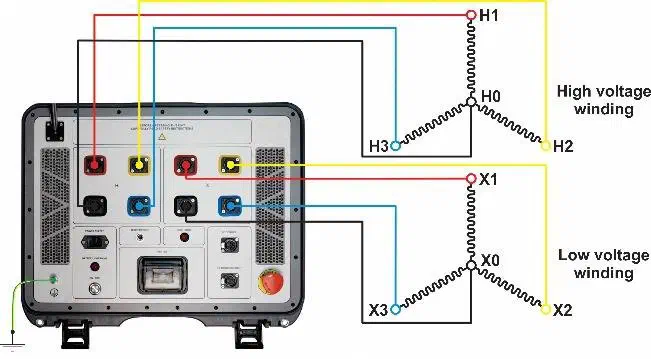
Three or four H cables and three or four X cables connect all HV and LV bushings, which greatly shortens field testing, especially on large transformers.
Winding resistance up to 25 A DC
True, ripple-free DC current with a dedicated algorithm for each transformer configuration. With all six windings connected, the instrument injects current simultaneously through the HV and LV windings on the same core limb, so the core saturates sooner.
Turns ratio up to 250 V AC under IEC 60076-1
Accurate ratio and magnetic balance measurements on large generation and transmission transformers, with automatic vector group detection and calculation of the deviation from the nameplate.
Tap changer under control
The built-in control unit operates the on-load tap changer remotely and automates testing across multiple positions with a single operator.
Applications
- Commissioning and maintenance of three-phase and single-phase power transformers and autotransformers.
- On-load tap changer diagnostics with DVtest across multiple positions.
- Ratio, polarity, winding resistance and demagnetization of current transformers.
- Winding resistance of motors, generators and other inductive objects.
About the product
Once the vector diagram is selected, the instrument runs the specific test for each connection -delta-wye, delta-delta, delta-zigzag, etc.- without changing the leads, and proprietary filtering cancels the interference of HV fields. The internal battery allows testing where no mains supply is available.
The 10.1" touch screen works with templates prepared in the office; the 32 GB SD card stores tens of thousands of results, which are printed on the 58 mm thermal printer or exported via USB. The PC software, included with free updates, exports results to Excel and generates PDF reports.
Technical specifications
| Test sources | 1 - 250 V AC (three-phase up to 200 V); 5 mA - 25 A DC (10 A on battery), up to 50 V |
| Turns ratio | 0.8 - 50,000; 5-digit resolution |
| Turns ratio test modes | Three-phase simultaneous, phase by phase or both |
| Turns ratio accuracy | ±0.03 % typical, ±0.075 % guaranteed (250 V, ratio 0.8 - 999) |
| Resistance accuracy | ±(0.1 % rdg + 0.1 % FS) typical; ±(0.2 % + 0.2 %) guaranteed, up to 10 kΩ |
| Winding resistance | 0.1 µΩ - 100 kΩ |
| Phase angle and excitation current | 0 - 360° (0.01°); 0 - 2 A |
| DVtest and AC current channel | 1 ms resolution |
| Temperature | -50 to +180 °C; Pt100 class B |
| Display, memory and interface | 10.1" touch screen; 32 GB SD; Ethernet and USB |
| Power supply | 90 - 264 V AC, 50/60 Hz; 14.4 V, 6.8 Ah Li-ion battery |
| Dimensions and weight | 503 × 193 × 406 mm; 11.0 kg |
| Standards and warranty | EN 61010-1:2010; EN 61326-1:2013; 3 years |
Frequently asked questions
Which turns ratio tester is best for a three-phase power transformer?
One with true three-phase excitation, a high test voltage, vector group detection and on-load tap changer control. TWR250B tests three-phase simultaneously up to 200 V AC or phase by phase up to 250 V AC, and measures winding resistance up to 25 A with the same connection, without a second instrument.
What turns ratio accuracy do I need?
IEC 60076-1 allows a deviation of ±0.5 % from the nameplate on every tap, so the tester must be considerably more accurate. TWR250B has ±0.03 % typical accuracy (±0.075 % guaranteed) at 250 V for ratios 0.8 to 999, more than six times better than that tolerance.
Which tests run without changing the leads?
All of them: resistance of all six windings, DVtest, demagnetization, turns ratio, phase shift and excitation current, with the same H and X cable connection.
Can it test single-phase transformers and CTs?
Yes. Single-phase units use two H and two X cables. On current transformers, the H cables go to the secondary and the X cables to the primary, or are slid through the core when there are no primary terminals.
Why demagnetize the core?
A DC test can leave residual magnetism that distorts other tests. The instrument removes it with a current of alternating polarity and decreasing magnitude down to zero.
How are results documented?
They are printed on the instrument, exported via USB or downloaded with the PC software, which generates customized PDF reports.