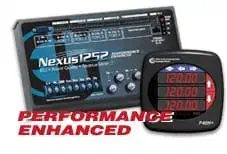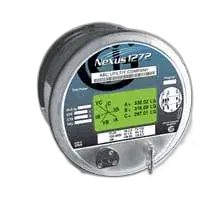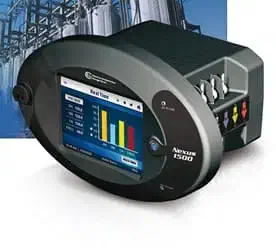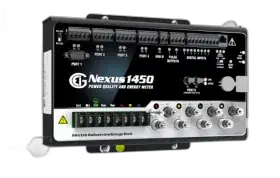
Class A power quality meter with transducer base and separate display, 0.06 % energy accuracy
Upgrading the metering of an installed switchboard without cutting the panel door, while obtaining revenue-grade energy and class A power quality data to IEC 61000-4-30, calls for a meter with a transducer base and separate display. The Nexus 1450 is a direct physical retrofit of the 125x series meters, measures energy to 0.06 % (ANSI C12.20 class 0.1 and IEC 62053-22 class 0.2S) thanks to two sensing stages on every current input, analyses harmonics to the 511th order, records waveforms at 1024 samples per cycle and communicates simultaneously over four RS-485 and two Ethernet ports with Modbus, DNP3 and IEC 61850.
Nexus 1450 key data
- Revenue accuracy: the Nexus 1450 measures energy to 0.06 % of reading from 0.025 to 20 A at unity power factor and meets ANSI C12.20-2015 class 0.1 and IEC 62053-22 class 0.2S; pick-up starts at 1 mA and full accuracy is reached at 25 mA, with 1 A or 5 A CTs on the same input (classes 2 and 20).
- Accuracy per quantity: voltage and current to 0.04 % of reading, neutral current to 0.1 %, frequency to 0.001 Hz, active and apparent power to 0.06 %, reactive power and power factor to 0.15 % and THD to 2.5 % of reading.
- Power quality: IEC 61000-4-30 class A edition 3, third-party certified; harmonics and interharmonics to IEC 61000-4-7 class A up to the 511th order (real-time magnitude and angle to the 127th); flicker to IEC 61000-4-15 class A on 230 V / 50 Hz and 120 V / 60 Hz systems; weekly EN 50160 reports and ITIC/CBEMA and SEMI F47 plots.
- Logging: waveforms at 512 samples per cycle (V1) or 1024 (V2) with 16-bit conversion and fault capture up to eight times full scale; internal database with 172 parameters, eight historical logs of 64 channels and 512 MB (V1) or 1200 MB (V2) of logging memory.
- Communications: six standard ports working simultaneously: four RS-485 (one selectable to RS-232, with RTU master capability) up to 115,200 bit/s and two independent Ethernet ports, RJ45 10/100BaseT and ST-terminated 100Base-FX fibre; Modbus RTU/ASCII/TCP, DNP3 level 2, HTTPS and SNTP, plus IEC 61850 with GOOSE on version V2.
- Measuring inputs: 20 to 720 V AC between any voltage inputs, isolated to 2500 V AC; fault current recording up to ±80 A peak; nominal frequency from 42.5 to 69.5 Hz and wideband measurement from 20 to 500 Hz.
- Installation: IP30 transducer base with LED display or 4.3″ colour touchscreen (IP65), eight status inputs up to 150 V DC, auxiliary voltage input, two pulse outputs, 96–276 V AC/DC or 18–60 V DC supply and operation from -25 to +70 °C.
Advantages
Two sensing stages on every current input
Each current input carries a high gain sensor and a low gain sensor that measure the signal from the external current transformers at the same time. The meter reads the signal level and chooses the optimal sensing circuit, which holds 0.06 % accuracy across an extended measuring range; pick-up starts at 1 mA and full accuracy is reached at 25 mA, so the same meter serves 5 A and 1 A secondary current transformers.
Advanced energy metering
- Full four-quadrant metering with maximum and minimum recording and time stamp.
- Transformer and line loss compensation for iron, copper and total substation losses.
- Coincidental readings, such as power factor or reactive power at the time of peak demand.
- Load aggregation through pulse inputs, including gas and water commodities.
Built for retrofit
- The transducer base is a direct physical retrofit of the previous 125x series meters.
- The separate display mounts into existing analogue meter knockouts.
- Eight built-in digital status inputs, an auxiliary voltage input and two pulse outputs as standard.
Applications
- Direct replacement of analogue 125x series meters in installed switchboards.
- Power quality measurement in substations and industrial distribution panels.
- Reliability studies: sags, swells, harmonics and unbalance.
- Integration into SCADA systems through DNP3, Modbus or redundant Ethernet links.
About the product
Accuracy holds from the bottom of the range to full scale, well inside the ANSI C12.20 and IEC 62053-22 limit lines, because the two sensing stages keep the error flat where single-stage meters lose accuracy. The meter carries an internal time reference accurate to 20 ppm and supports line frequency, DNP3, IRIG-B or SNTP synchronisation; nominal frequency range is 42.5 to 69.5 Hz, with additional wideband measurement from 20 to 500 Hz.
Voltage anomalies, harmonics, flicker, unbalance and other indices are measured to the class A specification, which makes the readings comparable between instruments and admissible in contractual disputes. It analyses harmonics and interharmonics to the 511th order and produces weekly EN 50160 power quality reports, together with ITIC/CBEMA and SEMI F47 plots for voltage events. Waveforms are captured at up to 1024 samples per cycle with 16-bit conversion, backed by an internal database that automatically logs 172 parameters and up to 4 GB of available memory.
Technical specifications
| Energy accuracy | 0.06 %; pick-up at 1 mA, full accuracy at 25 mA |
| Power quality measurement | IEC 61000-4-30 class A edition 3 |
| Harmonics and flicker | IEC 61000-4-7 and IEC 61000-4-15, to the 511th order |
| Waveform recording | Up to 1024 samples/cycle, 16-bit conversion |
| Memory | Up to 4 GB, with 1.2 GB reserved for logging |
| Communications | 6 ports: 4 RS-485 (one selectable to RS-232) and 2 Ethernet (RJ45 and fibre optic) |
| Time synchronisation | Line frequency, DNP3, IRIG-B, SNTP |
| Frequency range | 42.5-69.5 Hz nominal; wideband 20-500 Hz |
| Accuracy class | ANSI C12.20-2015 class 0.1; IEC 62053-22 class 0.2S |
| Measuring inputs | 20–720 V AC between inputs; 1 A and 5 A CTs on the same input; 1 mA pick-up |
| Protocols | Modbus RTU/ASCII/TCP, DNP3 level 2, IEC 61850 with GOOSE (V2), HTTPS, SNTP |
Frequently asked questions
What is the difference between the Nexus 1450 V1 and V2 versions?
V1 records waveforms at 512 samples per cycle with 512 MB of logging memory; V2 raises this to 1024 samples per cycle and 1200 MB, and adds the IEC 61850 server with GOOSE messaging and cross-triggering for distributed fault recording. Both measure to class A per IEC 61000-4-30, and a V1 can be upgraded to V2 after installation.
How accurate is the Nexus 1450 for voltage, current and frequency?
0.04 % of reading for line-to-neutral voltage, line-to-line voltage and current, 0.1 % for neutral current and 0.001 Hz for frequency at 50/60 Hz; active energy is measured to 0.06 % and reactive energy and power factor to 0.15 %.
Can it be installed in an existing switchboard?
Yes. The transducer base is a direct retrofit of the 125x series meters and the display mounts into the existing analogue knockouts, without cutting the panel door.
What accuracy does the meter hold?
0.06 % energy accuracy, thanks to the two sensing stages that pick up at 1 mA and reach full accuracy at 25 mA.
How much data can it log?
Up to 4 GB of memory, with an internal database that automatically logs 172 parameters and eight configurable historical trending logs.
How is the data protected against tampering?
With 32-character complex passwords, 128-bit AES encryption, fail lockout, a physical sealing switch and an anti-tampering event log.