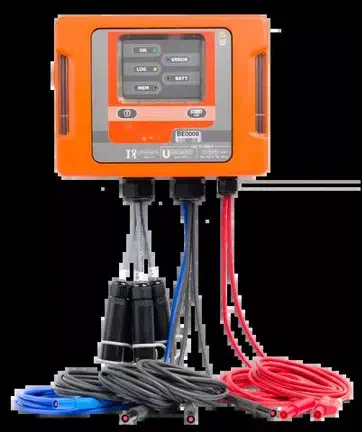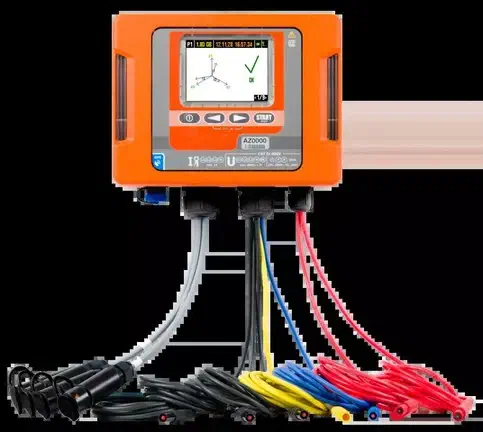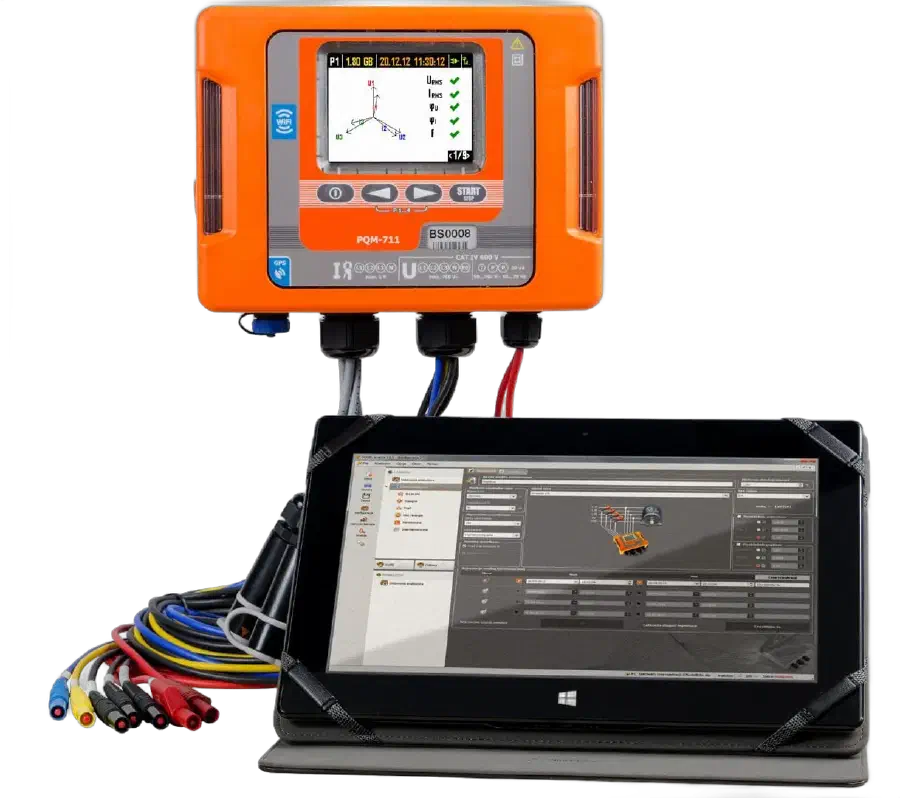
Diagnosing supply quality in the field without depending on a laptop calls for a portable class S analyser to IEC 61000-4-30 that is configured, displays readings and analyses recordings on its own screen. The APQM-707 does it on a 7-inch, 800 × 480 pixel touchscreen: five voltage inputs up to 760 V with ±0.5% of Unom, four current inputs up to 6 kA depending on the clamp with ±0.2% of Inom, harmonics to the 50th order, flicker, unbalance, events with waveforms and EN 50160 reports, on DC and 50/60 Hz networks.
APQM-707 key data
- Standards: class S per IEC 61000-4-30:2015; flicker per IEC 61000-4-15; harmonics per IEC 61000-4-7 (class II); compliance reports against EN 50160.
- Voltage: 5 inputs (L1, L2, L3, N and PE) up to 760 V RMS referred to PE, AC from 40 to 70 Hz or DC (±1150 V range); ±0.5% of Unom; CAT IV 600 V / CAT III 760 V.
- Current: 4 inputs (L1, L2, L3 and N) with automatic clamp recognition: flexible clamps up to 6000 A (±20 kA peak) and rigid clamps up to 1400 A; ±0.2% of Inom without clamps.
- Sampling and frequency: 16-bit at 10.24 kHz with simultaneous sampling on all channels (204.8 samples per cycle at 50 Hz); frequency from 40 to 70 Hz to ±0.05 Hz.
- Harmonics, flicker and unbalance: harmonics from DC to the 50th order to ±0.15% of Unom (or ±5% of the measured value from 3% of Unom), THD, TDD and harmonic powers; PST/PLT from 0.4 to 10 to ±10%; unbalance from 0 to 10% to ±0.15% absolute.
- Events: dips, swells and interruptions detected on the one-cycle RMS value refreshed every half cycle (±1% of Unom), with a 6-cycle waveform (2 before and 4 after the event).
- Recording: averaging from 1 s to 30 min; 4 GB microSD card expandable to 32 GB; 4-digit PIN lock; reports and settings copied to a USB memory stick through a second USB port.
- Battery and format: 11.1 V, 3.4 Ah Li-ion battery for about 6 h typical (at least 4 h at maximum brightness), recharged in 2 h; IP51, -10 to +50 °C, 288 × 223 × 75 mm and 1.75 kg with cover.
Advantages
Standardised class S results
Voltage is measured to ±0.5% Unom, current to ±0.2% Inom and frequency to ±0.05 Hz between 40 and 70 Hz, with every parameter recorded using the normalised algorithms of IEC 61000-4-30.
A screen instead of menus
The 7-inch, 800 × 480 pixel colour touchscreen shows the oscilloscope view, phasor diagram, time plots and harmonic bars at a glance, and the supplied stylus keeps it usable with dielectric gloves on.
Recording that outlasts the campaign
More than 10 years of data fit on the removable memory card, the internal Li-Ion battery rides through supply interruptions, and the analyser can draw its power from the very network under test.
Every event fully documented
Dips, swells and interruptions are stored together with their waveforms and half-cycle RMS plots, while the built-in energy cost calculator prices the consumption on the spot.
Applications
- On-site troubleshooting of disturbances in industrial and commercial networks.
- Energy audits with on-board energy cost calculation.
- Commissioning and inspection of photovoltaic installations.
- Power quality service providers and consultants.
About the product
Beyond the class S core, the APQM-707 measures P, Q, D and S powers, energies, cosφ, tanφ and power factor, harmonics with THD, flicker PST/PLT, unbalance and inrush current. Its CAT IV 600 V measurement category and IP51 housing with a hinged lid qualify it for harsh field conditions.
The PC analysis software supplied as standard downloads the memory card, displays live readings and produces reports to EN 50160, IEEE 519 or NEC 220.87, including dedicated reports for photovoltaic micro-installations up to 50 kW. Four 3 kA flexible clamps belong to the standard delivery.
Available accessories: four F-3A flexible clamps, 2.2 m leads marked L1, L2 and L3, crocodile clips, the AC-16 line splitter, magnetic voltage adapters, an 11.1 V Li-Ion battery, the Z-7 power adapter, USB cable, stylus and carrying case; C-4A to C-7A clamps and flexible probes up to 6 kA are optional.
Technical specifications
| Measurement class | Class S per IEC 61000-4-30 |
| Voltage inputs | 5 (L1, L2, L3, N, PE); 0…760 V; ±0.5% Unom |
| Current inputs | 4; up to 6 kA depending on the clamp; ±0.2% Inom |
| Harmonics | Voltage and current, DC and orders 1…50; THD |
| Flicker and unbalance | PST/PLT 0.40…10.00; unbalance 0…10% |
| Display | 7-inch colour touchscreen; 800 × 480 pixels |
| Recording | Removable memory card; over 10 years |
| Safety | CAT IV 600 V; IP51 housing |
| Frequency | 40…70 Hz; ±0.05 Hz |
| Sampling | 16-bit; 10.24 kHz, simultaneous on all channels |
| Battery, dimensions and weight | Li-ion 11.1 V 3.4 Ah, about 6 h; 288 × 223 × 75 mm; 1.75 kg |
Frequently asked questions
Is the APQM-707 a class A analyser?
No, it is class S per IEC 61000-4-30: it measures voltage to ±0.5% of Unom and frequency to ±0.05 Hz, valid for audits and EN 50160 reports. For class A, with ±0.1% of Unom, ±0.01 Hz and a GPS-synchronised clock, there are the APQM-702/703 and the APQM-711.
How long does the APQM-707 battery last?
About 6 hours typical between 0 and 40 °C at 50% brightness and at least 4 hours at maximum brightness, from a removable 11.1 V, 3.4 Ah Li-ion battery that recharges in 2 hours at most from the external power adapter.
What does class S mean in practice?
That every parameter — voltage, frequency, harmonics, flicker, unbalance, events — is measured with the standardised methods of IEC 61000-4-30, so the results are comparable between instruments and valid for audits.
Is a computer required on site?
No. Configuration, live viewing and data review are handled on the touchscreen; the PC software is reserved for in-depth analysis and EN 50160, IEEE 519 and NEC 220.87 reporting.
Which current clamps can be connected?
Flexible clamps from 1.5 to 6 kA and C-4A to C-7A clamps from 12 to 1000 A; the C-5A also measures direct current. Four 3 kA flexible clamps come in the standard set.
Does it keep measuring during an outage?
Yes. The internal Li-Ion battery sustains measurement and recording through the interruption — essential when the goal is precisely to document those outages.
Can it assess photovoltaic installations?
Yes. The software produces dedicated reports for micro-installations up to 50 kW, including the breakdown of active power states.