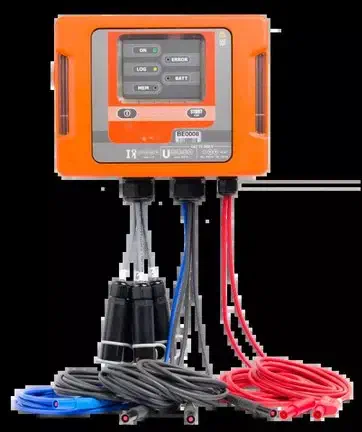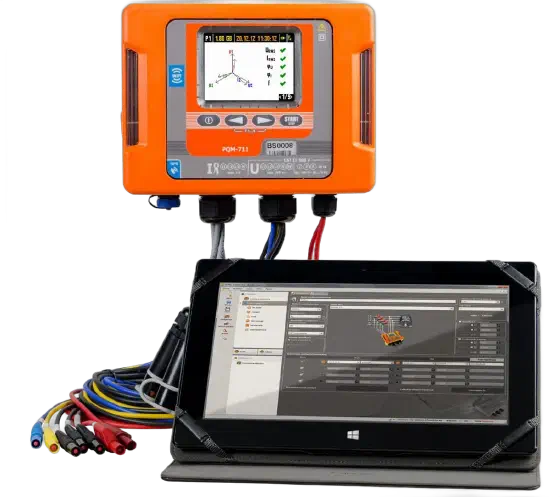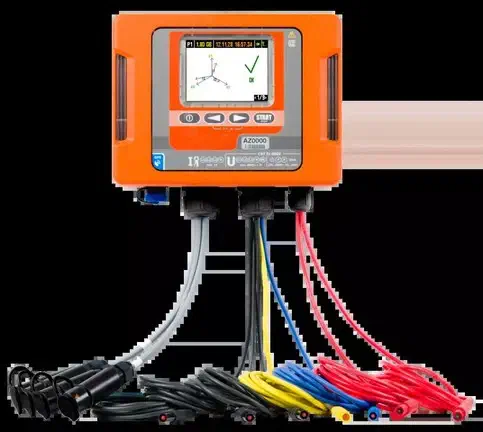
When EN 50160 supply quality reports must stand up with the utility or under a contract, you need a class A analyser to IEC 61000-4-30 with a GPS-synchronised clock; if fast surges must also be captured, a transient recorder is required. The APQM-702 and APQM-703 measure in class A, to ±0.1% of Unom on networks up to 1000 V with over 4500 recorded parameters, synchronise their clock with the built-in GPS and are managed remotely over the GSM modem; the APQM-703 adds a ±8000 V transient recorder sampling at up to 10 MHz.
APQM-702/703 key data
- Class and standards: class A per IEC 61000-4-30 (Ed. 3, 2015) and PQI-A-PO classification per IEC 62586-1/-2; harmonics and interharmonics per IEC 61000-4-7 class I; class F1 flicker per IEC 61000-4-15; reports to EN 50160.
- Voltage: 5 inputs (L1, L2, L3, N and PE) up to 760 V or 1000 V RMS to earth depending on the version; ±0.1% of Unom between 0 and 45 °C; CAT IV 600 V and CAT III 1000 V (1000 V version).
- Current and frequency: 4 inputs for rigid or flexible clamps up to 6000 A, ±0.1% of Inom without clamps; frequency from 40 to 70 Hz to ±0.01 Hz.
- Harmonics, flicker and unbalance: harmonics and interharmonics from DC to the 50th order to ±0.05% of Unom (or ±5% of the measured value from 1% of Unom), K factor from 1 to 50; Pst/Plt from 0.2 to 10 to ±5%; unbalance from 0 to 20% to ±0.15% absolute; ripple control signals from 5 to 3000 Hz.
- Events: dips, swells, interruptions and rapid voltage changes (RVC) to ±0.2% of Unom, with waveforms up to 1 s at 10.24 kHz and half-cycle RMS plots up to 30 s.
- Transients (APQM-703 only): 4 channels referred to PE up to ±8000 V, selectable sampling from 100 kHz to 10 MHz, 2.5 MHz bandwidth, triggering by amplitude (50–5000 V) or slew rate dV/dt, and ±(5% + 25 V) accuracy.
- Recording and communication: averaging from 200 ms to 120 min, 4 independent recording configurations, 8 GB card expandable to 32 GB; USB, 433 MHz radio and built-in GSM modem; GPS clock drifting less than ±0.3 s/day if the signal is lost.
- Field installation: supply from the measured network at 100…690 V AC or 140…690 V DC, 4.4 Ah Li-ion battery (about 2 h on the APQM-702 and 1.5 h on the APQM-703), heater, IP65, -20 to +55 °C, 3.5-inch colour LCD, 200 × 180 × 77 mm and 1.6 kg.
Advantages
Class A accuracy
Voltage with an error of ±0.1% of Unom, frequency within ±0.01 Hz, harmonics up to the 50th plus interharmonics, K factor, flicker and unbalance in accordance with IEC 61000-4-30 class A.
Five voltage inputs
It measures L1, L2, L3, N and PE up to 1000 V and currents up to 6 kA depending on the clamp, in 50/60 Hz networks, split-phase, wye, delta and Aron systems and DC circuits.
Remote control by GSM and GPS
The GSM/GPRS modem allows configuring the analyser and downloading data from anywhere, the GPS receiver synchronises the clock and the anti-theft function sends an SMS if the position changes.
Transients up to ±8000 V (APQM-703)
The APQM-703 incorporates a voltage transient recorder with a ±8000 V range and sampling up to 10 MHz to capture the fastest phenomena on the network.
Powered from the measured network
The internal 100…690 V AC power adapter allows direct connection on LV poles; the internal battery and the heater guarantee continuous measurement at -20 °C with IP65 protection.
Applications
- Class A power quality analysis for professional energy services.
- Diagnostics of disturbances in industrial plants and distribution networks.
- Measurements on LV poles and behind voltage transformers.
- Verification of compliance with EN 50160 with automatic reports.
About the product
Both models share an IP65 housing of 200 × 180 × 77 mm and about 1.6 kg, a 3.5-inch LCD display, an 8 GB card expandable to 32 GB and recording at intervals down to 200 ms; the APQM-702 covers the full class A analysis, the APQM-703 adds the transient recorder, and the APQM-702T variant also measures external temperature.
Technical specifications
| Measurement class | Class A per IEC 61000-4-30 |
| Voltage inputs | 5 (L1, L2, L3, N, PE); up to 1000 V; ±0.1% Unom |
| Current inputs | 4; up to 6 kA depending on clamp; ±0.1% Inom |
| Frequency | 40.00…70.00 Hz; accuracy ±0.01 Hz |
| Harmonics | Up to the 50th plus interharmonics; K factor; THD |
| Transients — APQM-703 only | ±8000 V; sampling up to 10 MHz |
| Recording | Over 4500 parameters; intervals from 200 ms |
| Memory | 8 GB card; expandable to 32 GB |
| Communication | Built-in GSM/GPRS; USB; OR-1 radio up to about 5 m |
| GPS | GPS-synchronised clock; anti-theft SMS alert |
| Power and environment | 100…690 V AC; battery; IP65; -20…+55 °C |
| Dimensions and weight | 200 × 180 × 77 mm; approx. 1.6 kg |
| Product standard | IEC 62586-1/-2: PQI-A-PO |
| Flicker and unbalance | Pst/Plt class F1 (IEC 61000-4-15), ±5%; unbalance 0…20%, ±0.15% |
| Transient accuracy — APQM-703 only | ±(5% + 25 V); amplitude or dV/dt trigger |
Frequently asked questions
Which power quality analyser should I choose for class A EN 50160 reports?
One that meets class A of IEC 61000-4-30 in time synchronisation too. The APQM-702 measures voltage to ±0.1% of Unom and frequency to ±0.01 Hz, and its built-in GPS receiver keeps the clock in class A without accessories; indoors it accepts an external GPS antenna with a 10 m cable.
What transients does the APQM-703 capture?
Surges up to ±8000 V on the four channels L1, L2, L3 and N referred to PE, with sampling from 100 kHz to 10 MHz (100 ns between samples), records of 2,000 to 20,000 samples and ±(5% + 25 V) accuracy; triggering is set by a threshold from 50 to 5000 V or by slew rate dV/dt.
What is the difference between the APQM-702 and the APQM-703?
Both are class A analysers; the APQM-703 adds a voltage transient recorder with a ±8000 V range and sampling up to 10 MHz, and the APQM-702T variant measures external temperature.
What accuracy do they offer?
Class A per IEC 61000-4-30: ±0.1% of Unom in voltage, ±0.01 Hz in frequency, harmonics up to the 50th and unbalance with ±0.15% absolute error.
Can they be controlled remotely?
Yes. With any SIM card with a static IP the built-in GSM/GPRS modem gives access from anywhere; the OR-1 radio receiver works up to about 5 m.
How are they powered?
From the measured network through the internal 100…690 V AC (140…690 V DC) adapter, with an internal battery for outages and a heater for low temperatures.
Do they work outdoors?
Yes. The IP65 housing and the -20…+55 °C operating range allow installation directly on low voltage poles.
What is the anti-theft function?
The built-in GPS receiver monitors the analyser position and sends an SMS notification if the device is moved.